


















When the fungus with the botanical name Hemileia Vastatrix is mentioned, shoulders shrug. Roya, coffee rust, coffee leaf rust is one of the worst and most feared fungal diseases on a coffee farm, whose outbreak has devastating consequences. It is responsible for damage in the millions every year, and it can even destroy entire harvests. The fatal part: coffee rust can be spread by wind and by humans. But let's take this one step at a time.
What is coffee rust?
Coffee rust, or in Spanish la roya or in English coffee leaf rust, is caused by the fungus Hemileia Vastatrix and is recognizable by orange pustules on the underside of the leaves of a coffee plant. If a leaf only has a few of the round, rust-colored spots, it can continue to function more or less normally. However, if the environment promotes the development of Hemileia Vastatrix, it becomes difficult for the leaves to provide the plant with the nutrients it needs. Heavily infested leaves subsequently die off.

The fungus only attacks the coffee leaves, but it damages entire plants. Due to the lack of leaves, the coffee plant has only limited ability to carry out photosynthesis, which means that in the year of infestation, due to lack of nutrients, it can produce up to 50% fewer flowers and accordingly fewer coffee cherries.
A distinction is made between primary and secondary loss
The primary loss (primary loss) refers to the crop loss that occurs in the year of the first infestation. The defoliated coffee shrub can no longer provide the plant with sufficient nutrients, the branches and cherries cannot develop properly.
In the following year, one speaks of secondary loss, which can be even more dramatic. After an outbreak in the year of the first infestation, it may seem as if the coffee plants could recover - because in the next season they can produce leaves again. But damaged or withered and thus dead branches can no longer produce cherries. Studies in Central America have shown that the primary loss can be up to 26%. With secondary loss, one even speaks of crop losses of up to 36%.
Coffee rust thus interrupts the delicate balance of nutrient supply
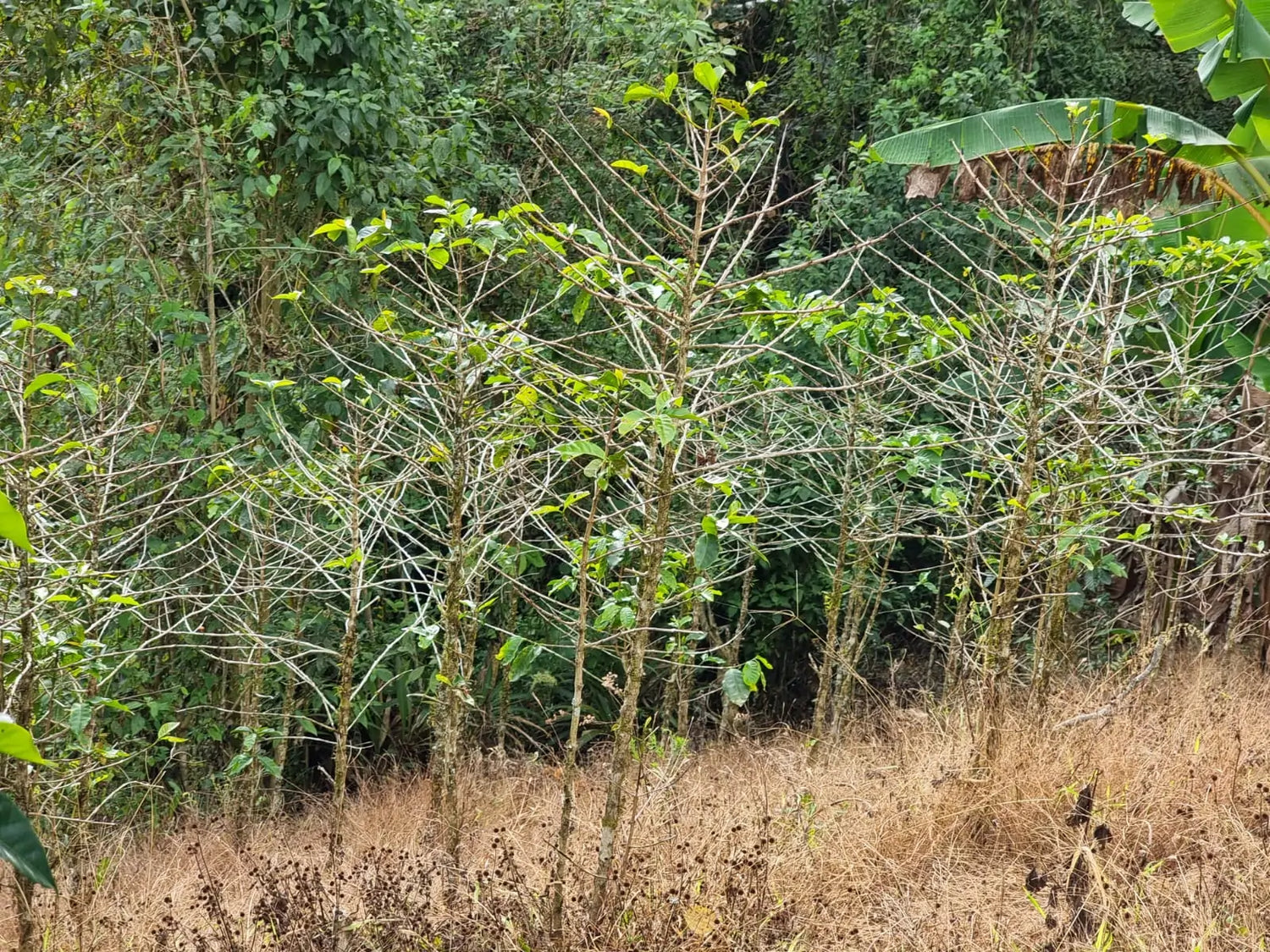
Hemileia Vastatrix makes entire coffee regions look like rows of skeletons and destroys the income sources of millions of coffee workers. As if the tragic scale of a coffee rust outbreak were not enough, the fungus also spreads with ease throughout the world.
In the 2012/13 and 2013/14 harvest seasons, the worst outbreak to date, also known as "The Big Rust," global losses rose to 600 million dollars. Or in other words: over 300,000 people lost their jobs due to insufficient harvest.
How does coffee rust spread?

The basic prerequisites for Roya can be explained using a triangle. To create the optimal conditions for the development of the fungus, three elements are needed:
- The right environment. Temperatures of optimal 21-25°C favor the spread of coffee rust, but it also does well with temperatures of 15°-28°C. If a hot and humid phase follows a rainy phase, conditions are ideal. Coffee rust needs water droplets on leaves to germinate. So if it's hot and dry, that's not a good environment for the development of Hemileia Vastatrix.
- The host. Coffea Arabica in particular is the desired host for the fungus. Coffea Canephora as well as Coffea Liberica and some varieties of Coffea Arabica are currently still resistant to coffee rust.
- The pathogen. If the environment is suitable and the host is present, there still needs to be a pathogen. If coffee rust is present in the region, the triangle is complete.
Once coffee rust is present in a region, it progresses unimaginably quickly. The most common means of spread is wind, which can carry spores over many kilometers. But it is also spread by birds and insects, as well as by travelers in ships, trains, and even airplanes. At the beginning of the spread of Hemileia Vastatrix, workers carried the spores on their bodies and clothing, spreading them from coffee land to coffee land.
On a single square centimeter of an infected leaf, you can find up to 120,000 - 150,000 spores - an almost unimaginable number.
A reinforcing factor for the spread of coffee rust is also the very low genetic diversity in Coffea Arabica. Most Arabica varieties trace back to genes from Typica or Bourbon, which also means that they are all susceptible to the same diseases and fungi.
Hemileia Vastatrix has the ability to constantly adapt to new environments, comparable to flu viruses in humans, and keeps mutating. Many of the varieties that were still resistant 10 years ago are now susceptible to this existential threat fungus. Higher temperatures, increased precipitation, extreme winds, and increased human mobility are some of the factors that have contributed to this.
Coffee rust. The history. The world map.
The coffee world looked on with panicked eyes at Asia when in the 1950s every corner of the Indian Ocean basin was affected by coffee rust. Hemileia Vastatrix continued its devastating conquest to West Africa and finally landed in the 1970s in the vast coffee farms of Latin America. By 1990, it had spread to every major coffee region. However, it seemed that coffee rust had been brought under control through adequate care and resistant varieties, which many farmers began to plant - coffee rust was, so to speak, a controllable nuisance.
Hemileia Vastatrix was already present before 1870 in the rainforests of Ethiopia, the place that many consider the cradle of the coffee plant. At that time there were hundreds of Coffea species and varieties and equally many diseases and fungi. But in harmony with nature and the way coffee production was handled and structured at the time, an infestation of one variety with the destructive fungus or another disease had no significant impact on the ecosystem and prevented a potential outbreak.
High biodiversity can stop coffee rust. In monocultures, however, it spreads at an alarming rate.
From the tropical hot and humid weather of Ethiopia, coffee was brought by the Ottomans to Yemen and grown there on a large scale for the first time. Whether they took coffee plants and thus also coffee rust, or whether they only took seeds, is not entirely clear. It is very possible that coffee rust never came to Yemen, as Hemileia Vastatrix sticks to coffee leaves and is not spread through seeds. In any case, the weather in Yemen was hot and dry and thus not a good foundation for the development of coffee rust and other diseases that cannot survive in this climate. The climate in Yemen was, so to speak, a natural preventative of a coffee rust outbreak, and so the devastating fungus remained undiscovered.
From Yemen, Coffea Arabica was spread throughout the world by the colonial powers France, Britain, and Holland. Thus the dormant monster was given new nourishment through favorable weather conditions. The Dutch brought coffee from Yemen to India and from there around 1800 to Ceylon, today's Sri Lanka. Soon after, the Dutch were driven out by the British, who immediately planted extensive coffee fields to make a lot of money.
Ceylon - a ticking time bomb
Coffee rust was first documented in writing in 1861 in Sri Lanka (formerly Ceylon), where it germinated excellently due to warm temperatures and extensive rainfall and destroyed the entire coffee cultivation - by the end of 1880, most farmers had switched from growing coffee to tea (this also explains why Sri Lanka is a major tea nation today).
The large-scale coffee farms were all attacked by coffee rust. Billions of fungal spores rose into the air and were distributed through air currents, by people, through ship transport, by birds and insects, and especially by wind to large parts of the world. By the 1950s, coffee rust had reached the entire Indian Ocean basin - except Yemen. Coffee rust contributed to the (temporary) demise of coffee production in Asia and the Pacific. While these regions had accounted for ⅓ of total production in the early 19th century, 100 years later it was just 5%.
From the mid-1950s to the mid-1980s, the epidemic broke out in West Africa and was first discovered on a farm in Bahia, Brazil in 1970. From there it continued to spread and arrived in Central America in the 1970s. Discovered in Nicaragua in 1976, Hemileia Vastatrix had reached almost every small corner of Central America by the 90s.
The 3 phases of the coffee rust outbreak
The history of coffee rust is historically divided into three phases.
The first phase, the colonial phase, lasted from 1869 to around 1945 and included the first major coffee rust outbreak in the Eastern Hemisphere. In this phase, the spread of the fungus Hemileia Vastatrix was driven by the mobility of the colonial powers and their exchange of slaves for harvest work.
The second phase, the developmentalist phase, describes the period from around 1950-1990, characterized by World War II and the Cold War. Global coffee trade was heavily regulated by the International Coffee Agreement (IAC) at this time. In order to keep prices relatively high and stable, the IAC set export regulations for each country. States took on a larger role in marketing their national coffee than they did in the colonial phase. For example, they supported farmers with technical and financial means and worked through various development projects for social and political stability.

Global distribution of the coffee rust, 1952. This map also reflects the global distribution of Arabica and Robusta coffee at the time. Most countries east of the line produced Robusta, while those west of the line produced Arabica. Coffee Areas of the World in Relation to Rust Disease. 1952. Foreign Agriculture 16:160.
Published in: Stuart McCook; John Vandermeer; Phytopathology® 2015, 105, 1164-1173.
Copyright © 2015 The American Phytopathological Society • DOI: 10.1094/PHYTO-04-15-0085-RVW
The third phase, also called the neoliberal phase, refers to the period from the late 1980s to today. An insanely destructive series beginning in Colombia is known as "The Big Rust," which reached its negative peak in the 2012/13 and 2013/14 harvest seasons in Central America.
In 2008, Colombia produced 31% less coffee than the previous year. The epidemic continued to spread northward through Central America to Mexico, then turned south again, finally reaching Peru and Ecuador in 2013/2014. The International Coffee Organization estimates that coffee production in Central America in the 2012/13 and 2013/14 harvest years cost more than 616 million dollars.
Unlike the previous outbreaks in the past decades, the Big Rust was not triggered by a carrier that was brought into an area where coffee rust had not previously existed. Rather, it was driven by extreme weather conditions that had favored the development of the fungus.

The "Big Rust" in Latin America since 2008.
Published in: Stuart McCook; John Vandermeer; Phytopathology® 2015, 105, 1164-1173.
Copyright © 2015 The American Phytopathological Society • DOI: 10.1094/PHYTO-04-15-0085-RVW
Conclusion on coffee rust
Hemileia Vastatrix constantly adapts to new circumstances
The ecosystem and the economy are in constant change, and of course so is coffee rust, which constantly mutates like flu viruses. This means that living together with Hemileia Vastatrix is always a snapshot and can change at any time. For example, it is nowadays much hotter in the higher regions than it was just a few years ago. While our partners at Finca El Arbol used to see daytime highs of around 25°C at Easter, the hottest time of the year in Nicaragua, temperatures now rise to 35°C or higher.
Unstable commodity market - catalyst for Roya
Added to this are the challenges of the commodity market, which keeps prices unstable and makes long-term future planning impossible. If prices are too low and the coffee farmer cannot work cost-effectively, let alone invest money in renewing coffee plants, maintaining the coffee farm, or fighting Hemileia Vastatrix or diseases, he must abandon his farm. The land becomes overgrown, and coffee rust spreads unchecked.
Roya increases the cost of coffee production
Controlling Hemileia Vastatrix has massively increased the cost of coffee production. At low prices, farmers cannot afford to control it and must abandon their farms, leave rural life, and build a new life elsewhere.
Roya shaped the coffee world as it is today
Coffee rust has only marginally reduced the global supply of coffee, but it has shaped global trade in other ways. After 1900, the Dutch invested in the development of the resistant species Coffea Canephora, which soon shook up the global coffee business and today accounts for about 40% of coffee production. The plant, originally developed as a response to coffee rust, transformed and shaped the structure of global coffee production and consumption in the 20th century. But that's a story for another time.
Further reading
https://www.youtube.com/watch?v=gnPChFLHWA4
https://perfectdailygrind.com/es/2021/01/13/roya-del-cafe-por-que-es-nociva-y-como-controlar-su-propagacion/
https://apsjournals.apsnet.org/doi/10.1094/PHYTO-04-15-0085-RVW#fig1
Stuart McCook, 2019, Coffee is not forever