





Freezing roasted coffee makes sense when done correctly. Otherwise, the statement still applies: "Coffee should not be stored in the refrigerator or freezer!"
We explain when freezing is worthwhile, what to keep in mind to keep the coffee delicious, and what should absolutely be avoided in this article and video. Since there are now initial research results on the topic, we incorporate those findings as well as our own tests. Over several months, we froze and tasted coffees of various quality levels. Afterwards, these were professionally tasted by three Q-Graders.
Why freeze coffee beans?
Freezing roasted coffee primarily serves to extend shelf life and conserve aromas as best as possible. The slowing of oxidation processes plays a particularly important role, as these would otherwise cause coffee to lose complexity. Oxidation occurs when the oils contained within the coffee come into contact with oxygen. The result is rancid, bitter, and other so-called "off-tastes" that make coffee increasingly unpalatable. Other aging processes also cause coffee to taste less complex, its acidity becomes more aggressive, and the flavor becomes flat.
Freezing can slow these processes. Moreover, research shows that grinding frozen beans can improve grinding quality.
Best practices for freezing coffee beans
1. Packaging:
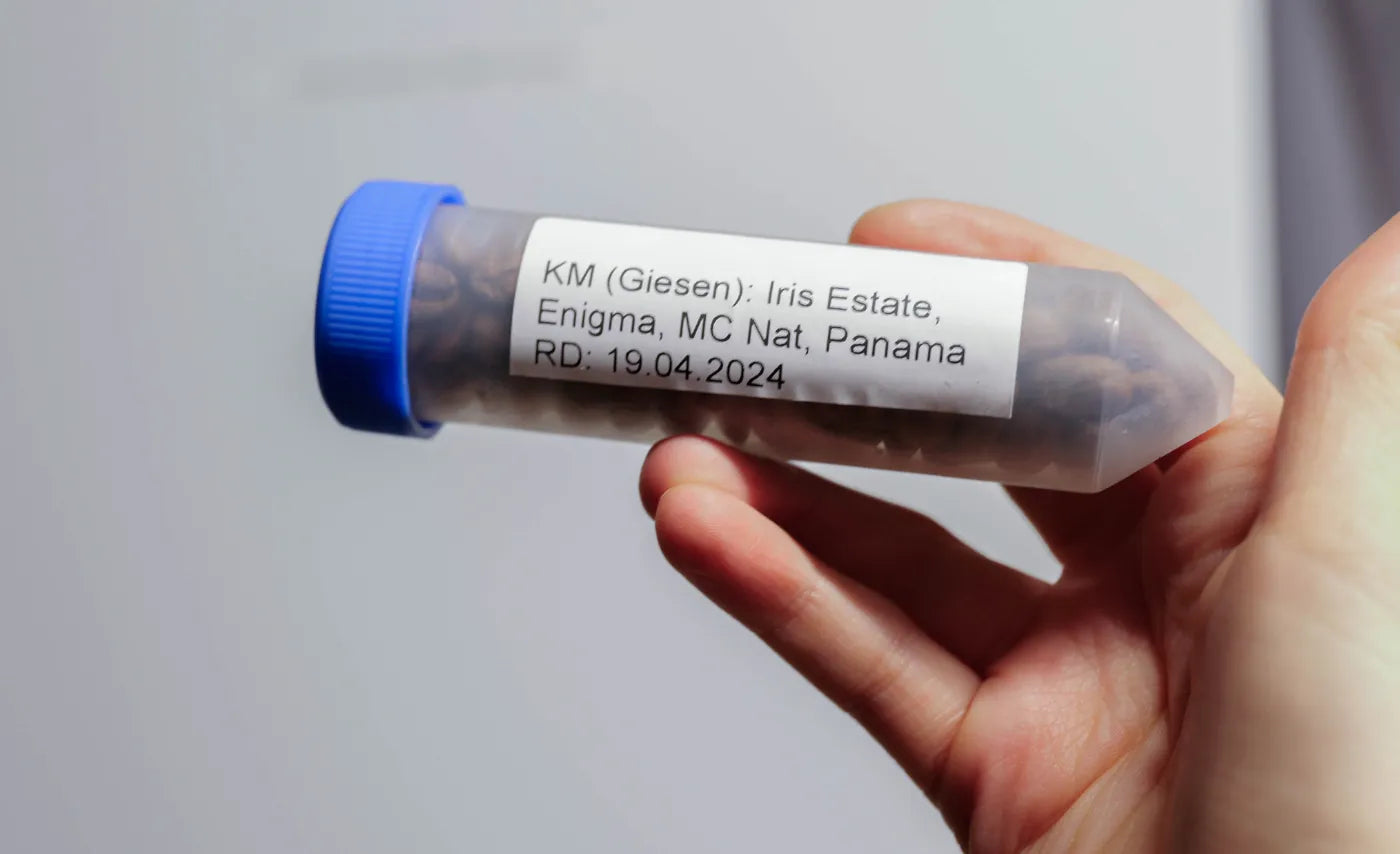
- Airtight containers or vacuum sealing are essential to minimize moisture and oxidation. We recommend choosing containers that match the amount of coffee needed to brew ONE espresso or filter coffee. It sounds elaborate, but we're serious about it. You should definitely not freeze an entire bag or larger airtight containers, but only what you use for that one coffee. Why? Each time you open it, new oxygen reaches your coffee, which negatively affects the quality of the coffee.
- Remember: Coffee should be frozen in small portions to avoid repeated thawing and refreezing. However, a container, like our tubes, should always be completely filled. We want to prevent the coffee from having access to much oxygen, with which it can react and age.
- We use these small tubes, which we found on Amazon*.
2. Timing of freezing:
- Ideally, beans should be frozen as soon as they reach their peak of freshness and quality.
- We recommend waiting about 5 to 10 days for filter coffees. For espresso, 8 to 20 days is a good window.
3. Temperature:
- A temperature of at least -10 °C, preferably -18 °C, is necessary to effectively slow down the aging process.
- Self-defrosting freezers are problematic because temperature fluctuations can occur.
4. Handling after freezing:
- Beans should be ground directly from the frozen state, especially for espresso.
- For filter coffee, a brief thawing of 1–3 minutes can be beneficial.
- The packaging should not be opened until grinding begins.
5. retention of frozen coffee
- Coffee can be frozen for at least six months without significant loss of quality.
- Longer storage periods are possible, although some aroma components may still break down.
- It remains difficult to compare frozen coffee with fresh coffee, as aromas can change subtly.

Impact on grinding and extraction
Scientific studies show that frozen coffee beans are more brittle, which affects grinding quality:
Colder beans result in finer and more uniform particle distribution. The number of very fine particles (fines) increases, which can affect extraction. Depending on the coffee, the grinder sometimes needs to be set slightly coarser. Depending on the grind size and brewing method, these changes can result in a sweeter or more acidic coffee.
What speaks against freezing?
- Loss of aroma compounds: Although freezing slows down oxidation processes, it cannot completely prevent the loss of volatile aromas. Nevertheless, it allows you to preserve the quality of the coffee and its nuances over a very long period of time.
- Not every coffee benefits: The more complex a coffee is, the more complex it remains. The starting point is always the starting product, which makes sense.
- Change in flavor profile: Despite a perfect process, coffee continues to age and changes flavor. You will always notice subtle taste changes.
- Effort and cost: Freezing correctly requires additional effort and possibly vacuum sealing equipment. However, for anyone who has gotten used to single-dosing routines, it's not that complicated. Instead of going directly into the grinder, the coffee goes into the retention container. The effort during brewing itself is even less because everything is already weighed.
- Moisture absorption: Improperly stored coffee beans can absorb moisture from the environment and lose quality. It should be weighed and packaged cleanly, and contamination should be avoided.

We recommend not eating the frozen beans, but preparing them as filter coffee or espresso.
Mistakes to avoid
- Freezing too large quantities at once – better to freeze in small portions.
- Forgetting to label – who wants to drink a generic blend when they're looking forward to Panama Geisha?
- Using unsuitable packaging – airtight containers or vacuum sealing are a must.
- Using self-defrosting freezers – temperature fluctuations impair coffee quality.
- Thawing and refreezing the coffee multiple times – consume beans removed once directly.
- Using incorrect grind settings – frozen beans behave differently when grinding. For filter coffee, this plays a lesser role. For espresso, however, the shot needs to work. In case of doubt, use a "forgiving" brewing profile.
Findings from our freezing test series
We drink frozen coffees daily using the technique mentioned above. To compare aging, we tasted coffees repeatedly over the course of a year. We compared the sensory evaluation with the original sensory evaluation. After six months, the sensory impact on taste is marginal. After a year, we notice a slight decline in complexity. Some coffees showed slightly more acidity, others became somewhat flatter. However, the rating only decreased by one to two points on the score sheet. Coffees that were more heavily processed lost significantly more complexity. After 1.5 years, the effect intensified. Nevertheless, we still drank fantastic coffees.
Additionally, we conducted a "short-term test." The goal was to determine whether freezing also makes sense over a shorter period of time. For this purpose, we froze two coffees in different ways and kept another bag of each coffee unfrozen.
The filter coffees Amiga and Ichamama were used. Tasting was done by three Q-Graders and the German barista champion Felix Hohlmann.
Both coffees were stored for two weeks using five methods and then brewed as follows:
- Tubes, ground frozen, brewed directly after removal from the freezer
- Tubes, whole beans frozen, ground directly after removal from the freezer and brewed
- Vacuum sealed, whole beans frozen, removed from freezer the evening before brewing, ground the next morning and brewed
- Vacuum sealed, whole beans frozen, ground directly after removal from the freezer and brewed
- Bag stored, then ground and brewed

Even over a period of two weeks, the results show that freezing can be worthwhile. Especially with the fruitier coffee, the Ichamama, all frozen variants were better than the coffee from the bag. With the Amiga, the more classic and slightly darker roasted filter coffee, the coffee from the bag still ranked 3rd.
In both scenarios, coffees that were ground directly after removal from the freezer taste good. With the Ichamama, however, removal from the freezer the evening before was also delicious.
The coffee should not be ground before freezing. With both coffees, this coffee ranked fourth and thus a worse position.
With the more classic filter coffee, the coffee should not be removed the evening before.
Conclusion on freezing roasted coffee
Freezing roasted coffee can be an effective method to preserve freshness and quality. However, it requires the right approach:
- Airtight packaging,
- small portions,
- tubes or vacuum-sealed bags filled to the brim to enclose as little oxygen as possible,
- the appropriate freezer temperature and prompt use after thawing.
Freezing and grinding frozen coffee changes the particle distribution and particle surface. Researchers have measured a narrower main peak and a higher fine content.
Freezing is a wonderful way to make special coffees from exceptional vintages and outstanding roasts long-lasting. Specialty coffee enjoyment is always a fight against aging and the passage of time. Freezing slows down this game and gives us more time. And so it is a great option for everyone who gives central importance to special taste notes and the best coffees in their coffee hobby.
* This is an affiliate link. If you order through it, it doesn't cost you more, but we receive a small commission that we invest again in test machines or test material.