



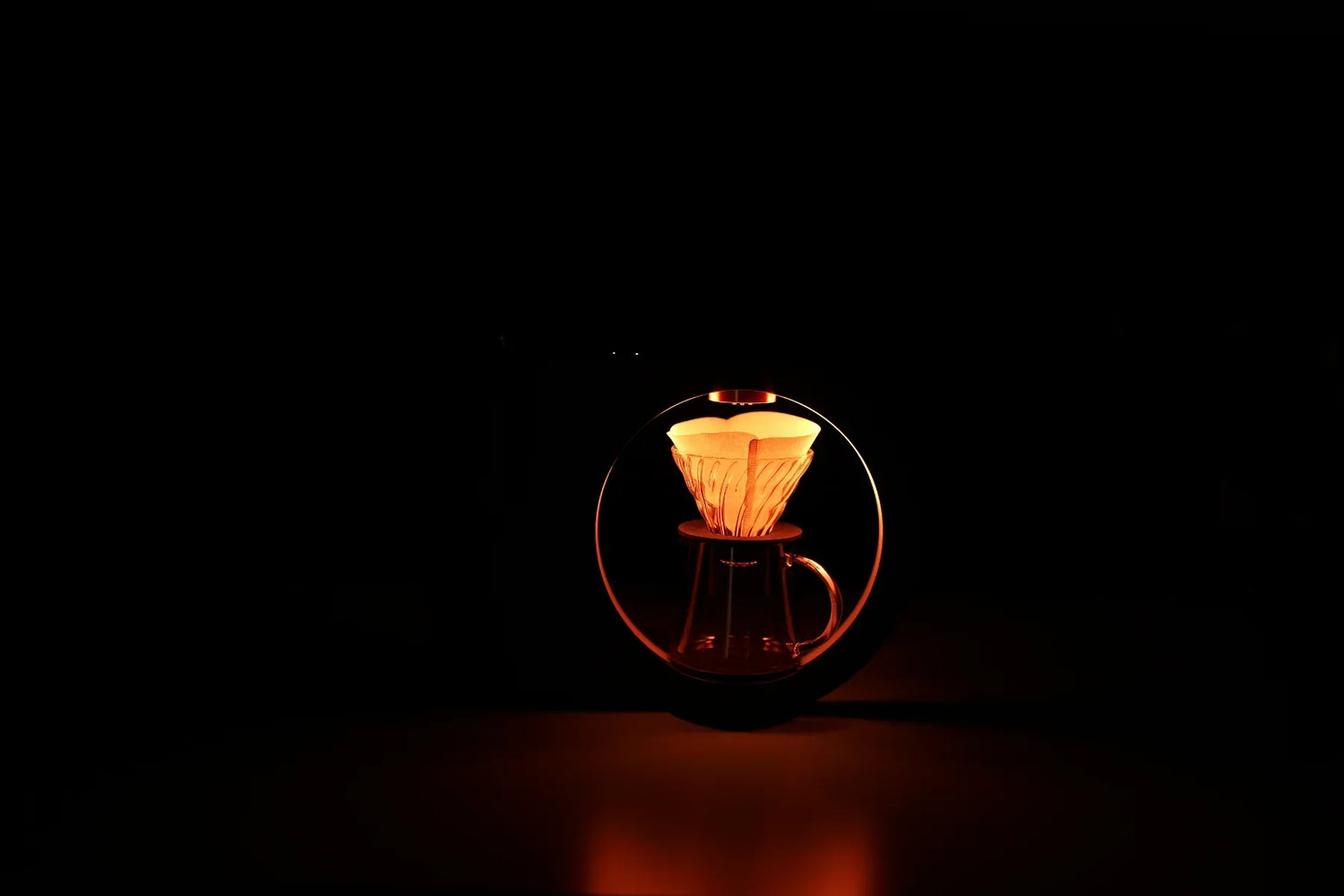

The Hikaru V60 by Hiroia delivers the most precise temperature consistency we've ever measured in a filter coffee machine. Nevertheless, we don't recommend it because of conceptual weaknesses in water distribution and a price of 700 to 800 CHF that bears no relation to its performance.
Why we conducted this test
We systematically test filter coffee machines. The Hikaru is the most expensive consumer-grade machine in this series. Our test protocol includes temperature measurement, brew profile analysis, and sensory evaluation. We worked with both the included Hario V60 and alternative brewers.
Technical specifications
The Hikaru operates with a boiler system (700 ml, 830 W) and offers an adjustable temperature range of 80 to 96 degrees Celsius. The flow rate can be adjusted in 10 levels from 1 to 10 ml per second. There are 9 presets, divided into three sizes (S/M/L) and three roast levels (Light/Medium/Dark Roast). Control is via an app (iOS 13+, Android 10+) or three buttons on the device. The shower head has 5 holes over a diameter of approximately 2.5 cm, equivalent to a 1-euro coin. The warm-up time from cold start is approximately 4 minutes.

Temperature measurement: best-in-class
We measured three brews at different temperature settings. Profile 2 at 92 degrees, Profile 3 at 85 degrees, and Profile 4 at 96 degrees. The machine maintains the set temperature throughout the entire brew with a maximum deviation of 1 degree. This is extraordinary. For comparison: even high-end consumer machines show temperature fluctuations of 3 to 5 degrees.
The three temperature curves run almost horizontally. At 85 degrees, the machine stays between 84.1 and 85.5 degrees. At 96 degrees between 95.2 and 96.0 degrees. At 92 degrees between 91.4 and 93.1 degrees.
The technical explanation: The boiler is fully heated before brewing. There is no flow-through heating effect that would reach its performance limit at higher flow rates. This results in consistent temperature.
Water distribution: the core problem
The shower head has five holes over a diameter of approximately 2.5 cm. Water hits the coffee bed centrally. With a conical filter like the Hario V60, this means: the center gets strongly agitated, the edges are less affected by the agitation, leading to underextraction.
We brewed 18 g of coffee with Profile S (290 ml, 5 pulses). The water barely reaches the outer coffee particles. They get wet, but aren't agitated. Extraction is uneven. You can taste this: the coffee lacks body, and the aftertaste leaves a slightly dry note.
With manual pour-overs, we control water distribution through pouring motion or spiral pouring patterns. The Hikaru's shower head is fixed. It can't compensate for this.

Solution attempt: Orea and Melodrip
We repeated the brew with an Orea flat-bed filter. Additionally, we placed a Melodrip between the machine and filter. The Melodrip has its own shower head that redistributes water and reduces impact velocity.
Our recipe: 16 g coffee, 250 ml water, 5 pulses of 50 ml each, 93 degrees (Light Roast).
The result: The coffee, a Rwanda Natural called Shyira, is juicy, balanced, with body. The dryness is gone. Extraction is significantly more even.
The setup works, but it requires two additional components (Orea, Melodrip) that aren't included and whose existence most buyers won't know about. An 800-CHF machine should brew good coffee without such workarounds.
Our video about the Orea dripper.
App and operation
The app, called Hikaru Brew, is functional. We can freely adjust flow rate (1 to 10 ml/s), temperature (80 to 96 degrees), pulse sequences, and pause times. There's a recipe library with proven profiles from professionals. QR-code sharing works. The Bluetooth 5.2 connection is stable.
Our criticism: The preset profiles (S/M/L) can't be edited directly. We have to copy them into custom profiles. This is cumbersome. The app announces an update that will add this feature, but it wasn't available at the time of testing.
The machine has no rinse function. We can't pre-rinse the paper without creating a custom profile for it. It's a detail, but it shows: the software isn't fully thought through.
Operation without the app: Three buttons (S/M/L) on the device. That's sufficient for everyday use. We only need the app for custom recipes.
Boiler versus flow-through heater: why a boiler makes sense here
We wondered why Hiroia installed a boiler. The 4-minute warm-up time is longer than with a flow-through heater, for example the Melitta Epos at approximately 1.5 minutes.
The physical limits: A flow-through heater can't maintain target temperature at high flow rates (for example, 10 ml/s). We've measured this in other tests: at 6 to 7 ml/s, temperature drops by 3 to 5 degrees. The Hikaru brews at up to 10 ml/s, which is only possible with a boiler or a flow-through heater with high energy input.
The trade-off: We accept the 4-minute warm-up time if the machine then delivers. The Hikaru does deliver, but only in a very specific setup, see the Orea solution.
Comparison: Sage Smart Brewer, Melitta Epos
Both cost about a quarter, so 200 to 250 CHF. Both have similar material construction, a plastic-metal mix. The Melitta Epos has a larger shower head with a better distribution pattern. The Sage has a shower head with radial design. Both brew better coffee than the Hikaru in standard setup without workarounds.
Temperature consistency: The Epos fluctuates by 2 to 3 degrees, the Sage by 3 to 4 degrees. This is worse than the Hikaru, but in practice less relevant if water distribution is correct. Even extraction at 91 degrees is better than uneven extraction at exactly 93 degrees.
Price justification: The Hikaru costs four times as much. For that you get: more precise temperature, more adjustment options, LED light show during brewing. This doesn't justify the premium.
Who should buy this machine?
The target audience according to the manufacturer: coffee professionals and enthusiasts who want reproducible brews.
The actual target audience in our view: people who first already own an Orea or similar flat-bed filter, second are willing to experiment with Melodrip or similar adapters, third prioritize temperature consistency above all else, and fourth have 800 CHF to spare and don't want to take the path of least resistance.
Not suitable for: Anyone expecting a plug-and-play solution.
Design and construction
The machine looks like it was built for Instagram. Textured surface, LED ring, rounded shapes. In practice, the LED blinking after 20 minutes is annoying. It can't be turned off, only the alert sound.
The construction: Solid. Plastic (Tritan, BPA-free), stainless steel shower head, glass carafe. Nothing rattles, nothing feels fragile. But nothing justifies 800 CHF either.
Conclusion
The Hikaru V60 is a technical demonstration unit for temperature consistency. If you need temperature curves for research purposes, this is the best tool on the consumer market. If you just want to drink good coffee, go for the Melitta Epos, save 600 CHF, and enjoy better cups.
Our advice: If Hiroia builds a version with an optimized shower head—larger diameter, more holes, possibly rotating—we'll happily test again. Until then: skip it.