










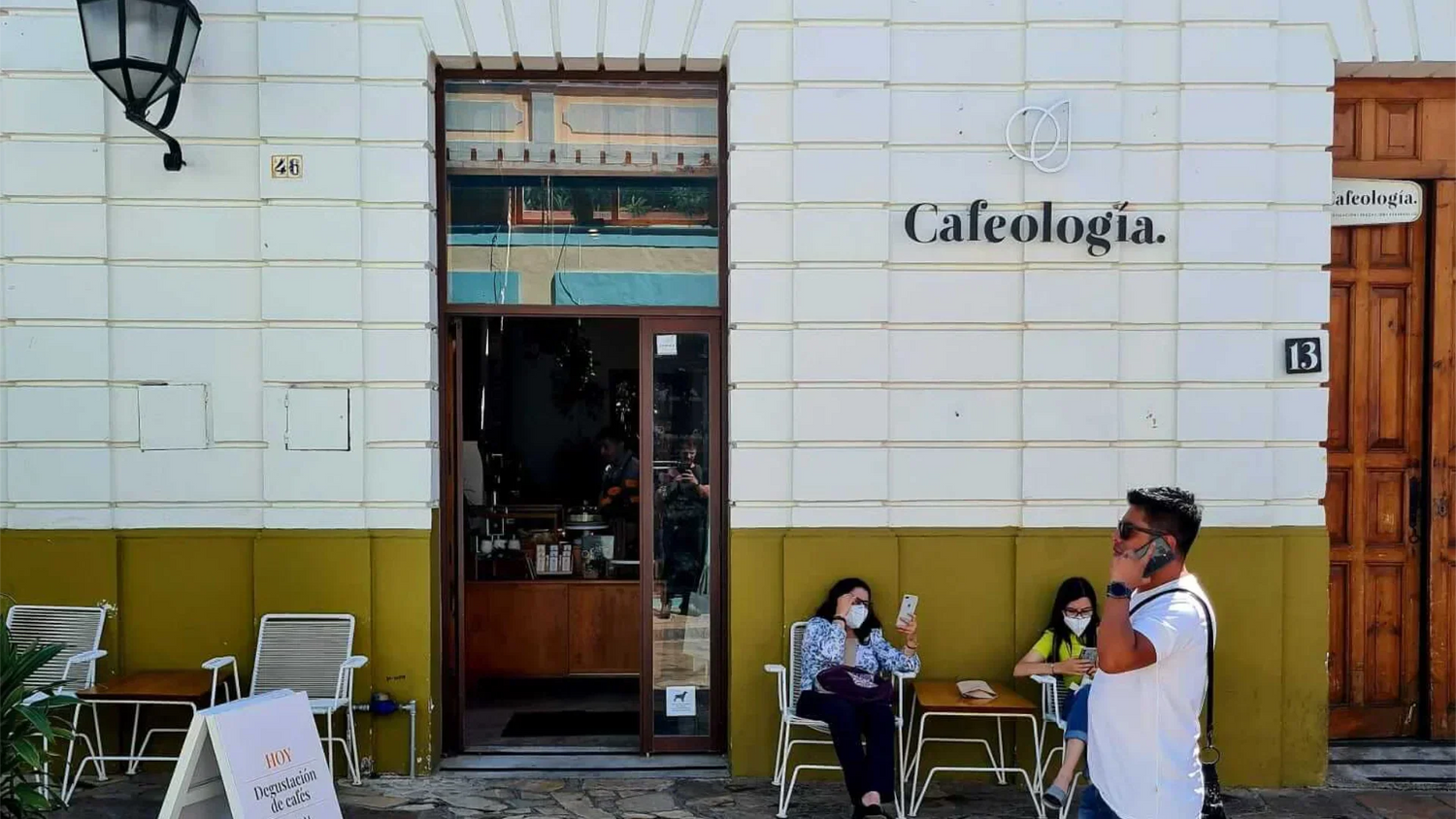

There are few companies that are as close to coffee as Cafeología. In southern Mexico, they work directly with producers, roast, taste, are baristas and share their knowledge at their coffee school. The team around Jesús Salazar has created a coffee island that can be groundbreaking for the entire coffee industry. Details, precision and patience characterize the work of Cafeología. We were on site.
"Coffee studies" as its own field doesn't exist as such, and yet it quickly becomes clear what it should be about: the totality of what makes coffee. It is a holistic approach to a topic that should include production, processing and consumption. "Cafeología" dedicates itself to this great goal as a company and says that "harmony between the environment, families and quality" is at the forefront.

Cafeología's motto: We create the human, economic and material conditions to express the maximum potential of coffee and those who made it
What does Cafeología do exactly?
Many who come into contact with Cafeología do so through social media. The Instagram accounts of the company and Jesús (Cafeólogo) are a stylishly crafted diary of their work. The first physical contact point is probably the cafés, with the headquarters in San Cristóbal being particularly noteworthy, as well as a small shop at Tuxtla airport. At their headquarters in San Cristóbal, they operate a coffee roastery and a coffee school, where they train employees, coffee professionals and interested parties.
On the roof they have a drying facility for coffee cherries. Outside the city they operate a dry mill, where they hull, sort, clean and manually remove defects from coffee, and export green coffee, mainly to Europe. In the region around San Cristóbal they work with four indigenous communities, where they operate their own beneficios and offer producers workshops for quality optimization. This broad and diverse work has developed over the past ten years

View into the dry mill, where coffees are sorted manually
In autumn 2022 I was on site in San Cristóbal, after we had already been in contact with Jesús for three years and had bought two natural nano-lots from Pedro Vásquez twice. I was excitedly nervous. The media work of Cafeología is impressive and creates high expectations.
The Cafeología Café
In the café I met Pablo Salazar, who heads the finances. The café itself is furnished in a mix of 70s architecture with lots of wood, high ceilings, many plants and subtle colors. The place itself radiates calm and invites you to drink several cups of coffee. The baristas are well trained and take time with their extractions.

Cafeología's flagship café in San Cristóbal
Guests choose from filter coffees with different point scores. The 85-point coffees are the starting point, then come the 86 and 87 point coffees. The 85-point coffees offer a lot of balance, soft texture and plenty of sweetness. The even higher point scores become more floral, fruitier and increasingly less reminiscent of classic coffee flavor.
"It's about the details," says Pablo.
He is the CFO of the company and discovered coffee only a few years ago when his brother Jesús recruited him for the project. "If we want to communicate details in coffee, we also have to look at it in detail." Details—a word that would accompany me throughout my days in San Cristóbal.

Pablo Salazar, Cafeología
There were the specially designed coffee cups that concentrate the aroma and make it stronger. There was the soap made from coffee byproducts in the room, there was the calibration in the language of all employees, how they described the coffees. There was the same music in all rooms, there were the labeled cupping cups in the lab, and there was the same high-quality coffee, no matter who brewed it.
The Roastery
Right next to the café, Claudia and her team operate the roastery. They roast on a 15kg Giesen roaster. They roast one curve per coffee variety. The filter coffee roast curve is their baseline, and for espresso they follow the same curve but roast a bit longer. By now they roast almost 30 tons for their own use. They supply five Cafeología cafés, sell on site and in the online shop, and some coffee shops in Mexico itself serve their coffee.

View into Cafeología's roastery.
The awareness and consumption of local coffee is already much more pronounced in Mexico than in other coffee-producing countries. At Buna in Mexico City, for example, guests choose between different coffee regions first, only then the farm. Actually, the way we know it from wine.
The Coffee School and the Lab

Claudia also heads the adjacent lab, where tastings take place daily. Claudia also judges at the Cup of Excellence, the most prestigious competition for a country's best coffees. The tastings with Claudia and her team were very valuable because we were able to calibrate ourselves.

We wanted to learn from each other how we think, talk and feel about coffee. This helps all of us so that in the future we can communicate even more precisely with each other and Cafeología can find us the coffees we're looking for.

Cafeología's cupping lab
We tasted coffees from three zones around San Cristóbal. Cafeología's focus is on washed coffees and those fermented in the cherry and dried using dry processing. Carlos is responsible for the post-harvest processes, and I had a long conversation with him about fermentations and drying.

Carlos is responsible for the entire post-harvest process
However, Carlos didn't speak of drying, but of "dehydration"—that is, water removal. It seems like a detail, but that's exactly what it's about. The method, the speed, the temperature and the sun exposure with which we remove water from coffee has a massive impact on taste and storage capacity.
Drying on the Roof
Just in front of my room were the first drying beds. Where other houses would have a balcony to sunbathe and drink a glass of wine, Carlos and his team dry coffee cherries. A dream for every coffee person.

Drone view of Cafeología's roof just before the drying beds were brought up.
"Here we have total control over the process," he says, because he can check the progress of drying and fermentation multiple times a day. These are certainly laboratory conditions, but from these they can derive general recommendations that Diana and her agronomy team can then pass on to producers.
The Focus on Quality
In 2022, Cafeología processed approximately 70 tons of green coffee. That's about as much as we roasted in 2022. Of these 70 tons, they roast almost half themselves; the rest goes to the local specialty market or for export.
Cafeología's focus is on characteristic, high-quality coffees with more than 85 points according to the SCA standard. Not all coffees from producers they work directly with achieve 85 points. For these coffees that score between 84 and 85 points, they created two of their own cafés, the "Carajillo". There they offer specialty coffee that is somewhat more accessible, and in doing so they also create a larger market for their partner producers. Coffees below 84 points they sell on the local green coffee market.

All producers receive this receipt that certifies the quality of the cherries and defines the expected salary.
The strong focus on complex coffees is of course interesting from a sensory perspective. However, it's worth considering whether this very focus also excludes producers, and if so, how.
Visit to Aldama at the Community Beneficio
We visit the Beneficio Comunitario. This is a collection station for coffee cherries. Cafeología built this station together with a local coffee producer. To get there, we drive to Aldama in an indigenous community of Tzotzíl, not far from San Cristóbal. Two hours by car or 30 kilometers as the crow flies separate the two places physically—but in terms of content, there's a universe between them.
"I grew up in Chiapas," says Pablo, "and never had to define myself by my skin color. I'm from here. But the first time I was in Aldama, I was suddenly the white guy."
Aldama lies east of San Cristóbal in a region that showed much sympathy for the socially revolutionary Zapatista movement in the 1990s. The region's history is different from that in San Cristóbal. Rural areas are still shaped by strong indigenous customs, traditions and values. In the small communities, few people speak Spanish; the communities remain and often live among themselves. This fragmentation creates micro-regions and micro-worlds, so that Cafeología initially worked with three translators in the area around San Cristóbal alone.
In Aldama itself we meet Inéz Vázquez. She is the daughter of Pedro Vásquez, from whom we have already roasted two nano-lots. Inéz is a young woman who worked as a barista at Cafeología for five years, then roasted coffee, and today she manages a collection station for coffee cherries. This fact alone breaks with many traditions in her community: as a young woman, she takes on work that previously only men performed. She runs the beneficio and thus has not only responsibility but also many rights—she decides which quality of cherries to buy or reject. At the same time, she provides feedback and conducts workshops for producers to convey Cafeología's philosophy.

Inéz Vázquez. Producer's daughter, entrepreneur, barista, roaster.
"The beginning was a bit bumpy," says Inéz. But after three years, the number of producers supplying cherries to Inéz has tripled. Quality keeps getting better, and that's mainly due to the simple, direct and transparent way Cafeología and Inéz share knowledge.
There are no surprises for producers because, first, Cafeología communicates the prices for delivered coffee cherries before the season and makes them public for everyone. What might sound somewhat obvious is simply not standard in coffee-producing countries. Often coffee is harvested without knowing what the value will be at the end of the day. This seemingly small lever flips an entire system.
Above all, it creates incentives in a region that is largely ignored by official Mexico. The recent history of the Zapatista region seems to be one reason why there are few state interventions or development programs to support the poor, rural population. Far too often, and also in this case, there are state pensions meant to support people, but in reality they keep them still and in a vicious cycle.
In the case of the Aldama region, young people have the right to their own house at age 15. There are no building zones. So whoever wants to build can do so without major restrictions, anywhere. There is also a state subsidy for this. Likewise, parents receive a state pension for each child. And this combination creates a cocktail where there are many young people in the region with many children living in their own, one-room house. The money from child benefits is often enough to survive, but not for much more.
Coffee Quality as an Incentive
"That's not a system, that's stagnation," says Inéz. No incentives are created to do anything. In Cafeología's system, it's about incentives. Aldama is in a region at 1800 to 2000m above sea level. The region has little coffee rust because it's very cool. Many producers work organically because they have no access to mineral fertilizer. Varieties like Geisha, Bourbon or Java grow here—varieties that are no longer grown in many parts of Mexico because they're not rust-resistant. The conditions for high quality are present. But to really achieve it, you need plant care and precise harvesting.

Claudia and Diana
Diana is an agronomist and supports all producers that Cafeología works with. I love and appreciate traveling with agronomists, asking detailed questions and getting profound answers. Diana advises on how producers can design their farms sustainably in the long term, what suitable varieties are for new plantings, how diseases and pests can be prevented proactively, and how other crops can be planted between coffee trees.
What about organic production? "Step by step," says Diana. Mexico and organic coffee is a story in itself. Since the 1980s, Mexico has been one of the world's largest producers of organic coffee, which is supplied mainly to the USA. All of Mexico's coffee regions switched to organic coffee, but mainly focused on certification rather than plant care.
"Many organic farms here are broken," I heard repeatedly. Organic doesn't just happen. Organic isn't organic just because nothing is done. And this approach long prevailed in Chiapas. "Whoever doesn't fertilize, whoever doesn't prune, whoever simply does nothing, is organic," says Diana. But that's not what organic is about—it's about working with the soil, the entire farm system, and that takes deep understanding and a lot of work if it's to succeed.
"We have to first show that we're trustworthy partners. Then we have to show that we need high quality. And then we slowly guide our producers toward nature-based production."

Many organic farms in the region think organic = doing nothing
It should be noted, however, that the vast majority of producers working with Cafeología already work in a nature-based way; some are even organic. However, there are also many bad and recent memories of organic certification.
Certification for individual producers is unrealistic, especially if they're small. Cooperatives offer a path to certification, which in Mexico are often double-certified, organic and Fair Trade. But a cooperative alone makes no difference; it must be conscientiously managed and developed in service of its members. Too often cooperatives have failed because money was embezzled, because individual members' opinions weren't heard, causing a loss of trust and many cooperatives dissolving again.
"Paso por paso. Rushing brings nothing. We have to create understanding, build trust, and then move forward step by step. We're still guests here." Diana, who is from Colombia, notices this threefold. As a woman, as white, as Colombian.
The Dry Mill and Export
Once the coffee is dried, it's made export-ready in the own dry mill. It was the first time I didn't wear a mask in a dry mill. There was hardly any dust. "We clean the hulling machines after every run," says Pablo. After that, the green coffee is sorted by density and size. They standardly repeat this process five times—I've never seen that before.


The high uniformity achieved in this way results in extremely homogeneous roasting quality, as all beans can process the roaster's energy evenly. This year we bought two nano-lots from Cafeología. The coffees are brought to Europe via Belco.
We are delighted about this partnership with Cafeología. It's a pleasure to be able to exchange so broadly and deeply about coffee. We'll be able to offer you nano-lots from the region around San Cristóbal annually, and together we're learning to know the region sensorially even better.