



























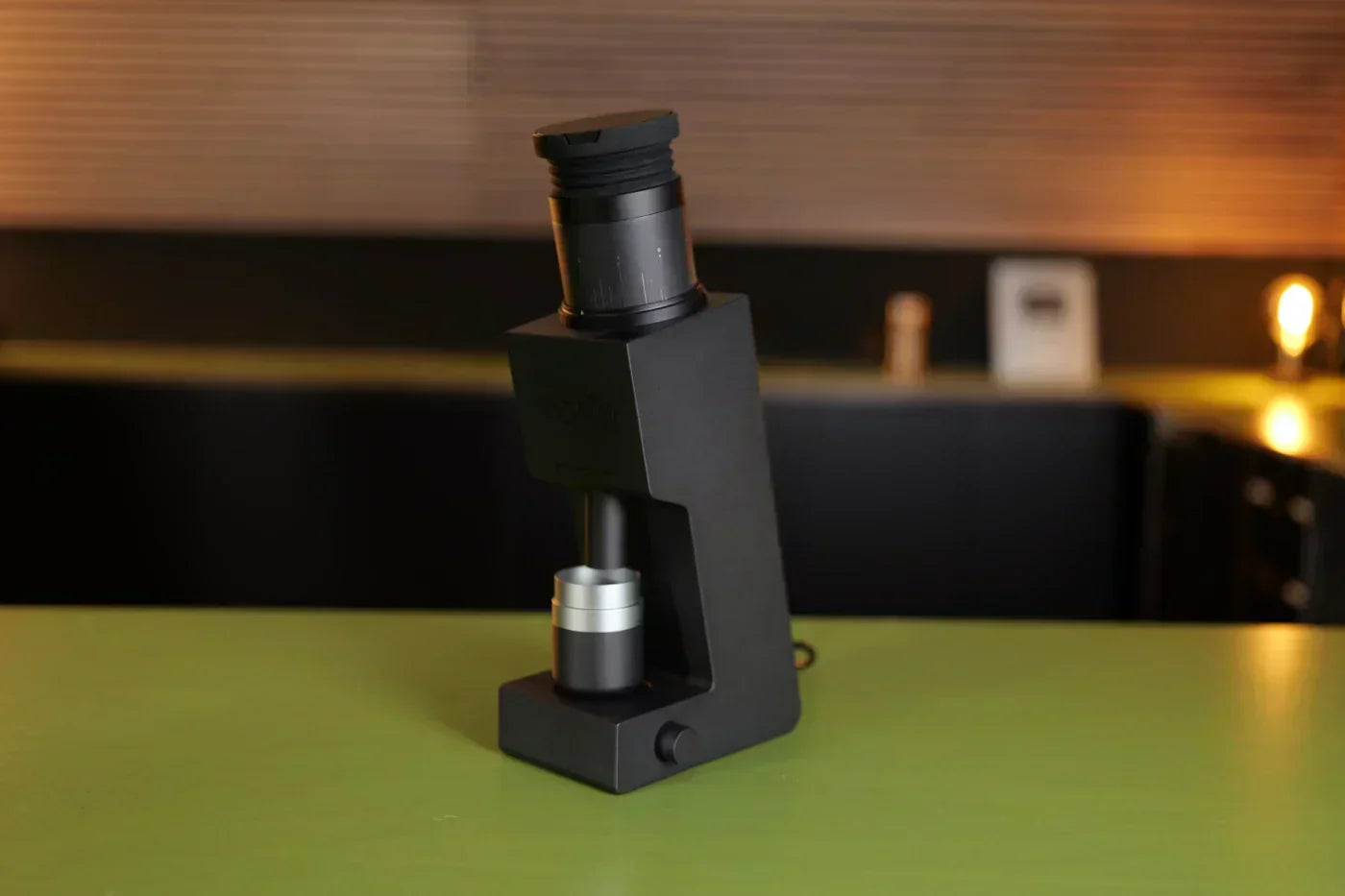

The Varia VS6 coffee grinder has come to market as the "big sister" of the Varia VS3 and is aimed at demanding home baristas. The grinder market is currently experiencing a boom – new manufacturers are bringing out smart single-dosing grinders, and Varia is following this trend with the VS6. In this blog post, we summarize the findings of a six-month test. With the help of university support, we analyzed particles, tested the grinder at home and in our coffee school, and are now ready to present our results.
We examine design and build quality, espresso and filter coffee performance, particle distribution, speed, noise level, retention, and cleaning. At the end is a conclusion with the strengths and weaknesses of this grinder and the question of whether the VS6 is worth its premium price tag.
Many experience reports on the Varia VS6 have already accumulated in the comments. We're delighted if you use the comments section to continue sharing your experiences and exchanging ideas.
Note: We purchased the Varia VS6 and report freely and independently on our experiences with the grinder.
We compared 10 single-dosing grinders in the price range of 500 to 1000 euros. Learn more in our article on the topic.
Design, Quality and External Facts
The Varia VS6 presents itself with a minimalist, modern design. Made from a solid aluminum block, it radiates high quality. The housing is robust, durable, and feels very high-quality thanks to precise manufacturing. The shape is functional: The grinder stands at an angle of 76.5°, which not only looks sleek and elegant but is also intended to counteract retention. How well this works is discussed further below…
With dimensions of approximately 13 × 19 × 40 cm (W×D×H) and a weight of just over 10 kg, the VS6 is a substantial device – significantly larger and heavier than the entry-level VS3 model. Varia clearly positions the VS6 in the pro league: Price-wise, the grinder costs around 850–900 €, making it almost three times the price of the smaller VS3.
The grinder follows the single-dosing principle, where only the weighed portion of coffee beans is freshly ground each time (instead of storing beans in a hopper). Varia recognized this trend and implemented it consistently. There is no large bean container – you fill the desired dose into the short funnel at the top. A high-quality metal dosing cup is included for collecting the ground coffee, which is conveniently positioned with a magnet at the bottom directly under the outlet. This cup is visually styled to match the grinder and fits exactly into a 58 mm portafilter, making transfer clean and simple. The grind adjustment is infinitely variable at the top of the grinder. The scale is fine enough and smooth, allowing very precise adjustment. Overall, the design conveys a thoughtful, minimalist impression – a high-quality construction that combines form and function.

Espresso and Particle Distribution
For espresso, the quality of ground coffee plays a crucial role. The VS6 impressed in testing with a very uniform particle distribution. We examined the particles in collaboration with Zurich University of Teacher Education: The ground coffee shows a narrow main peak (concentrated particle sizes) and a certain amount of very fine particles. A narrow particle distribution means that the coffee powder is relatively homogeneous – an important factor for uniform extraction. Indeed, the espresso from the VS6 tasted correspondingly clear and structured, with pronounced sweetness and soft texture. Even with longer extraction times, the espresso showed no disturbing "dustiness" or bitterness, which is due to the good composition of the ground coffee. We were surprised how full-bodied and clean the espresso turned out with the 58 mm flat burrs of the VS6 – especially with such a narrow main peak. The espresso extractions of our Apas Espresso tasted "very sweet" with a silky texture and clear flavor profile.
A special feature of the VS6 is variable speed control. A rotary knob allows you to adjust the grinding speed between 500 and 1600 rpm. The tests showed that this setting has noticeable effects on particle distribution and taste. Low speed (e.g., 500 rpm) resulted in a narrower main peak in the particle curve – the ground coffee is even more homogeneous, the cup appears "clearer" in flavor. If you increase the speed toward the maximum (1600 rpm), the particle peak became slightly wider again; in espresso, there was then a tendency toward more body, but sometimes also less uniform extraction. We recommend experimenting with the RPM setting here: If the flavor profile is too "frayed" or there's light channeling, a lower speed can help calm and focus the extraction. This "playing with speed" is an exciting feature of the VS6 that enables different flavor profiles without changing the grind setting.
In terms of consistency and reproducibility, the VS6 also does an excellent job. During testing, the grinder was deliberately adjusted – from an espresso grind to coarser for, say, lungo or filter, and then back to the original espresso point. It became clear that once you find a grind setting, you can precisely re-establish it: Both the median particle size and the main peak were almost identical to the original values after re-adjusting. This stability is also reflected in the cup – once determined recipes can be reliably reproduced. Overall, we rate the "espresso potential" of the VS6 as very high, in the very good to outstanding range. The grinder consistently delivers full, balanced espressos with pronounced flavor profiles and can compete with the top models on the market in this discipline.

Filter Coffee
Single-dosing grinders are often developed primarily for espresso – which is why it was particularly interesting to see how the VS6 performs with filter coffee. The answer upfront: surprisingly well. In our intensive testing, the VS6 proved it can grind coarsely without any trouble and is therefore suitable for hand filters, French press & co. You could easily set an appropriate filter grind and get a clear, sweet filter coffee with a soft character. The filter coffees were also "round and sweet" with very clear cups, which is due to the uniform grinding and the narrow main peak.
We brewed various filter coffees in the test. For comparison with other grinders, we standardly use our Amigo filter coffee, which, like the Apas espresso, is very consistent and approachable. The sweetness and clarity of the coffee particularly surprised us positively.
A major advantage is the fine-tuned grind adjustment of the VS6, which allows quick switching between brewing methods. For instance, you can make espresso in the morning and filter coffee in the afternoon without worrying about finding the exact espresso grind again later. The scale is so precise and repeatable that you hit exactly the same point again after re-adjusting – this kind of grind repeatability is hard to find on many other grinders. In testing, for example, after brewing a filter coffee, the previously noted espresso point could be re-established, and the next shot ran exactly as before. This makes the VS6 ideal as an all-around grinder for a household or small café where you frequently switch between different brewing methods.
Speed, Noise Level, Retention
The VS6 prioritizes thoroughness over speed. In testing, at medium speed (~1000 rpm), approximately 11.5 g of coffee was ground in 10 seconds. For a typical espresso dose of 18 g, it takes around 20 seconds until all beans have passed through. This is significantly slower than some other electric grinders – the VS6 is one of the more leisurely models. For its intended purpose (single-dosing, meaning individual shots one after another rather than continuous use in a café), this is rarely a problem. When preparing at home, a difference of 5–10 seconds per grind makes little difference and rarely weighs negatively in a careful workflow. If you're in a hurry, you can also increase the speed – at 1600 rpm the grinding would be faster (but with the mentioned effects on the ground coffee).
Retention
Retention: A critical point with single-dosing grinders is retention – that is, coffee grounds that remain inside the grinder after grinding. Here the VS6 shows light and shadow. Technically, the grinder is designed to have as little retention as possible: The discharge chute is short and angled, and a blower (rubber pump) is supplied with which you can blow out remaining particles from the burr chamber. This would actually allow retention to be reduced to nearly zero – ideally only about 0.05 g of coffee grounds remain in the grinder. In practice, however, a problem emerged in testing: With normal pressing of the blower, the grind setting shifts slightly. This means you unintentionally adjust the grind when you want to blow out the last bit of coffee powder. This seemingly small problem has a major impact because it makes single-dosing uncomfortable in practice – nobody wants to re-adjust the grind after every blow. As a consequence, we did not use the blower and accepted the retention. This is frustrating because the concept of the grinder doesn't work here.
Without using the blower, however, somewhat more coffee grounds remain in the burr chamber. In long-term testing, approximately 2.3 g retention was measured when you don't tap or blow out extra after grinding. Of this, around 0.3–0.4 g can be loosened by lightly tapping the grinder – this portion is referred to as temporary retention. The remaining approximately 2 g, however, sits firmly in corners of the burr chamber (permanent retention) and only comes loose during thorough cleaning of the grinder. For this, the grinder must be opened and the retention around the burrs must be loosened.
Compared with other single-dosing grinders, this is relatively high retention – some competing models achieve <0.2 g without major tricks. With the VS6, theoretically it should also be possible to reach this range thanks to its efficient discharge and blower. But as it stands, this potential remains untapped. The Varia VS6 is shooting itself in the foot here.
We'll see if Varia improves this in the future. Some kind of grind setting lock would be desirable. Until then, you have to weigh your options: either accept minimal retention and clean thoroughly regularly – or use the blower very carefully each time you grind and monitor the grind setting. In daily handling, unfortunately, this weakness somewhat diminishes the otherwise excellent impression of the VS6 as a true single-dosing grinder.

The Varia VS3 on the left and the Varia VS6 on the right.
Cleaning
In terms of cleaning and maintenance, the Varia VS6 is delightfully user-friendly. The device is designed so that you can reach the burr chamber with just a few movements: First, you remove the magnetically held adjustment ring, then the upper burr element can be unscrewed. Now the grinding chamber is open and you can conveniently brush it out with the included brush. This process is simple and takes only a few minutes – overall, cleaning is very easy to handle. In long-term testing, it proved worthwhile to perform thorough cleaning every 4–6 weeks (with daily use). We recommend this because the permanent retention of the grinder is 2 grams.
To make cleaning easier, Varia has built in anti-static pins in the discharge chute. These ionization needles are designed to reduce the static charge of coffee powder, so fewer particles stick to walls and the outlet. In testing, it was indeed found that little coffee grounds remained stuck statically, especially compared to grinders without this technology.
Nevertheless, it is advisable – as is customary with single-dosing – to lightly dampen the beans before grinding (known as the RDT method, e.g., with a water spray from a spray bottle). Especially if you don't use the blower, a hint of water helps minimize static charge and reduce clumping. This way, hardly anything sticks, and you need to completely disassemble the grinding chamber less often. Some users reported in forums about small challenges with thorough cleaning, particularly getting all remnants out of corners. In our testing, however, it became clear: With the described procedure (regular brushing out, occasional disassembly), the VS6 can be kept clean without much effort. The maintenance intervals are entirely practical, and thanks to the thoughtful construction, there are no inaccessible spots – even the permanent retention of ~2 g can be completely removed if needed by removing the burrs and blowing/vacuuming out the grinder. Overall, there is little reason to complain about cleaning and maintenance.

Conclusion on the Varia VS6
The Varia VS6 proves to be a high-quality coffee grinder with many strengths in testing. The design and workmanship are at a professional level – from the solid housing to the precise burrs, you feel the quality. In espresso performance, the VS6 fully impresses: It produces a very homogeneous particle distribution, which results in clear, sweet, and well-structured espressos. We were impressed by the consistency of the results and the versatility of the grinder. Both espresso and filter coffee are successful at a high level of taste – a rare combination that makes the VS6 an all-around talent for coffee enthusiasts. Particularly noteworthy is the excellent grind setting reproducibility: You can switch between different settings and always return exactly to the starting point. This stability, combined with the ability to play with speed, opens up room for experimenting with the flavor profile without switching beans or needing a second grinder.
But where there is light, there is also shadow. The main criticism point of the VS6 concerns precisely the central single-dosing promise – namely retention-free grinding. While the grinder would theoretically be able to retain almost no coffee grounds thanks to its design and blower, in practice a design detail prevents this perfection: The blower shifts the grind setting when you use it. Rather than endanger the carefully chosen setting, we prefer to do without the blower – but accept that approximately 0.3 to 0.4 g of coffee remains in temporary retention. That's annoying!
For a grinder designed for single-dosing, this is an irritating flaw, as it diminishes the advantage of always having just fresh coffee in your cup. Varia has done pioneering work here with the variable speed and exchangeable burr set, but falls short on this small (yet important) detail. At the end of the day, the Varia VS6 is still an excellent grinder: superbly built, technically thoughtful, and powerful in the cup. Anyone who primarily makes espresso and occasionally filter coffee will love the precise adjustability and balanced taste. Only those who expect absolute zero-retention single-dosing must be aware of the mentioned limitation. Should Varia be able to improve here, the VS6 would be nearly perfect. As it is now, it remains one of the best grinders in its class, but with a particular quirk that every home barista should weigh for themselves. For many ambitious coffee lovers, however, the offered advantages will likely far outweigh the drawbacks – the Varia VS6 delivers exactly what you expect from a first-class single-dosing grinder in everyday use: consistently excellent coffee.

