






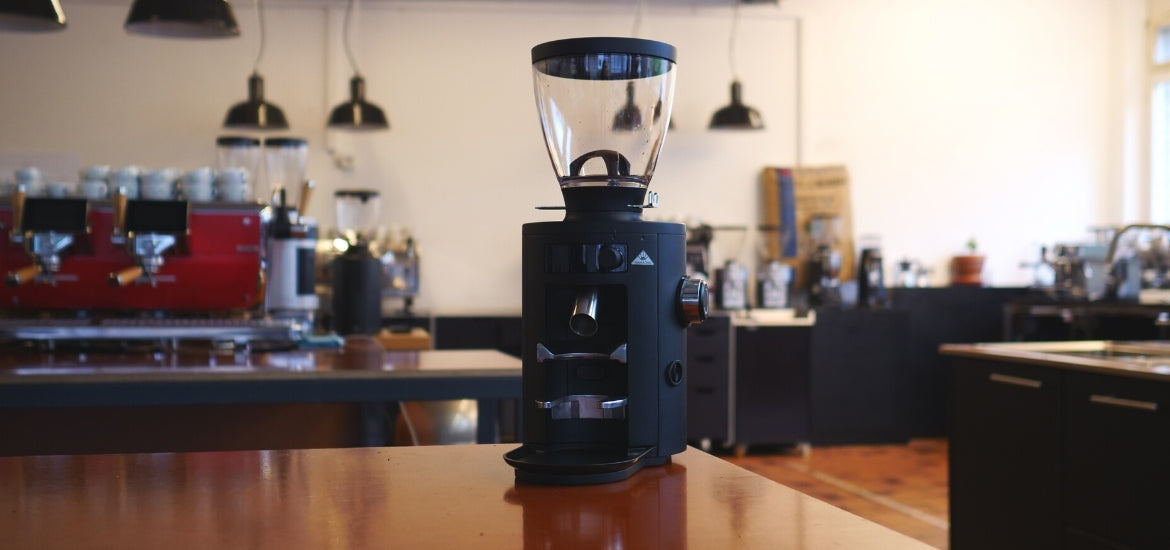

The Mahlkönig X54 espresso grinder is on the market. As a coffee grinder, the X54 is designed for espresso and filter coffee and is intended to serve as an "all-rounder" for home coffee drinkers. At 460 euros, the price is very competitive and opens up a new price segment for industry leader Mahlkönig.
We took a first look at the Mahlkönig X54 when it came out. In the meantime, we followed up with a comprehensive test as part of our extensive espresso grinder test series. Everything you need to know about retention, consistency, and particle distribution can be found in this report.
We have classified the Mahlkönig X54 in comparison group 4 and compare it with the Eureka Specialià, the Lelit PL72, and G-Iota. The additional videos and comparison video will be released in March 2022.
Buy Mahlkönig X54
The following specialty retailers carry the Mahlkönig X54 and we can recommend purchasing a machine from these businesses. They all offer the option to readjust the offset of the machine.
Germany: [Partner links]*: Stoll Espresso, Craft Coffee Gear, Bohnendealer
Austria: [Partner links]*: Bohnendealer
*We search for specialist partners for you, from whom we know they provide good work and good service. We are in close contact with the retailers. These are commission links. If you order through this link, it won't cost you more, but we receive a small commission that we put into new test equipment. We continue to do this and are looking for competent partners for you in the DACH region.
First Impression – the External Design of the X54
The Vario from Mahlkönig was previously the entry-level grinder of the Swiss-German coffee grinder company. I also had one at home what felt like a decade ago – a grinder like a foreign body in an otherwise high-quality range of coffee grinders. Mahlkönig simply didn't make grinders for beginners – or if they did, only with the hand brake firmly applied – that was my conclusion back then when using the plastic contraption. When I think back to adjusting the grind setting with the two levers, I still get cramps today.
So I was all the more pleased about the announcement of the X54. A proper grinder – an "all-round home grinder" with an espresso focus. That's quite ambitious! The precision required in the fine espresso range of particles demands a lot from a grinder and rarely goes hand in hand with good grind adjustment down to the filter range.
The first impression of the X54 was certainly impressive. The machine looks very high-quality, well-made. At around 5 kg, it's on the lighter side, but still feels solid. The exterior of the X54 resembles the E65 in miniature or the Anfim Practica, which like Mahlkönig are part of the Hemro Group.

View of the Mahlkönig X54.
The bean hopper is made of quite resilient plastic. It can withstand the occasional drop. This is much better than with earlier Mahlkönig grinders. The bean hopper attachment is also solid. No more tedious snapping in and breaking off like with the K30 or Peak. The grind adjustment feels just as premium and the display functions well. This is a pleasure!
Grinder Consistency – Shot by Shot
For proper espresso adjustment, reliable ground coffee amount is an important factor. We measured 10 shots each in both the espresso range and filter coffee range. The grinder varies by 0.3g +/- from the target grind setting. This isn't perfect, but completely acceptable for a home-use grinder. Notably, there were occasionally outlier shots. For example, instead of the target amount of 18 grams of coffee, only 16.5 grams were dispensed, and then an increased amount was dispensed at the next grind. Unfortunately, the Mahlkönig X54 has a tendency to occasionally retain coffee powder beyond the usual retention in the grinder. This powder sticks in the fairly large open area around the burrs and then releases during a later grind.
New grinders initially produce more static charge until the burrs wear in a bit. The static charge remained manageable and wasn't noticeably high. Once the grinder has a hundred shots behind it, the static of the particles will reduce on one hand, and the variation will likely settle at 0.2 to 0.3 grams on the other.

Particle Distribution and Espresso Quality
The view of particle distribution is initially positive and fits well with many good espressos we've had from the Mahlkönig X54. In our T4 measurement, we adjusted the espresso grinder again to an espresso with our Apas training espresso and a dose of 18 grams as well as 45 grams of espresso drink weight in 25 seconds.
The measurement shows a relatively low fine fraction of 19.6% compared to other grinders and simultaneously shows a relatively narrow main peak of 236 microns. Sensorially, this manifests in clear espresso shots, relatively low unpleasant bitterness, and good extraction behavior.
Unfortunately, the grinder didn't produce the same distribution every time. The diagram above and the following one make this clear.

For T3 and T4, the grinder was adjusted to the target espresso recipe. After T4, a ristretto (T5) and café crème (T6, see diagram further above) were pulled. For T7, the grinder was readjusted to the same marking on the grind adjustment wheel using the best possible setting method.
In all cases, the curves and measurements deviated from one another. This manifested in "jumping" extraction results and espresso quality. However, in all cases the results were in the good range, so the variations didn't weigh as heavily. Nevertheless, the large variations were a negative surprise.
.tg {border-collapse:collapse;border-spacing:0;} .tg td{font-family:Arial, sans-serif;font-size:14px;padding:10px 5px;border-style:solid;border-width:1px;overflow:hidden;word-break:normal;} .tg th{font-family:Arial, sans-serif;font-size:14px;font-weight:normal;padding:10px 5px;border-style:solid;border-width:1px;overflow:hidden;word-break:normal;}
| Espresso Recipe T2 | ||
|---|---|---|
| X50 | 332,125783 | |
| Fine peak | 17,5294 | |
| Coarse peak | 244,1144852 | |
| Espresso Recipe T3 | ||
| X50 | 353,6270026 | |
| Fine peak | 16,2155 | |
| Coarse peak | 255,9786224 | |
| Espresso Data (T4) | ||
| X50 | 315,8588965 | |
| Fine peak | 19,5779 | |
| Coarse peak | 235,5817838 | |
| Ristretto Data (T5) | ||
| X50 | 241,8600157 | |
| Fine peak | 27,0234 | |
| Coarse peak | 202,4481579 | |
| Café Crème Data (T6) | ||
| X50 | 643,2831203 | |
| Fine peak | 6,8572 | |
| Coarse peak | 434,9229908 | |
| Espresso Data (T7) | ||
| X50 | 340,7732122 | |
| Fine peak | 17,9228 | |
| Coarse peak | 249,9478125 |
Stepless or 35 Steps on the X54?
Mahlkönig made an error in their own communication here, and some resellers picked up on it. The grinder doesn't have 35 steps but is stepless. However, it does have a scale that spans 35 digits or division increments.

When adjusting the grind setting, you don't feel any resistance or clicking. Conversely, this means the grinder can be adjusted with stepless precision. We effortlessly switched the grinder from espresso to filter and back again. In the espresso range, it then takes several shots to dial in the perfect espresso extraction perfectly. That's our first impression. We'll examine this area of the grinder more closely. At first glance, the grinder seems significantly more flexible than many classic espresso grinders.

Grind adjustment of the X54.
In principle, we prefer to use a grinder only for espresso and a separate grinder for filter coffee. Whether the Mahlkönig X54 will change our opinion, we'll report to you after further tests.
Retention – the Forgotten Ground Coffee in the Grinder
Retention refers to the space in the grinder that doesn't empty of ground coffee after a grinding cycle ends. Depending on the grinder geometry, burr assembly, and surrounding space, more or less ground coffee remains in the grinder. This ground coffee is pushed out of the grinder first during the grinding of further coffee beans at the next grind cycle. At the end of a grinding cycle, new powder remains behind again.
When checking retention, we distinguish between areas in the grinder where ground coffee isn't replaced every time and areas where the ground coffee is exchanged with every grind. For example, ground coffee sticks in screw head openings over time, which then isn't replaced with every grind.

Plenty of space for old ground coffee.
The retention of the X54 is relatively large. Ground coffee accumulates in the area of the carriers and in front of the flapper. On our new grinder in July 2021, we measured a retention of 7.6 grams at an espresso grind setting. However, Mahlkönig has since upgraded and changed the durability and size of the flapper. And as much as we initially didn't want to believe it: the new flapper reduces retention to 4.1 grams, which is significantly better.

The smaller flapper on the right in the image replaces the new flapper. The conversion can be done easily at home. Anyone who bought one of the first models should replace the flapper.
Why is this adjustment so important? Retention fills with old coffee. This is then used for preparing the next espresso. To put this in proportion to an espresso shot: a double espresso with 18g IN would consist of more than one third of "old" ground coffee. A single espresso shot of 9 or 10 grams would, well, be made mostly with old ground coffee.
Single Dosing and Ways to Combat Retention
Partly due to the large retention, the X54 is definitely not a grinder designed for single doses. Too much old coffee simply remains in the area around the burrs. It's a shame that Mahlkönig isn't moving with the times here and hasn't picked up on these market impulses and worked on reducing retention. Niche shows the way, and Eureka provides with the "Blow Up System" at least approaches to dealing with retention.
Retention isn't a problem if the next espresso is pulled immediately. It becomes problematic if the espresso won't be pulled until the next morning. So how do you deal with such a problem if the grinder otherwise performs well? Brief intermediate grinding is the best approach.
Especially with the X54, 4 grinding dose settings can be programmed. Grind dose 1 can be set so that when the grinder is used, it first empties the retention and refills it. Only then can, for example, grind setting 2 dispense the actual grinding amount.
In our comprehensive espresso grinder test, we tested a grinder's single dosing capability as follows: we ground the grinder empty. Then we removed the coffee beans from the bean hopper. Now 18 grams were weighed and filled in. We then ground for 30 seconds. The test criterion was how reliably the respective grinder would completely eject the ground coffee during this time.
Here, the sticking problem mentioned above appeared again. While the grinder usually retained only small amounts of 0.2 grams, some outliers with up to 1.2 grams ruined the result. 0.2 grams would be a good result from our perspective. 1.2 grams, however, is a poor result. In any case, weighing is necessary with the X54.
How Fast and Loud Does the Mahlkönig X54 Grinder Grind?
We achieved a grind time of 16.5 seconds to dispense 18 grams of ground coffee for preparing our espresso from the APAS cooperative. The roast is on the darker side for our standards, so a medium roast in the overall picture. Lighter roasts will take longer, darker roasts will happen faster due to the brittleness of the coffee.
In 10 seconds, the grinder reached a grind amount of 13.7 grams. This makes it one of the slower espresso grinders in our test field.
Home espresso grinders are often not only loud but also sound "tense," jerky, and "unhealthy." In comparison, the 81.8 decibel hum of the Mahlkönig X54 is more of a purr. The grinder is thus in the better middle range of all test grinders.

Temperature and Bean Hopper
Among the positive results is the relatively low temperature of the burrs, or the low temperature transferred to the ground coffee. Over six grinds, the ground coffee showed a temperature of 31.1° Celsius and only increased by 1.2°C. In this temperature range, we don't expect any negative sensory effects on the ground coffee.
The bean hopper of the X54 is very easy to remove with a convenient slider. It closes well and the entire suspension feels very premium. Below the slider, however, 20.8 grams of residual beans remain. This is a medium value. Quick switching between coffee varieties is possible, but requires grinding out or flipping the grinder.

Conclusion and Your Experiences
That concludes our initial test of the Mahlkönig X54. The grinder delivers a lot of good and really stands out for its build quality. The ease of use is also good and overall the grinder looks very premium. The improved retention is an important step. However, the espresso grinder has ongoing difficulties in the grinding chamber. Too often, the ground coffee isn't reliably ejected. Too often the amount varies and reveals when opening that a lot of powder is stuck around the burrs. This dampens the good impression.
However, if you quickly weigh the grind amount and don't grind directly into the portafilter, you have a very good grinder with excellent value for money in the X54. The accessory market is assured and so is repairability. This is particularly lacking in cheaper grinders, such as those from Sage.
Very good espresso can be prepared with the X54. That's the most important thing, and despite some wishes for improvement, we can definitely recommend the grinder.
If you want to learn more about espresso preparation, take a look at our course offerings at our coffee schools in Switzerland and in Germany, and if the journey to us is too far, perhaps our online home barista course is an option for you.
---
What are your experiences with Mahlkönig's new grinder? Do you share our impression or do you disagree? What stands out to you positively and what bothers you? We're excited to hear about your experiences.