



























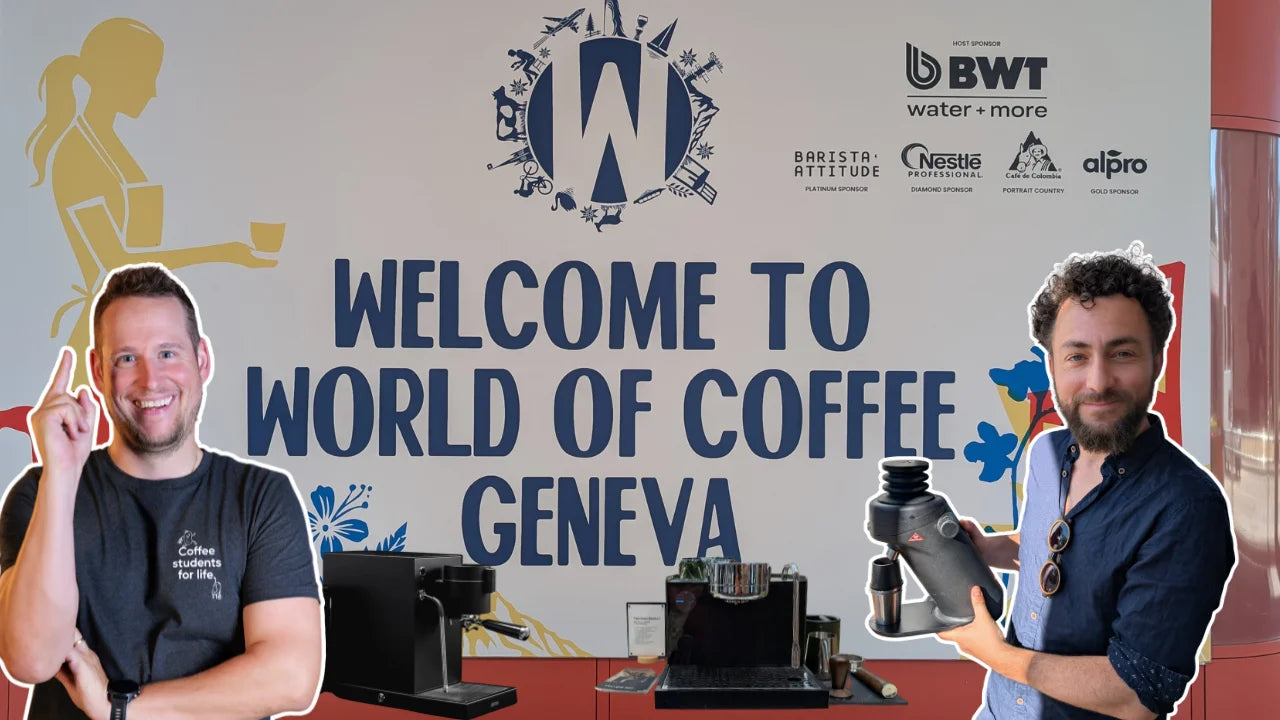

The World of Coffee 2025 in Geneva offered coffee enthusiasts a colorful fireworks display of innovations. We took a critical and curious look at what was on offer – and present to you here all the important new developments in espresso machines and grinders for home use.
There are indeed innovations and new developments on display. At the same time, many manufacturers continue in their usual fashion to put old wine in new bottles and present a new color variant of an espresso machine as a quantum leap. We'll spare you such offerings and focus on what matters. From smart grinders to motorized lever espresso machines to portable devices – here you'll learn what's moving the industry and where it's headed.
As always with this trade show report: we have not tested any of the devices mentioned and can only provide a first impression. How well the announced features actually work in practice, we'll only be able to report after thorough testing in our Coffee Academy.
Varia VS4 – Single Dosing Made Easy
We start with a grinder that had our espresso grinder tester Michel Indelicato absolutely beaming at the trade show: Varia VS4, the latest offspring of the well-known Varia grinder series. This single-dose grinder fills the gap between the compact VS3 and the larger VS6. What makes it special?
- Conical burr set: The VS4 features newly developed conical burrs (53 mm diameter) – not identical to those of the VS3, but a unique design.
- Adjustable RPM: For the first time, Varia offers RPM adjustment on a smaller model too, to further optimize grinding speed and grind consistency.
- Lightning-fast cleaning: The highlight is how easy it is to clean. With just a few simple steps, you can open the grinder without changing the grind setting. Michel was thrilled: Finally, you can clean the burrs without having to re-adjust afterward!
- Anti-static: The chute features a kind of ionizer or anti-static technology, so virtually no coffee crumbs should stick to the housing anymore.
- Price and availability: The VS4 is expected to launch at the end of 2025, with a target price of around €450 – a strong offering for such a grinder.
Assessment: Even the smaller VS3 was a price-to-performance hit, and the VS4 raises the bar even higher. For single-doser enthusiasts on a budget, this grinder should be very appealing. Innovative features like RPM adjustment and effortless cleaning show the trend: user convenience and ease of maintenance are paramount.

Zero:Hero – Portable Espresso Machine with Power
On my outdoor adventures, I like to test portable espresso brewers. One such device is the hand espresso brewer by Zero:Hero, which has won a Red Dot Award.
At the trade show booth, we tried out the small, mobile espresso maker, which bears a suspicious resemblance to a competitor's product – but makes one crucial promise: it gets hot enough!
This handy device is conceptually similar to well-known portable espresso devices, but should be able to heat water up to 92 °C. That's exactly where I had a criticism of a competitor – the brewing temperature. Zero:Hero aims to put an end to that. I'll do a comparison and test as soon as possible.
Key Facts Zero:Hero:
- Operation: Battery-powered, usable with hot or cold water. With already hot water, up to 200 shots are possible, from cold water approximately 4–5 espressos per charge.
- Brew group & handling: Fill in coffee, screw together, tamp – the ritual remains manual. The design is based on familiar models, which provides instant familiarity.
- Temperature: According to the manufacturer, the device reaches approximately 92 °C brewing water temperature. If that actually works, it would be a game-changer in this segment. Personally, I'd even go higher.
- Fun factor: Should Zero:Hero meet expectations, it's the ideal companion for espresso on the go and will soon accompany my kayaking and cycling tours.
Assessment: There are many portable devices, but they often fall short on temperature or the number of possible shots. Zero:Hero promises to solve both. We remain (cautiously) optimistic. If the little hero actually gets hot enough and has good endurance, it could become the reference among travel espresso makers. Price-wise, we expect it to be in line with similar devices (there was no concrete information on this at the trade show).

Source: meticulous
Meticulous Espresso – The Robot Lever for Home
Next was the Meticulous booth – and here espresso tech dreams came true. Meticulous is a unique espresso machine that executes a classic manual lever shot completely mechanically – but with far better dynamic control. We pre-ordered this beauty some time ago via crowdfunding; according to the manufacturer, the first machines should be delivered in summer 2025.
What makes Meticulous special? Essentially, you get an electronically controlled lever machine, just without a visible lever. An internal piston does the pressing, and numerous sensors monitor the extraction process in real time:
- Plenty of sensors: Built-in sensors measure flow, pressure, and temperature during the shot. Nothing is left to chance – every parameter is captured.
- Single-dose water system: Before each shot, you fill a defined amount of water into a front chamber directly above the portafilter, which is then precisely heated to temperature. Only the necessary water is heated.
- Integrated scale: A scale is built into the drip tray – brilliant for accurate output measurement. Simply place your cup on it, press the button, and the espresso weight appears on the display. Dosing and even manual single-dosing for filter coffee are possible.
- Digital profile control: Pressure curves can be freely programmed and controlled. The machine can theoretically automate everything from pre-infusion to flow and pressure profiling. Profiles can be saved and recalled at any time.
- Brewing process: One button press and the piston raises in the brew head, allowing water to fully saturate the puck. Then pressure and flow are gradually increased according to program. Flow, pressure, temperature – everything is controlled to the second. For the espresso tinkerer, there are no limits.
Planned price: Kickstarter supporters invested around $1,200; officially, the Meticulous Espresso should cost about $2,000 (without optional milk frother). If everything works as Meticulous promises, that's more than competitive.
Assessment: Meticulous could become the bridge between professional lever machines and smart machines. At the same time, the Meticulous brews immediately! No tubes, no distance between heating element and brew chamber. The heating and pressure creation happens at the brew chamber or portafilter. There are many other strengths and few weaknesses that Meticulous will likely have. We're looking forward to our machine more than almost any machine before.
Muvna Switch-Grinder – Two Grinders in One
At trade shows you see a lot – but this novelty amazed even us: A manufacturer showed an espresso grinder where you can swap out the entire burr set within seconds. Yes, you read that right: Conical or flat? You no longer have to choose, you just swap them out!
The grinder – announced in the European market under the name Muvna – features two interchangeable burr sets: a massive 98 mm conical burr set and a flat set with 83 mm discs. Using a lever, you remove the entire front section, which is attached to the main body of the grinder via metal pins. The other burr set is then reattached the same way. The "burr swap" is complete in 3–4 seconds.
Further facts about Muvna:
- Minimal retention: Due to the design of the swap system, virtually no coffee grounds remain in the grinder. Less retention = less old coffee in the next shot.
- Target audience: High-end home users and lab technicians? Just kidding – Muvna targets hardcore enthusiasts who want to choose the optimal burr type depending on the bean (conical for more traditional espressos, flat for light roasts, for example). Or for the indecisive who simply want both or like to experiment.
- Performance: Specific technical data (motor, RPM, etc.) were not mentioned on-site. But the burr sizes alone show: we're playing in the top league here.
- Price & availability: The Muvna grinder should be ready for the market around August 2025. A price of around $3,000 was hinted at – definitely not a bargain.
Assessment: Muvna takes a radically innovative approach. Whether you really swap between conical and flat all the time in everyday use is debatable – but as a technology demo alone, it's impressive. For well-heeled espresso nerds, Muvna could be the all-in-one solution. Retention, flexibility, and engineering excellence were clearly paramount here. We're honestly curious to see how this grinder performs in testing and whether the swap mechanism is robust long-term. Definitely one of the most exotic highlights of WOC Geneva 2025.

WPM Primus – Pro Features in Compact Format
WPM is hardly a secret tip anymore when it comes to affordable espresso machines. In Geneva, the Hong Kong-based company delivered twice over: with the new Primus espresso machine and exciting updates to their grinders.
Primus: Dual Boiler, Thermoblock & Pressure Profiling
The WPM Primus looks at first glance like a typical 1-group home machine, but inside is pure high-tech. It's aimed at ambitious home baristas and small cafés. What makes it special?
- Innovative heating system: The Primus combines a classic 0.8l boiler with PID control for espresso with two thermoblocks – one for hot water and one ("Supersteam thermoblock") for steam. Result: rapid heat-up time and strong temperature stability despite compact design. According to the manufacturer, the machine is actually ready to use in about 2 minutes – impressive if it works. Many have claimed this and few deliver. We'll see.
- Gear pump with profiling: Instead of the usual vibration or rotary pump, WPM uses a quiet gear pump. This allows precise pressure profile control: You can adjust the pressure curve during the shot or even (in the future) control by flow. Already now, multi-stage profiles with programmable phases are possible – from pre-infusion to pressure ramp-down.
- Built-in sensors: The machine also has a flow meter and according to the manufacturer, in the hot water area. That's really more than just extraordinary in this price class. Plus, there's a fairly intuitive LED display showing all parameters.
- Plenty of steam: The dedicated steam thermoblock delivers dry steam with good power – fine microfoam for latte art is achievable. How achievable, the developer showed us directly on the machine. It was the most beautiful latte art I've ever seen made by a technician. The steam boiler only runs when you need it, saving energy.
- Tank & fixed water supply: WPM supplies both a water tank and fixed water connection from the factory – at no extra cost, with a target price of around €2,000. Many other manufacturers charge extra for the fixed water option; here it's standard.
Assessment: The Primus combines many trends in one machine: quick-heat technology, pressure profiles and step control, plus energy efficiency. That WPM offers this for ~€2,000 is quite a statement. Of course, we need to check how the hybrid approach (boiler + thermoblock) performs in practice and whether the machine can actually deliver the heat-up time and temperature stability. But what WPM is showing here is very, very promising.
WPM ZP-1 and KONOS: Single-Dosers in Pairs
Alongside the machine, WPM also showed new grinders. Already known is the WPM ZP-1, a compact single-dose grinder that debuted at the last Frankfurt Coffee Fair. In Geneva, the surprise: KONOS, a new conical grinder built on the ZP-1 platform.
WPM ZP-1 – the flat burr single-doser:
64 mm flat burrs, adjustable RPM, and very low retention. Praised for its solid construction. (We haven't tested it ourselves yet, but we have an order in to catch up.)
- Single dose conical: KONOS features a 71 mm conical burr set.
- Adjustable RPM: Like the ZP-1, KONOS also offers adjustable burr RPM to control grind and speed.
- Easy-clean mechanism: Inspired by the ZP-1, KONOS features a quick-clean mechanism for the burr unit. Removing coffee grounds is supposed to be a breeze – important for single-dosing.
- Design & quality: Aluminum housing, modern look.
Assessment: With ZP-1 and KONOS, WPM has two arrows in its quiver to shake up the single-dose market. The strategy is a bit reminiscent of Niche (which also offers flat vs. conical options with Zero and Duo). What's exciting is the combination of RPM adjustment and ease of cleaning. In short: WPM is stepping on the gas to appeal to ambitious home users. We're already looking forward to thoroughly examining both grinders!

Fellow Espresso Series 1 – High-Tech in a Plastic Shell
The manufacturer known for stylish water kettles and accessories, Fellow, is now entering the espresso arena. At the Fellow booth, the brand-new Espresso Series 1 was presented, Fellow's first portafilter machine. Here are the key impressions:
Technology & Features:
- Three heating elements: The Series 1 uses a thin-film heater + mini boiler + brew group heater in combination. Specifically: A pre-heater rapidly heats water and feeds a small boiler, which in turn supplies the brew group, which also has a heating element. That gives triple water heating along the way. This should make the machine heat up quickly and maintain temperature very stably – ambitious!
- Full profile control: Remarkable for a machine in this class: You can program pressure profiles. Pre-infusion and pressure ramping – all of that should be possible and intuitively adjustable via dial/display. Plus, there's a profile save function, so you can store recipes for different beans (including temperature, pressure, and flow throughout the shot).
- Quick steamer with a catch: The Series 1 is dual-use (espresso & milk), but technically behaves more like a single boiler when switching to steam. To froth, the mini boiler needs to heat up, which takes a moment, then cool back down for espresso. Fellow emphasizes they've implemented smart solutions – how well that works (and how quickly they cool back down) tests will show. Additionally, there's an Assisted Steaming function: The machine offers pre-selected steam temperatures for different milk types (e.g., less heat for oat milk).
- Operation & aesthetics: The device has a modern, sleek design (available in black, red, brown) and reminded us of some existing machines in terms of form factor – though aesthetics are in the eye of the beholder. Operation is via a turn-push wheel and display. Everything should be very intuitive. In practice, we couldn't get out of some menus easily – but you'll get used to it.
- Price & material: Here it gets interesting: The target price is around €1,500–1,600 ($1,499 MSRP for Fellow USA, early birds paid $1,399). That's extremely competitive considering the features – but it's only possible through generous use of plastic for the housing. The machine is almost entirely made of robust plastic, with metal found only in a few places. That keeps costs down but raises questions about durability and longevity.
Assessment: Fellow has taken a bold step with the Espresso Series 1. On paper, it combines features you'd expect from more expensive machines in a sleek, compact device at a mid-range price. If the concept works, Fellow could score a real hit and challenge incumbents like the Lelit Bianca. However, skepticism is warranted: How well does temperature control work with the small boiler? How long will the plastic housing last in daily use? Critical, but curious, we await a test unit. Because if the Series 1 delivers on its promises, many home baristi could soon be pulling "shots from stored profiles" without breaking the bank. Innovative, but please also solid – that will be the key.
ECM & Profitec Innovations – Exacto Grinder and More
At the joint booth of ECM / Profitec, we found two highlights: a new single-dose grinder called Profitec Twist SD54 (already tested by us) and the prototype of the ECM Exacto, a grind-by-weight grinder.
ECM Exacto – Grind-by-Weight with Brains
The ECM Exacto is set to arrive in late 2025 and marks ECM's entry into weight-based grinding. Its name says it all. Here are the key facts we learned:
- Direct dosing by scale: The Exacto has a built-in scale that weighs the ground coffee in real time and automatically stops grinding once the target dose is reached.
- 64 mm burrs are used.
- Stepless adjustment with digital display: The grind adjustment is stepless via a dial, but with a digital scale in the display. That means as you change the grind setting, a display shows the numeric value with high resolution.
- Portafilter detection: The grinder automatically recognizes whether a single or double basket is inserted. Accordingly, it could suggest different standard doses. That's something all other weight grinders under €1,500 lack.
- Development stage: The prototype at the trade show felt good already, but needed some fine-tuning. ECM wants to show an improved version at the HOST trade show in fall and then get to market quickly. Visually, the grinder is somewhat larger than previous ECM grinders – no surprise, it has significantly more technology inside.
Assessment: With the Exacto, ECM enters a trend that companies like Baratza and Eureka have already picked up: smart grinders with weighing technology. For ECM fans who value German craftsmanship and sleek design, the Exacto could be a great complement to an ECM portafilter machine.
Price-wise, there was no information yet, but the grinder will likely cost more than €1,000. If the accuracy and reliability are there, the Exacto will definitely find customers – "nicely fine grounds" was what Michel noted on the trade show shot. We'll stay on top of it and hope to soon have more to report and test the particle distribution.

The DACH-Arkel Connection was also at the trade show. Lukas Brenneis from Brewspire, Markus Berger from Vitudurum (Switzerland), and Wolfgang Köppl from Die Röster (Austria) closely collaborated with Fernando Moreira from Arkel on the development of the new Arkel Coast Dual Boiler. The machine wasn't at the trade show, but a unit arrived with us today and will be tested soon.
Sage/Breville Oracle Dual Boiler – When the Machine Adjusts the Grind
Sage Appliances (in Germany under "Sage", worldwide as Breville) made another step toward integration at its compact machines at WOC 2025: espresso machine and grinder merge into one intelligent system. Specifically, we got a preview at the Sage booth of the next generation of the Oracle line and the Dual Boiler machines. And they had a lot up their sleeves.
What's new at Sage? In short: the Sage Oracle Dual Boiler with more control for the user and automatic adjustment by the machine. In detail:
- Fine-tuning all parameters: The new models offer far more adjustment options than before. Grind mode selectable (by time or weight) – even with integrated grinder. Pre-infusion can be time-controlled (with constant low pressure, ~1–2 bar), similar to a "blooming" phase. Overall, the machines seem much more open to the user, whereas previously much was preset and limited.
- Integrated grinder with auto-adjust: The Sage Oracle Dual Boiler combo machine monitors the extraction and automatically adjusts the grind setting. If the shot runs too fast, the machine makes it finer; if too slow, it goes coarser – all on its own. This feature has previously only been known from commercial machines, like self-regulating grinders in large super-automatics or the Mahlkönig grind-by-weight plus sync system in networked form. Sage is now bringing this to the home.
- Connectivity: The machines feature smart functions like remote power-on capability. Via app you can preheat the machine, for example from bed. Cozy!
- No turbo-heater, but parallel operation: Sage consciously decided against a pure thin-film heater/thermojet to enable simultaneous espresso pulling and milk frothing. The new dual boilers heat up in roughly 10–15 minutes, which is somewhat mitigated by remote start.
Assessment: Sage/Breville is taking a major step toward "machine learning" in the espresso kitchen. The grinder responds if the espresso runs too fast or slow. Since the Sage Oracle Dual Boiler also relies on its own automatic tamping, the machine now controls the entire process.
For entering the espresso world, that could be invaluable: fewer failed attempts, more consistency. Experienced users might turn up their nose ("I'll adjust it myself!"), but they also benefit from expanded control (pre-infusion, etc.). The question is what this will all cost.
The connectivity issue (i.e., machine "talks" with grinder) is striking here. Sage led the way – and as we heard, other manufacturers are also working on it (Rocket is experimenting with a Bentwood grinder as an integrated system at the commercial level, for example). Conclusion: the gap between fully automatic coffee machines and portafilter machines is getting shorter, as more smart mechanisms make espresso prep easier.

Baratza Encore ESP Pro – Espresso Entry 2.0
Among grinders, one of the most delightful news was the Baratza Encore ESP Pro. Baratza is known for home grinders (Encore, Virtuoso, Sette…), but now they've souped up their entry-level Encore model significantly. The Encore ESP Pro debuted at the expo in Houston and was also front and center at Geneva.
What Does the Encore ESP Pro Offer?
- Stepless & fine: Unlike the classic Encore with coarse clicks, the Pro version features a stepless burr set with ultra-fine resolution of 2.2 micrometers per step in the espresso range. This allows precise dial-in for portafilters, but it still covers a wide range up to filter coffee (the burr set has two zones: espresso and brew).
- Digital display & timer: For the first time, Baratza is installing a proper display. It not only shows grind time in 0.1-second increments, but also displays the grind setting as a number! Turn the hopper and the display switches from timer display to numeric grind setting – super helpful for reproducing settings. We were impressed by how precise and repeatable it felt.
- Auto-off for single dosing: The grinder has two modes: timer mode (classic for hopper operation) and single-dose mode with auto-stop. In SD mode, the grinder senses when no beans remain in the burr set and shuts down automatically. No more grinding empty – practical! For single-dosers, a small air blower can be attached to blow out the last crumbs – though Baratza has another innovation ready here…
- Integrated ionizer: Yes, you read that right – Baratza has equipped the Encore ESP Pro with a static remover via ionization. A small plasma generator module creates ions that neutralize the static charge of the ground coffee. Result: hardly any more static buildup and sticking in the chute. Baratza has essentially brought the big anti-static tech down to the entry-level segment. Hats off!
- Further details: LED lighting in the chute (so you can see what you're doing), improved interior materials (more metal parts for stabilization), and an easily swappable bean hopper (you can switch between single-dose hopper and a small attachment for continuous operation). Oh, and best of all: virtually no retention according to them – we'll check and measure ourselves.
- Price & market launch: The Encore ESP Pro will be surprisingly affordable at $300 (around €299). It will gradually replace the old Virtuoso line and form with the existing Encore ESP (non-Pro) the new Baratza entry-level duo. Market launch is set for fall 2025.
Assessment: Here might be the new reference under €300. Baratza brings together in the Encore ESP Pro much of what you previously only found in pricier grinders: stepless fine adjustment, timer & display, anti-static. Especially for espresso newcomers, the new Baratza should be extremely appealing.
Eureka Mignon Specialità Smart – When the Grinder Thinks Along
Italian grinder manufacturer Eureka has given its bestseller, the Mignon Specialità, a brain upgrade. The new model is called Specialità Smart and brings a patented "Smart Technology" that's mainly designed to guide beginners.
What Can the Smart-Specialità Do?
- Burr-distance display: The grinder features a digital screen showing the burr spacing in real time. Turn the grind setting and you immediately see the change in micrometers on the display while the burrs move. No more guessing where you are – you can't get more precise.
- Extraction time assistant: Here's where it gets really clever: You can input your target extraction time into the grinder (e.g., 25 seconds for an espresso) and then the actual runtime of your last shot. The grinder then calculates a grind setting suggestion – specifically it might say: "Go from setting 195 to 200, so coarser, to reach your goal". It all works with saved recipes too (dose, output, time): you can store multiple profiles (for different beans) and then get a grind setting hint to get back to where you want to be.
- Recipes & storage: Up to 12 recipes can be saved, including target input, output, and brew time. If you switch beans and load a saved recipe, the grinder shows: "For 18 g in, 36 g out in 30 seconds set from 201 to 175." Something like that – very helpful for quickly finding the sweet spot you discovered before.
- High-precision construction: Eureka apparently also optimized mechanically to ensure repeatability. Plus, they announced extending the motor warranty to 10 years – a vote of confidence in durability.
- Price: The Specialità Smart costs around €600 and will be available from June/July 2025.
Assessment: Eureka takes a similar path to Sage and others, but from the grinder's perspective. The grinder "coaches" the user to the right grind setting – something we hadn't seen in grinders before.
Exactly what smart machines already do (e.g., the new Sage) provide tips ("dial finer/coarser") – Eureka now does standalone in the grinder. The industry trend is clear: devices should support beginners, flatten the learning curve. For pros it might be a nice gimmick, but for beginners, such a digital helper can save frustration.
It's tempting to conclude that Eureka is also thinking about connectivity: Today the grinder reads the time from the user – tomorrow maybe directly from the machine? Just a small step until machine and grinder exchange data directly and react automatically. That's not happening yet, but we can easily imagine a future Eureka getting info from an espresso machine with an open interface and automatically adjusting on its own.
Conclusion: The Mignon Specialità Smart is an exciting link between classic grinder and smart era. And even without networking, it's simply a top grinder with modern operating concept – innovative and user-friendly for beginners.
Gilda Dual Boiler – Swiss Turbo-Machine with Volume Doser
Just before the trade show ended, we reconnected with Bruno Trepp of Kaffeewelt GmbH, a Swiss barista and entrepreneur institution. Bruno competed on stage with us at barista championships over ten years ago. The busy "Kafimaa" (as he's called himself for years) took over the Swiss espresso machine manufacturer Gilda last winter. It was founded by Marco and Dorothea Tschümperlin in 2012.
Bruno wants to help his team bring the already innovative machine to wider distribution. Here are some details about the dual boiler machine:
- 2 minute heat-up: Yes, dual boiler, but thanks to a tiny coffee boiler (120 ml) and four heating elements totaling 1600 watts, the machine is ready in 2:00 minutes! (The portafilter still needs about 6 more minutes to heat, or you can flush through it.) That's record time in the dual boiler segment, but needs confirmation through thorough testing in our lab.
- Eco-steaming on demand: The steam boiler stays off until you need it – then it heats to steam ready in 40 seconds. That saves tremendous energy.
- To go with the Gilda espresso machine, there's also a grinder with unique volumetric dosing: The bean hopper has two chambers (for single and double portions); you fill the beans in, flip it over and the volume matches pretty much the needed dose.
- A built-in flow meter in the machine ensures the right amount of water is used for the shot.
Assessment: This project shows what's possible in energy saving and speed without sacrificing dual boiler comfort (working simultaneously). With a price of 3,995 Swiss francs for the Swiss-made machine, it's quite substantial though.

Mahlkönig X64 SD – Big Player Goes Single Dose
A real treat to finish: Mahlkönig – synonymous with coffee grinder quality Made in Germany – is now also jumping on the single-dose train. The X64 SD looks interesting and especially boasts a very competitive market price of €499. That's only possible because Mahlkönig is for the first time moving core brand production to China. So that's how pretty much all other grinders in this price range come about. The key question will be: can Mahlkönig maintain its quality in this long-distance relationship? The first impressions of the grinder I gathered in Geneva are promising though:
- Flat 64 mm burrs
- Flexible use: The X64 SD can be used classically as a single-dose grinder with an air blower or with a small bean hopper. Since it doesn't have a timer, that makes less sense. Three different attachments are included. That's nicely versatile.
- Magnetic dosing cup: The included dosing cup snaps magnetically into the holder. The cup itself can be extended upward and neatly catches coarser grounds with static buildup tendency.
- Easy cleaning: The entire discharge unit can be removed with a single motion and cleaned with a brush. To access the burrs, three screws need to be loosened.
- Price & availability: Mahlkönig aims for a price under €499, which sounds quite attractive for a premium brand. Market launch should happen soon.
Assessment: Mahlkönig officially enters the single-dose game for home espresso machines. Unofficially, they started already. The EK43, with Matt Perger, paved the way for this trend. For the EK43 though, you still shell out more than €2,300 today.
Between the EK43's rise to the favorite grinder of many baristi and 2025, more than three dozen single-dose grinders from other manufacturers came to market. For the home segment, Niche paved the way.
10 years later, Mahlkönig responds now with its own version and is quite competitive right out of the gate. The first impression of the Mahlkönig X64 single dose is positive. Pricing tempts. We're already looking forward to thoroughly testing our unit over the coming weeks and months.
The Mahlkönig X64 SD will be available through recommended specialist retailers like Stoll Espresso
Industry Trends: Intelligence, Connectivity, and Comfort
After this tour through the innovations, it's worth a quick look at the big picture. What trends are emerging in the home espresso industry in 2025?
- Smart helpers & automation: Whether Sage's self-adjusting grinder in the Sage Oracle Dual Boiler or Eureka's grind-setting-advising Specialità – devices are thinking more and more. The goal is to support the user, avoid mistakes, and simplify the perfecting process. Espresso machines and grinders are syncing or at least giving clear hints. Especially beginners benefit from a shorter learning curve. The barista isn't replaced, but guided.
- Networking and communication: First steps toward machine-to-machine communication are visible. Today the combo machine corrects its own grind setting, tomorrow maybe the portafilter machine signals the external grinder: "Shot ran too fast – dial finer!" Rocket Espresso showed something like that at the commercial level (Bentwood grinder connection). Hemro (Mahlkönig) recently acquired German machine maker Xenia – likely to push such integrations. In coming years, we'll see increasingly more networked ecosystems where machine and grinder work in harmony. This brings the systems we know from Dalla Corte and Mahlkönig in commercial use to the home segment too.
- Sensors and data logging: Meticulous impressively shows how sensors (pressure, flow, temperature, weight) let us transform every shot into data. Such data will increasingly be used to create profiles, make auto-corrections, or simply give the user feedback. Scales in machines (see Meticulous) or IoT modules will become more common. The home barista of tomorrow might have more graphs on their tablet than the roaster of yesterday. 😉
- Speed and energy efficiency: Nobody wants to wait 30 minutes to heat up anymore. Thick E61 brew groups come under pressure from new technologies. Whether Fellow's three-heating system, WPM's boiler + thermoblock combo, or Gilda's 2-minute boiler – fast heating is the motto. At the same time, manufacturers focus on saving energy: thermoblocks only on when needed; small boilers insulated; standby modes and app-controlled startup. The ecological footprint of the home espresso oasis should shrink without sacrificing comfort.
- Single dosing and low retention: With grinders, the trend clearly continues toward single-dose concepts. Reasons: less retention, easier bean switching, flexible grind setting. At the same time, we see innovation in anti-static (ionizers, coatings) and cleaning (tool-free opening, swappable burrs). Manufacturers understand that high-quality coffees only show their complexity if home baristi can easily clean their grinders.
Finally to note: The World of Coffee 2025 in Geneva was an intense ride. Over three days we spoke with many manufacturers and gathered information for you.
The industry is becoming more diverse, smarter, and at the same time more user-oriented. Sure, we coffee people love the analog, the manual – but who says clever chips and motors can't make our lives easier? As long as the coffee turns out better in the end, innovations are welcome. And there were quite a few this year. Many manufacturers did save their big reveals for the Host in Milan, which takes place in late October though. We'll definitely stop by and report.
In that spirit: We're looking forward to thorough testing with proper depth as soon as all these exciting machines and grinders arrive with us. As always, we'll keep you posted with videos and articles. The home barista world stays in motion – and we're staying on it for you, critically, curiously, and with lots of fun. Until then: Take care of yourselves and drink good coffee!

