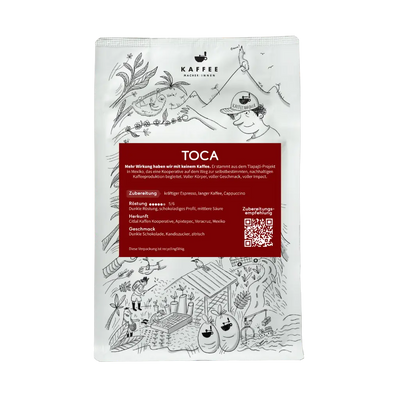











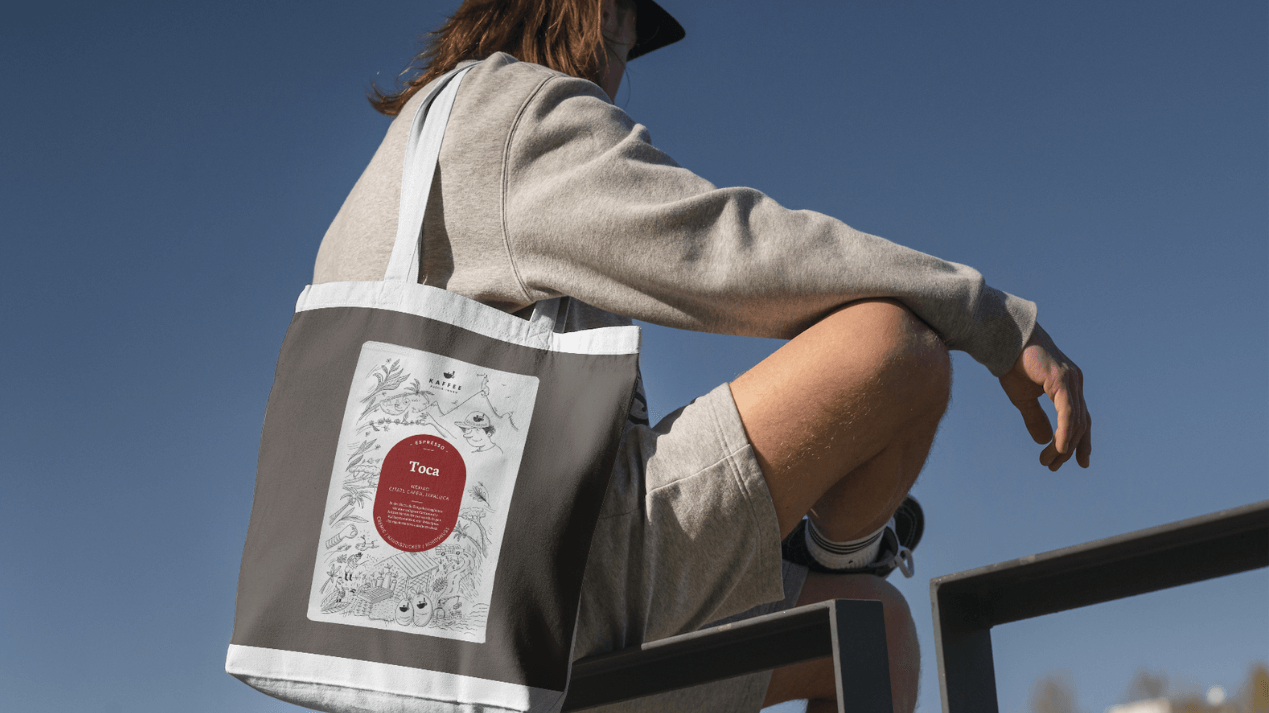

Our Toca coffee is the first coffee from our project to promote regenerative coffee production in Veracruz, Mexico, which we run together with Ensambles as our implementation partner. In recent months, much has changed on the ground: producers have left the newly founded cooperative, there has been a restart, new buyers have emerged, and we're asking ourselves: are roasteries actually active in development cooperation?
What is the Toca Project?

At the end of the last online update with the project team from Ensambles in Mexico, Miguel, who coordinated the Toca project, said:
Caminante, no hay camino, se hace camino al andar. Roughly translated from the original attributed to Franz Kafka: Paths are created by walking them.
These were the closing words that would echo with me for a long time. They summed up the recent months in which the local project team of Lorena, Miguel, and Gibran had to repeatedly find new paths, solutions, and new producers. The cooperative founded in 2022 has partially dissolved, new producers have joined, and old wounds have been reopened.
What Happened?
In the summer of 2019, we held our first workshop with Ensambles and discussed our shared goal of developing a model approach to support coffee producers in their transition from conventional methods to regenerative practices.
In fall 2021, the project kicked off in Ixpaluca, a small community south of Córdoba, Veracruz. Lorena, who works in the field every day for Ensambles and the project, began visiting producers, advising them, and providing training as needed. She explained the project and quickly earned their trust.

The valley around Ixpaluca is fertile and characterized by coffee and corn production.
20 producers were interested in participating in this new approach. They brought their samples, and Lorena and the local team provided feedback and recommendations. Expectations were high on both sides.
Ensambles helped the interested producers establish a cooperative. After some initial difficulties and deliberation over who should lead the cooperative, the newly created Citlal Cafen cooperative was founded and became the seller of the coffee.
In the summer of 2022, the first 40 sacks of green coffee arrived in Europe. Ensambles sent us the coffee and we conducted our first tests. Since late summer last year, Toca has been available from us and is the standard espresso in our Café Frühling.
In October, we visited Ixpaluca. The nervousness in the village was palpable, as our visit had been announced long in advance, and it meant much more than just getting to know each other. As a coffee roastery, we have committed to supporting a newly created cooperative on its path toward regenerative agriculture and organic certification, and to accompany them on that journey. Ensambles is our implementation partner on the ground and exports the coffee.

From left to right: Philipp, Patrizio (Balloon Coffee Roasters), Lorena, Gibran, Michel
During the ceremony, I was asked to present the project again and speak to the village community about our work. I'm used to such situations, but I felt more tension in the air than usual.
Expectations were high because new buyers kept appearing in the Ixpaluca area, making big promises and offering hope of direct market access and better prices for the coffee sold. Most of them failed to follow through on their words or disappeared after a year. Under these circumstances, our visit was more than just getting to know each other—it was also a way to gauge whether we were serious.
Year Two Begins
At the meeting itself, some producers asked me how much we would pay for the coffee. Prices are a sensitive topic, and it would be uncomfortable for everyone involved to set a price in such a situation. Besides, Ensambles, as our partner on the ground, purchases the coffee, adds project costs, and sells it to us. So price negotiations happen between Ensambles and the cooperative.
The price paid by Ensambles was 20% above the local market in the first year. In the second year, Ensambles even offered 36% more than the local market, which resulted in the same kilogram price as the previous year: 5.72 USD/kg green coffee paid directly to the producers.
The cooperative itself did its own accounting during this time. Some representatives felt Ensambles' price was too low and looked for alternative buyers. Just then, a new buyer appeared in the region, offering a significantly higher price. Nearly ten of the twenty producers left the newly founded cooperative and wanted to work with the new buyer—a decision that would turn out to be a mistake.

On the farm of Don Adrian, who has always prioritized high soil quality.
When the season began, only seven of the original 20 producers were still participating in the Toca project. Lorena continued to visit the producers every day, held workshops, and remains our link to the community.
Lorena and Miguel visited further communities around Ixpaluca with Don Roque and Yazmani, two dedicated producers of the Toca project. They managed to find producers in nine additional communities and hamlets who identified with the project and were willing to adjust their production methods.
In total, they collected 100 sacks of 69kg each of Toca coffee. The producers were trained by the local team on how to wash, depulp, and ferment the coffee in small batches on their own farms to achieve the desired quality.
Lorena describes as a celebratory moment the day when all old and new producers of the Toca project brought their coffee together to the dry mill in Zongolica, the small town where the laboratory is located.

Lorena during one of her workshops with producers in the region around Ixpaluca.
Old Wounds, New Suffering
During our October visit, we heard stories of how often producers in this region have been cheated.
Distrust became self-protection, and high demands became the basis for negotiation.
After the official meeting, we were taken to the village gym to discuss a price again. We sat in the hot seat, flanked by Miguel, who moderated the discussion with aplomb. It wasn't the right time to set prices. Every price was the wrong price at that moment.
Some producers left the meeting and remarked that it might be worth waiting and giving the new buyers a chance. Others were torn, as other cooperative representatives wanted to reach an agreement.
The meeting ended with a declaration of intent that we as buyers, Ensambles as advisor on the ground, and the cooperative itself, had to agree on a price that hurt everyone a little, but was actually good.

Miguel, who directs Ensambles' projects across Mexico.
In early 2023, Lorena received word that more than half of the cooperative had decided to go with the new buyer in the region. They would withdraw from the Toca project and leave the cooperative. Hope now rested with the new buyer, who could offer a higher price than we could.
In June 2023, I received word that the buyer had decided not to purchase the coffee after all, and the thirteen former cooperative members had to sell their coffee on the local market.
This news saddened me. The tragic fate of buyers not keeping their promises now befell some producers again, driving them further toward hardship and distrust.
Our Role as a Coffee Roastery. Are We "Development Workers?"
As a coffee roastery, we are the link between diverse smallholder agriculture in the Southern Hemisphere and an equally diverse customer base in the DACH region. More on this balancing act in the next chapter. The work of green coffee sourcing goes into a depth where we can bring about change if we engage intensively with the people and places where the coffee comes from.
To initiate change with the Toca project, it comes down to these concrete points:
- Providing access to markets with differentials = higher prices
- Assisting producers in adapting coffee production to climate change
- Paying for green coffee immediately when producers bring it
- In the future, part of it should be pre-financed
- Working toward independent fertilizer production as much as possible to become independent of the global nitrogen price, which drives fertilizer prices up
How deeply are we thus involved in "development cooperation"?
This project goes far beyond mere green coffee purchasing. We enter into commitments and expose ourselves in the process.
The region around Ixpaluca is what Mexican government authorities classify as a "rural development region." Most people produce corn, some grain, perhaps coffee, keep livestock, and live from subsistence farming and: subsidies.
Support payments are also a popular tool in Mexico to bring about positive change with relatively little effort. However, the effects are not showing as hoped; the region remains impoverished. In Ixpaluca itself, there is no pharmacy, and it takes several hours to reach the nearest doctor.
As coffee buyers, we often find ourselves in these situations where we visit impoverished areas, spend hours or a few days there, and then leave.
We come for the coffee and leave with memories and images in our heads showing daily life. One that is different from ours and one that we try to understand.

The farms in the Sierra de Zongolica are small, and most producers cannot live from coffee production alone.
Once we become active as buyers in this region, we are inevitably connected to the people. To bring about positive and progressive change, the coffee price serves primarily—it should be attractive enough that we can partly provide a financial base with it, so that producers can freely decide where and how they grow and invest.
In other cases, such as on our own farm in Nicaragua, we're building a kitchen and a house for the family living on the farm. As owners of the farm in Nicaragua, we see it as our responsibility to ensure decent housing and living conditions on the farm. In the case of the Toca project, we are neither owners nor direct buyers, but rather end buyers offering a project as an invitation to pursue a different agricultural approach and the associated certification, which should open up additional new markets for the producers.
As buyers who don't live on site, it's not our role to intervene in local decisions and processes. But we may extend invitations for alternative paths, which can be accepted or rejected.
What matters most in advancing such a project is consistency and proximity. Consistency in that Ensambles is present on the ground as the implementation partner. Consistency in that we buy coffee every year, with the idea of increasing this volume. And proximity, which is provided by Lorena as a resident of the village.
The Coffee Balancing Act
Coffee roasteries inherently perform a great balancing act. On one side, they are involved in smallholder agriculture in the Southern Hemisphere. On the other side, they stand in a direct, increasingly differentiated end-consumer market, where short attention spans seem to increase pressure for ever catchier promises.
On one hand, we work to an annual rhythm when we plan from harvest to harvest. On the other hand, we work to an hourly rhythm when we upload Instagram stories and engage in direct dialogue with consumers. This contrast is enormous and affects coffee as a product like hardly any other commodity.

Smallholder agriculture realities from the Southern Hemisphere meet daily trends in the end-consumer market.
Roasteries that are aware of this situation and want to become active in their own supply chain quickly find themselves in a similar situation to ours in the Sierra de Zongolica. We see conditions as they are.
But we also see that it's not our responsibility to try to solve structural problems. However, we understand that with coffee purchasing we conduct a kind of extraction economy: Ixpaluca produces, we buy. Awareness of this interplay doesn't free us from responsibility, but it doesn't make us liable if we do nothing either.
But opportunities do present themselves that a coffee roastery can use here: it can connect with a place and its people.
It can build relationships, be a reliable partner, an interpreter for a market that is far away. It can open the window to a market and carry a brand outward, bringing other potential buyers along—which we did this year with our colleagues from Black Hen and Kaffeewerkstatt Kucha.
If we now make supply chains more human and meet each other as people in this chain—what speaks against adding flanking measures to the mere extraction of coffee beans that could make life a little better?
As long as interpretive authority and decision-making power are symmetrical, there is nothing standing in the way of a joint approach to improving the status quo.
And so we are in active exchange with our partners in Mexico. The updates delight us, they are sometimes concerning, then exuberantly joyful, then pragmatic and promising again. Working from Central Europe with coffee producers is a long-distance relationship. It requires time, consistency, and much trust, which only develops when we both do our part and engage in honest exchange. And that's what gives us the energy for this work.
Vámonos!
Overview of Status Quo and Next Steps

About the coffee: