



























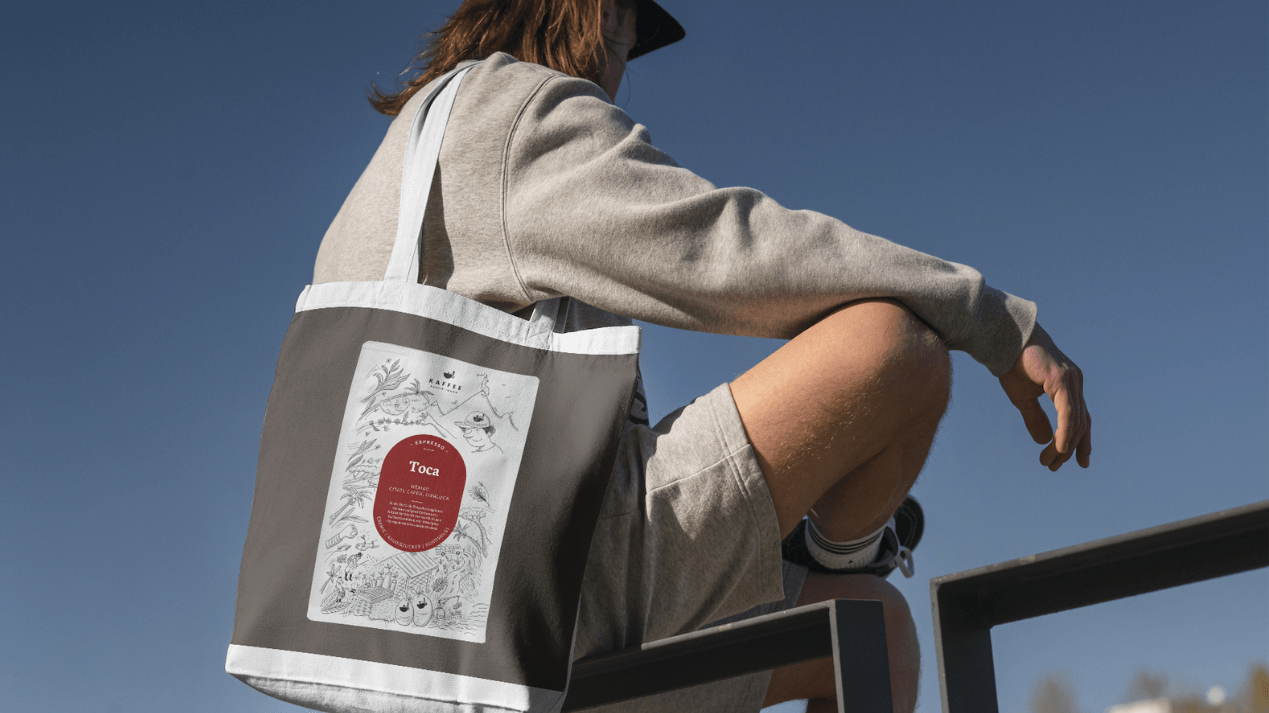

Our Toca coffee is the first coffee from our project to promote regenerative coffee production in Veracruz, Mexico, which we run together with Ensambles as our implementation partner. Over the past few months, much has changed on the ground: producers have left the newly founded cooperative, there was a fresh start, new buyers appeared, and we're asking ourselves: are roasteries actually active in development cooperation?
What is the Toca Project?

At the end of the last online update with Ensambles' project group in Mexico, Miguel, who coordinates the Toca Project, said:
Caminante, no hay camino, se hace camino al andar. Loosely based on the original attributed to Franz Kafka: Paths are created by walking them.
These were the closing words that would echo with me for a long time. They summed up the past months in which the local project team, led by Lorena, Miguel, and Gibran, had to repeatedly find new paths, solutions, and new producers. The cooperative founded in 2022 partially dissolved, new producers joined, and old wounds were reopened.
What happened?
In the summer of 2019, we held our first workshop with Ensambles and discussed our shared goal of developing a model approach to support coffee producers in their transition from conventional methods to regenerative practices.
In the fall of 2021, the project launched in Ixpaluca, a small community south of Córdoba, Veracruz. Lorena, who works in the field every day for Ensambles and the project, began visiting producers, advising them, and providing training when needed. She explained the project and quickly gained trust.

The valley around Ixpaluca is fertile and characterized by coffee and corn production.
20 producers were interested in taking part in this new approach. They brought their samples, Lorena and the local team provided feedback and recommendations, and expectations were high on both sides.
Ensambles helped the interested producers establish a cooperative. After some initial difficulties and discussions about who should lead the cooperative, the newly created cooperative Citlal Cafen was founded and became the seller of the coffee.
In the summer of 2022, the first 40 bags of green coffee arrived in Europe. Ensambles sent the coffee to us and we conducted our first tests. Since last late summer, the Toca has been available from us and is the standard espresso in our Café Frühling.
Then in October, we visited Ixpaluca. The nervousness was high in the village, as our visit had been announced well in advance and it was about much more than just getting to know each other. As a coffee roastery, we committed to supporting and accompanying a newly established cooperative on its path to regenerative agriculture and certification for the organic label. Ensambles is our implementation partner on the ground and exports the coffee.

from l. to r.: Philipp, Patrizio (Balloon Coffee Roasters), Lorena, Gibran, Michel
During the ceremony, I was asked to present the project again and speak to the village community about our work. I'm used to such situations, and yet I felt more tension in the air than usual.
Expectations were high because new buyers kept appearing in the area around Ixpaluca, making big promises and offering hope for direct market access and better prices for the coffee sold. Most of them failed to follow through on their words or disappeared after a year. Under these circumstances, our visit was more than just getting to know each other; it was also a chance to see if we meant business.
Year two begins
At the meeting itself, some producers asked me how much we would pay for the coffee. Prices are a sensitive topic and it would have been uncomfortable for everyone involved to set a price in such a situation. Moreover, Ensambles, as our partner on the ground, buys the coffee, adds project costs, and sells it to us. So price negotiations run between Ensambles and the cooperative.
The price paid by Ensambles was 20% above the local market in the first year. In the second year, Ensambles even offered 36% more than the local market, which resulted in the same kilogram price as the previous year: 5.72 USD/kg green coffee directly to producers.
The cooperative itself made its own calculations during this time. Some representatives felt Ensambles' price was too low and looked for alternative buyers. Just then, a new buyer appeared in the region offering a significantly higher price. Nearly ten of the twenty producers left the newly founded cooperative and wanted to work with the new buyer—which turned out to be a poor decision.

On Don Adrian's farm, where he has always focused on high soil quality.
When the season began, only seven of the original 20 producers were still part of the Toca Project. Lorena, as before, was with the producers every day, holding workshops and serving as our link to the community.
Lorena and Miguel visited further communities around Ixpaluca with Don Roque and Yazmani, two dedicated producers of the Toca Project. They managed to find producers in nine additional communities and hamlets who could identify with the project and were willing to adjust their production methods.
In total, they gathered 100 bags of 69kg each of Toca coffee. The producers were trained by the local team on how to wash, pulp, and ferment the coffee in small batches on their own farms to achieve the desired quality.
Lorena describes as a celebratory moment the day when all the old and new producers of the Toca Project brought their coffee together to the dry mill in Zongolica, the small town where the lab is located.

Lorena at one of her workshops with producers in the region around Ixpaluca.
Old wounds, new suffering
During our October visit, we were told how often producers in this region have been shortchanged.
Mistrust became self-protection and high demands became the basis for negotiation.
After the official meeting, we were led to the village gym to discuss a price again. We sat in the hot seat, flanked by Miguel, who moderated the discussion skillfully. It was not the right time to set prices. Every price was the wrong price at that moment.
Some producers left the meeting and mentioned that it might be worth waiting and giving the new buyers a chance. Others were torn, as other cooperative representatives wanted to reach a conclusion.
The meeting ended with a declaration of intent that we as buyers, Ensambles as the advisor on the ground, and the cooperative itself would have to agree on a price that hurts everyone a bit, but is actually good.

Miguel, who leads Ensambles' projects throughout Mexico.
In early 2023, Lorena received word that more than half the cooperative had decided to go with the new buyer. That they would leave the Toca Project and abandon the cooperative. Hope was now pinned on the new buyer, who could offer a higher price than we could.
In June 2023, I received word that the buyer didn't actually purchase the coffee and the thirteen former cooperative members had to sell their coffee on the local market.
This news saddened me. The miserable fate that buyers failed to keep their promises and that this now prompted some producers to adopt greater hardship and mistrust had befallen them again.
Our role as a coffee roastery. Are we "development aid workers?"
As a coffee roastery, we are the link between diverse smallholder agriculture in the southern hemisphere and an equally diverse customer base in the DACH region. More on this balancing act in the next chapter. The work of green coffee procurement goes into a depth where we can bring about change if we engage intensively with the people and the place where the coffee comes from.
To initiate change with the Toca Project, we focus on these specific points:
- Providing access to markets with differentials = higher prices
- Assisting producers in adapting coffee production to climate change
- Paying for green coffee immediately when producers bring it in
- Planning to pre-finance part of it in the future
- Working toward autonomous fertilizer production as much as possible to become independent of global nitrogen prices, which drive up fertilizer costs
How much are we thus involved in "development cooperation?"
This project goes far beyond the mere purchase of green coffee. We make commitments and expose ourselves in the process.
The region around Ixpaluca is what Mexican authorities call a "rural development region." Most people produce corn, some grain, perhaps coffee, raise animals, and live off subsistence farming and subsidies.
Support payments are also popular tools in Mexico to bring about positive change with relatively little effort. However, the effects are not as desired, the region remains poor. In Ixpaluca itself, there is no pharmacy, and it takes several hours to reach the nearest doctor.
As coffee buyers, we often find ourselves in these situations where we visit poor areas, spend hours or a few days there, and then leave.
We come for the coffee and leave with memories and images in our heads that show daily life. One that is different from ours and one that we try to understand.

The farms in the Sierra de Zongolica are small and most producers cannot live off coffee production alone.
Once we become active as buyers in this region, we are inevitably connected to the people. To bring about positive and progressive change, the coffee price serves primarily—it should be attractive enough that we can partially provide a financial foundation with it, so that producers can freely decide where and how to grow and invest.
In other cases, such as in Nicaragua on our own farm, we build a kitchen and a house for the family living on the farm. As the owner of the farm in Nicaragua, we see it as our responsibility to ensure respectable living and life on the farm. In the case of the Toca Project, we are neither owner nor direct buyer, but end buyers who offer a project as an invitation to pursue a different agricultural approach and the associated certification, which should open up new markets for producers.
As buyers who do not live on site, it is not our role to interfere in local decisions and processes. But we may extend invitations for alternative paths that can be accepted and also rejected.
What is most important in moving such a project forward is consistency and proximity. The consistency that Ensambles is present on the ground as an implementation partner. The consistency that we buy coffee every year with the idea of increasing this volume. And the proximity that is provided by Lorena as a village resident.
The coffee balancing act
Coffee roasteries inherently perform a great balancing act. With one leg, they are involved in smallholder agriculture in the southern hemisphere. With the other, they stand in the direct, increasingly differentiated end-consumer market, where short attention spans seem to increase the pressure for ever punchier promises.
On one hand, we work in annual rhythms when we plan from harvest to harvest. On the other hand, we work in hourly rhythms when we upload Instagram stories and are in direct dialogue with consumers. This contrast is enormous and affects coffee as a product like few others.

Smallholder agricultural realities from the southern hemisphere meet daily trends in the end-consumer market.
Roasteries that are aware of this situation and want to actively work on their own supply chain quickly find themselves in a situation similar to the one we're in in the Sierra de Zongolica. We see the conditions as they are.
But we also see that it is not our responsibility to solve structural problems. However, we understand that with coffee purchasing, we conduct a form of extractive economy: Ixpaluca produces, we buy. Knowledge of this situation does not free us from responsibility, nor does it make us liable if we do nothing.
But there are opportunities that a coffee roastery can seize here: it can connect with a place and its people.
It can build relationships, be a reliable partner, an interpreter for a distant market. It can open the window to a market and carry a brand outward, bringing other potential buyers along—which we did this year with colleagues from Black Hen and the Kaffeewerkstatt Kucha.
So if we make supply chains more human and meet each other as people in this chain—what speaks against not adding flanking measures to the pure extraction of coffee beans that could make life a little better?
As long as interpretive authority and decision-making power are symmetrical, there is nothing preventing a joint approach to improving the status quo.
And so we are in active exchange with our partners in Mexico. The updates please us, they are sometimes concerning, then they are exuberantly joyful, then pragmatic and again promising. Working from Central Europe with coffee producers is a long-distance relationship. It requires time, consistency, and much trust, which only arises when we both do our part and are in honest exchange. And that is what gives us energy in our work.
Vámonos!
Overview of the status quo and next steps

About the coffee:


