
Reading time: 4 minutes. This article is a short blog. You can access the detailed blog article here on our Swiss site.
Since your coffee drink consists of over 90% water and less than 2% dissolved coffee particles, it's worth taking a closer look at the water. Even if it tastes good as drinking water in a glass, there are some criteria that make your tap water a good start for your coffee drink.
What makes good coffee water?
Basically, coffee water should be soft, usually softer than what comes out of your tap. There are two measurements:
- Total hardness = Magnesium Mg+2 and Calcium Ca2+
- Alkalinity = Bicarbonate = HCO3-
For filter coffee, the best values are:
- Total hardness: 2 – 3 °dH
- Alkalinity: 1 – 2 °dH
For espresso, the best values are:
- Total hardness: 3 – 6 °dH
- Alkalinity: 2 – 4 °dH
Alkalinity is often also referred to as carbonate hardness, which is not strictly correct, but the term carbonate hardness has become established.
That already sounds very complicated. We explain here how to achieve such good values, as you will very likely not get such soft water from your tap.
How good is my water at home?
There are several ways to measure water hardness. A conductivity meter, a ppm meter, and a drop test (the easiest method). In the latter case, 10ml of your water is poured into a tube and a few drops of test liquid are added. You count the drops and once there is a color change, you know the water hardness. You also have the option of contacting your local water provider or checking their website.
How and what does the table water filter remove?
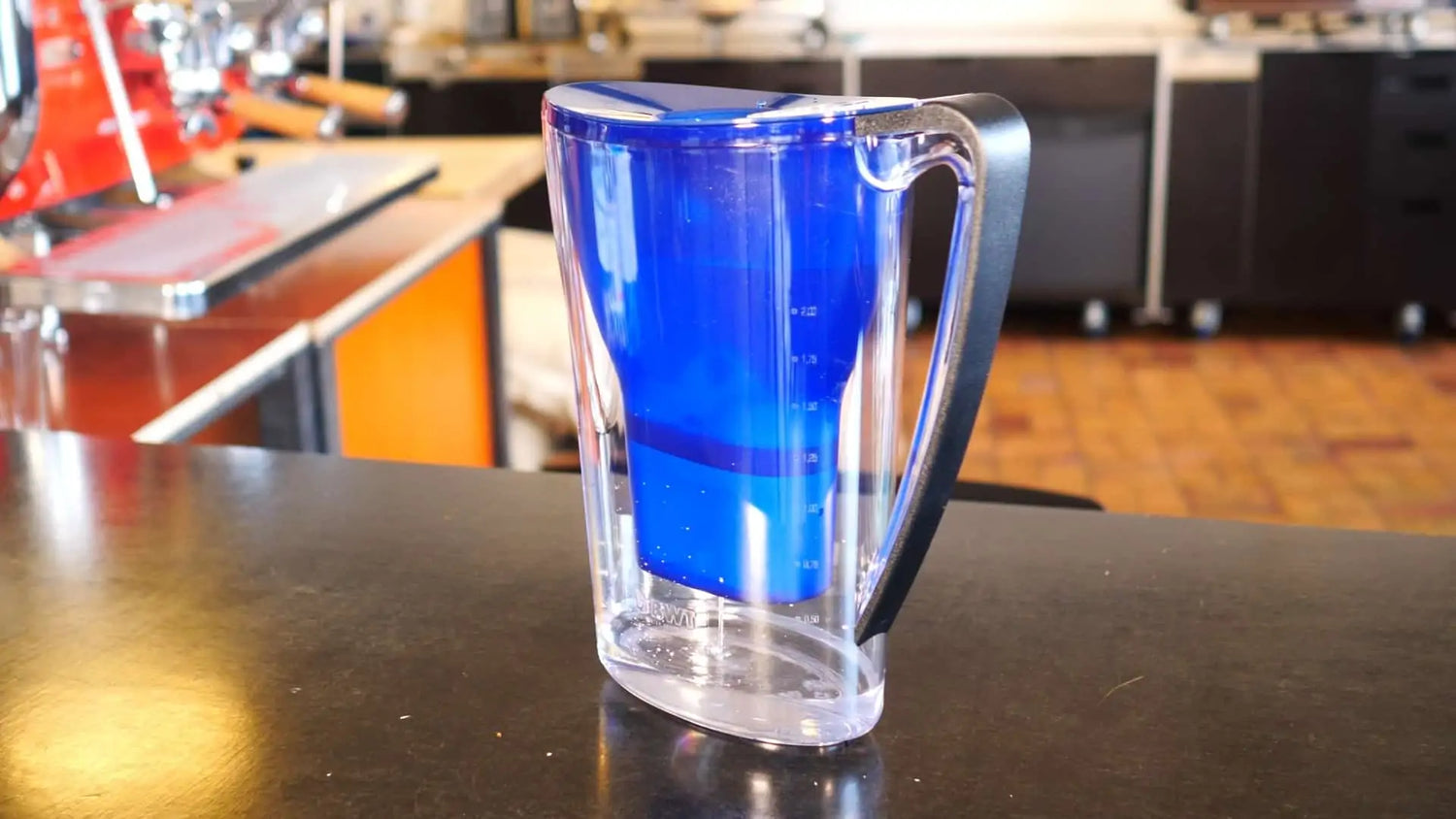
Table filter units are inexpensive and widely used. Water is poured in and 50% of the water is decarbonized at most. The other 50% simply flows through the activated carbon filter of the unit.
A quick calculation: From the tap we have drinking water with 16°dH total hardness and 12° dH alkalinity. After one pass through the water filter, the alkalinity halves to 6° dH, but the total hardness only reduces to 10° dH. Since this is still far from perfect coffee water, we need a second pass.
After the second pass, the alkalinity is at 3°dH and the total hardness is at 7°dH. That's already good, but we only reach the perfect range with the third filtration (1.5° dH alkalinity and 5.5° dH total hardness).
In some cases, table filter units require 3 or more passes. Quite laborious!
The water filter with permanent water connection
A luxury is a water filter with a permanent water connection, that is, a permanently installed undersink filter. It has higher and more consistent filter performance and filters the water directly to the desired value. Decarbonization occurs through ion exchange, which in turn changes the pH value of the water.
But is this luxury necessary? If you have hard water and make a lot of coffee, purchasing one is worthwhile. 90% of machine defects are due to hard water. Considering the expensive purchase price of a good espresso machine that you certainly want to use for a long time, you should consider such a filter system. Usually, buying an undersink filter is cheaper than having your portafilter machine serviced once. In many cases, installation is simple, but can also be performed by professionals.
Another advantage is the reduced lime content of the water, which you will also notice immediately in your kitchen, as white deposits will hardly be found anymore.
Desalination systems are not an alternative!
In some homes, the drinking water system is connected to a desalination system. This softens the water through ion exchange (calcium and magnesium are replaced by sodium), but alkalinity remains. This imbalance leads to coffee tasting bland and boring during coffee preparation, since the interplay of balanced acids and bitter notes doesn't work. The only way out here is to go into the garden, since the water hoses are usually not connected to the desalination system.
Concrete approach to achieving your ideal coffee water
We're happy to help you achieve the right water hardness at your home. Here's how to proceed.
- You measure your current water hardness with a drop test or ask your water provider.
- You estimate the amount of water you need per day.
- You send the total hardness and alkalinity (carbonate hardness) together with the water amount and your type of coffee drink to support@kaffeemacher.de
- We will get back to you as quickly as possible with a concrete recommendation on how to achieve your target values.