



























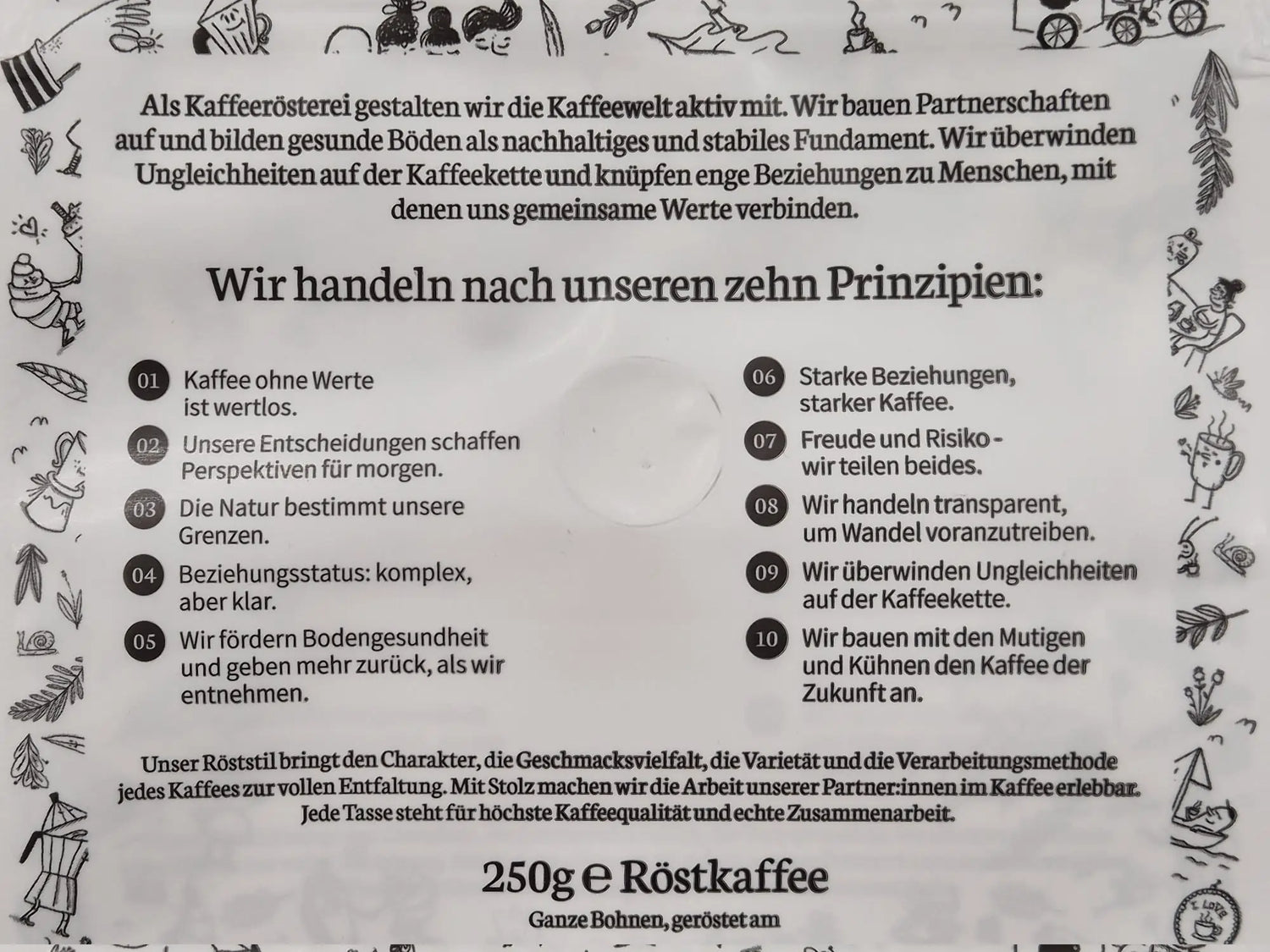

On our new coffee packages you'll find ten striking statements that sum up our work as a coffee roastery. We exchange ideas daily with our production partners, who may be far away but are essential to making sure we can all drink coffee. We learn from them what it takes today so we can still drink coffee tomorrow.
Sometimes clear messages are needed. On our new coffee packages we've placed ten of them prominently.

The back of the new coffee package.
1. Coffee without values is worthless.
If we understand coffee production and consumption only as a mechanical action, we fail to give coffee the value that is inherent to it. Countless hands have picked it, processed it, exported it, roasted it, packaged it and made it available. Coffee is a product made by people. When we value the product, we can also appreciate the work of the people behind it.
 Producers sort coffee cherries by ripeness, Apixtepec, Mexico
2. Our decisions create perspectives for tomorrow.
Coffee is a long-term project – the plant grows slowly and change takes time. Awareness of coffee is developing, but yes: it takes time. And because we work with people, change sometimes needs time. That's why it's so important that we shape the future today and understand our decisions as an investment in a tomorrow. Together with producers, we create new perspectives.

Joél turns the coffee in the parchment so the coffee can dry evenly. Apixptepec, Mexico
3. Nature sets our limits.
Long-term coffee production is only conceivable in connection with high biodiversity, plenty of shade and intact ecosystems. Coffee cannot be produced in isolation, but rather is guided by the limits that nature sets. There are varieties that grow well in Brazil but not at all in Nicaragua. Certain processing methods work consistently in one place – but not in others. Understanding our surroundings and accepting that nature determines what is possible and what is not gives us direction: what we can influence – and what we should leave alone.

Our partner farm El Arbol from above. The coffee trees integrate into an existing forest.
4. Relationship status: complex, but clear.
We maintain several long-distance relationships with our production partners. We always try to clarify mutual expectations early on and think ahead. The collaboration is always context-dependent and sometimes differs greatly from other relationships. Like any relationship, a partnership is complex and varies from point to point, but clear in its communication.

Don Roque is a founding member of the Citlal Kaffen cooperative in Mexico.
5. We promote soil health and give back more than we take.
Soil is a complex system – with many components, but above all: full of life. Microorganisms, minerals and organic matter ensure that plants develop well and stay healthy. Coffee plants get their energy from the soil, which in turn must be nourished. Excessive use of fertilizers and pesticides shifts focus away from the soil, even though it is precisely the soil that secures long-term production. We focus on soil in our partnerships and work to give it back more than we take from it.

Célia Bühler from HAFL wrote her MA thesis on compost production in Nicaragua
6. Strong relationships, strong coffee.
We all love coffee. The taste, the feeling when drinking it, the effect. We love coffee so much that we go to its source and build relationships with the people who grow it. When we manage to make these relationships strong, lasting, overcome crises and constantly renew themselves – then we're not just drinking coffee that is strong in flavor, but carrying a strong story within it. And that makes the coffee taste even better.

We've always connected all points along the coffee chain. Here: our Coffee Farm Training in Nicaragua
7. Joy and risk – we share both.
Someone once said that coffee production is quite simple – it consists of only 100 lessons, and each year you learn one. Each year there is reason for joy, and each year new challenges. Sometimes it rains too much, then not at all. Then no ships sail or prices explode. Harvest workers are missing, credit is too expensive. But then a partner wins the Cup of Excellence, a natural lot knocks our socks off, or the sorting was never as good as this year. We listen and go into responsibility together with our partners – because that's part of a relationship.

Marcia is a pioneer of organic coffee farming in Brazil. She is part of the Apas cooperative
8. We act transparently to drive change.
Coffee has a long history – and sometimes it's dark (Coffee & Colonialism). Today much is better along the coffee chain, but there remains a large knowledge gap and power asymmetry. Producers often have only fragmented knowledge about the coffee market, while buyers have access to a wealth of information. We believe: transparency is the first step to change.

Mauricio (left) is the manager of the Apas cooperative. Here he discusses pricing with Philipp
9. We overcome inequalities along the coffee chain.
This knowledge gap often shows itself in financial starting positions. We work to close it – and invest locally in coffee-producing countries to drive change and work on equal terms with our partners.

Miguel (white shirt) in conversation with Don Roque and Doña Alma from the Citlal Kaffen cooperative
10. We build the coffee of the future with the bold and the daring.
The coffee world is sometimes slow-moving. Change takes time – or is seen as a risk. Roasteries need security, as do producers. If both play it safe, much stays the same. We seek partnerships with the bold and the daring – with those who have their own minds, question habits and want to co-write the future today.

Yazmani is the manager of the Citlal Kaffen cooperative. He leads with great dynamism and vision

