



























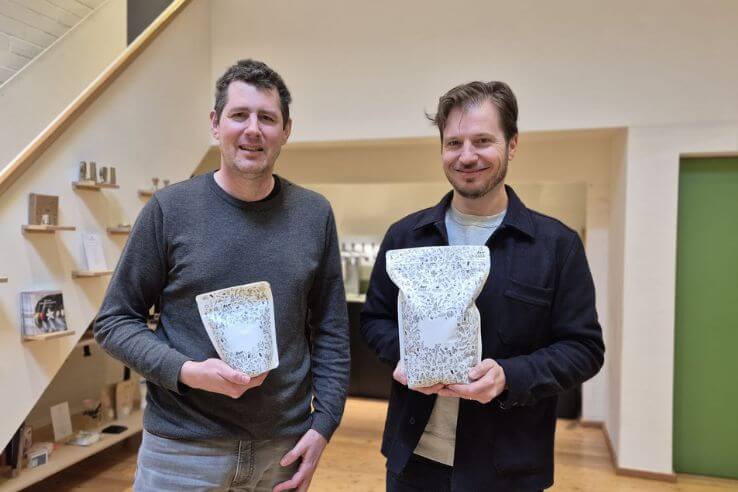

We have a new coffee packaging. We did extensive research for it and developed the bag ourselves. Our current solution keeps the coffee fresh for even longer and produces fewer emissions. Packaging is a continuous optimization process, which is why we keep improving here too. What we've learned, which packaging is sustainable, and what you should pay attention to when buying coffee, we describe here.
In an ideal world, we wouldn't need packaging. In our coffee universe, however, we ship more coffee than we physically sell in our two cafés in Basel. For our purposes, packaging is a must to be able to ship the coffee at all, to maintain quality and to guarantee food safety.
At the same time, packaging serves as a carrier of information: a brand design burns into memory and through labels we can describe our coffees, tell their stories, and create desire for enjoyment.

Our "New" - 250g and 1000g made from mono-material: 60% renewable raw materials via mass balance, 30% recycled plastic via mass balance, and 10% virgin plastic.

When we look at packaging in the coffee world today, we see very different ideas in the specialty coffee industry about what coffee packaging can and should do.
We see pragmatic approaches to packaging that simply do what they're supposed to do - make coffee transportable. We see approaches focused more on pure design: especially when a lot of material is used. And then we see increasingly more ideas about how packaging can be made at least recyclable, but even better circular.
In the best of all worlds, there would be packaging that addresses all the criteria mentioned:
airtight, pleasant to hold, circular, and stylish.
With this idea, we started a long learning journey. It's not finished yet, but we've been able to develop a clear picture and clear stance on what properties good coffee packaging must have, and what doesn't make sense for us.
We focus on continuous improvement in everything we do. With packaging too, sustainability is our priority.
How high are the environmental emissions of coffee packaging?
In the overall calculation of our emissions from 1kg roasted coffee until the moment a coffee bag leaves our roastery, the packaging itself only accounts for about three percent of total emissions.
In our case: packaging accounts for "only" 3% of coffee emissions
In the first chart, we look at the emissions we produce at our Basel roastery. In 2023, all packaging used accounted for 16.7% of all roastery emissions.

Emissions from Kaffeemacher roastery in Basel, 2023

The figures refer to harvest 22/23 at Santa Rita, Nicaragua.
We know exactly where we have the biggest opportunities to reduce emissions in a coffee chain: in cultivation, not in coffee packaging. But: where we are, we can drive rapid change with what we know. And that's why we must continually improve packaging too.
An aspect we don't want to overlook when developing sustainable packaging is the look and feel. The emotions we experience when we see, hold, and feel a certain package influence our purchasing decisions.
And that's sometimes rather absurd:
- Paper-like packaging can suggest to us that roasted coffee is sustainable, even though there's no connection. The coffee could have been produced in a completely unsustainable way.
- The opposite is also possible: highly sustainably produced coffees are sold in aluminum packaging, which is by far the most environmentally harmful (see chart below).
So we looked for packaging whose appearance matches its contents. Sustainable coffee must go in sustainable packaging.

Aluminum performs worst in terms of emissions, but has the best freshness retention capacity. Design: Tobias Milz, Dataset from ecoinvent
New packaging - a process, not a state
In November 2022, we wrote a blog about our new packaging saying it was now more sustainable. Back then, we switched from the widely used paper-plastic composite to mono-plastic, with the idea that mono-plastic bags could be recycled and we'd have a better carbon footprint.

Our packaging upgrade from November 2022
Around the same time, we came across an article from DIW and disappointment set in. Thermal recycling of plastics produces about 2.7 kg CO2e, which roughly doubles emissions when viewed over the entire lifetime. Tobi put it bluntly then:
"Well, that was a real mistake."
And why exactly?
Because we used a lot of new material, so-called virgin material, based on fossil raw materials. The old and new packaging weighed the same, just under 13 grams. But the new packaging, though recyclable because it was mono-plastic, used twice as much virgin material as the old packaging.
Learning 1:
The amount of material used is crucial to whether emissions are low. We're seeing more and more recyclable coffee packaging. That's actually progress - designing packaging so it can theoretically be recycled for another purpose. But: if only a small percentage worldwide (9%) gets recycled and the rest is burned or ends up in the environment, is the idea really achieving its goal?
Anecdote:
We had lunch with an innovation manager from an energy company.
"Don't make more plastic"
was his input. His company burns household waste to produce district heating, steam, and electricity. However, today's household waste is "too clean" because people separate their plastic and packaging waste.
Household waste now has too little combustible mass, so plastic and packaging waste has to be added back for burning to work at all. Alternatively, the waste pile is sprayed with an oil derivative instead of plastic waste.
"But not recycling isn't a solution either"
we heard from various quarters who otherwise vehemently disagreed. So there's something like a consensus in science and industry that recycling must happen, but the whole system is still far too underdeveloped, and plastic consumption keeps rising.
Learning 2:
Recycling is not yet a functioning system. And yet we must do it. Legal requirements are becoming stricter, recycling is becoming more widespread, and pressure for change is growing.
Yet we asked ourselves whether recycling makes sense for us if we consume even more plastic doing it. Or should we work with packaging that doesn't need to be recycled at all?
We went looking and conducted more than three dozen conversations with researchers, developers, manufacturers, recyclers, certifiers, other roasteries, and innovation people. Our project was called internally: "the best of all packaging."
But we learned: the best packaging doesn't exist. It's always a snapshot and must always be reviewed.
We had an early exchange with a startup that can make films from byproducts of tofu production. It all sounded very promising, but scaling from lab to larger quantities takes years. We're confident that in a few years, new materials for films will be in use and available for the broader industry.
Learning 3:
We decide on a form and the bag's properties, but remain flexible about which material we use. Huge progress is happening right now.

Over more than a year and a half, we contacted various material suppliers and had exchanges with them.
So while we searched for revolutionary materials, we also questioned our own requirements and processes.
- Why do all bags have the same shape today?
- What sizes do we have? Do we need them?
- What are the processes for packing, sealing, and shipping?
- Are the existing dimensions right for us?
- What does each department want?
Through a community survey on Instagram, we realized that our coffees are typically consumed within eight weeks. Every coffee package must have a best-by date by law. We provide one too, but at the same time recommend going by the roast date and consuming the coffee within a few weeks and a maximum of two months.
Since we don't exhaust the best-by date, as often happens with large-scale production for supermarkets where coffee can sit on shelves for up to 18 months, we can rethink the retention issue. We have no need for an extremely long shelf life. Our bag barrier should keep coffee top-fresh for about three months; that would be enough. This saves on material used - as much as necessary, as little as possible.
The following additional research questions came up:
How quickly does coffee age in the bag?
To find out, we tested three different coffees from the same date over eight weeks for oxygen content.
How airtight is our current packaging?
When testing oxygen content, it turned out that not all packages were equally airtight, and we sometimes found up to 17% oxygen (of a possible 21%) in the package.
How do other packages on the market perform?
We analyzed coffee packaging from more than a dozen coffee roasteries and over two-thirds had the same problem: the package wasn't airtight.
How does coffee age in "airtight" packaging?
Much more slowly: the coffee showed more character, more aromas, and overall seemed rounder
We learned through observations, tests, and lots of tastings. With learnings from our preliminary tests, we sought conversations with manufacturers. With each conversation we learned more and quickly realized that most manufacturers need to rethink their approach.
Those already working with new materials, however, still have capacity bottlenecks or lack approvals for use with food, which makes scaling difficult.
Data and facts about our new bag
Our new bag is made from a mono-material and therefore recyclable. The old bag was not. In composition, our new bag consists of
- 60% ISCC-certified renewable raw materials via mass balance method: tall oil, which is a byproduct of paper processing
- 30% ISCC-certified post-consumer recycled plastic via mass balance method: recycled plastic
- 10% virgin material, meaning new plastic
Under the mass balance method, we pay for more sustainable materials. These are mathematically present in the bag, physically if at all only marginally. So our packaging could consist of 100% new plastic.
Green electricity and biogas work on the same principle: you pay for alternative materials, which the manufacturer then buys. You purchase materials that are bilanaced as renewable, but from the outlet or tap comes a mixed product.
In the following charts, we therefore work with both a mathematically best-case scenario and a real-case scenario.
Best case scenario:
shows what emissions our bag would theoretically have if the 60/30/10 mix were exactly in the bag. It shows the purely mathematical ideal value.
Real case scenario:
shows what emissions we have in reality if 0% of the more sustainable materials are present in a bag.
The real case scenario still performs better than the old bag because we use roughly four grams less material.
The ecological footprint of our new packaging
New bag, theoretical best case scenario: material, manufacturing, disposal without recycling
If our bag is not recycled, we have total emissions of 92g CO2e per 250g bag.
New bag, theoretical best case scenario: material, manufacturing, disposal with 35% recycling
For plastics (PE and PP) which typically make up coffee packaging, downcycling occurs. The global rate is 9%; in Germany, about 35% becomes usable granulate.
Old bag: material, disposal
Our previous bag, which switches to the new bag progressively in April and May 2025, produces more emissions. We're improving by approximately 25%.
New bag: detailed calculation in best case scenario
Reality check - what really hurts and where there's joy
The longer we dealt with this topic, the more questions emerged. At times we felt like researchers or investigative journalists - but really we were just looking for packaging for our coffee beans.
The packaging issue is complex and too often too intertwined with technological backwardness and lax legal trade regulations.
Minimal improvements were presented to us as "world firsts" and what some titled a "smart approach" we probably would have categorized as common sense. The packaging issue is both emotional and pragmatic.
You can quickly be bothered by bio-cucumbers wrapped in plastic, but you can't transport individual coffee beans. We need to sharpen our perspective on where packaging makes sense and what properties it really needs or doesn't need.
In these learnings, there were a few things that hurt, but also things that gave us confidence.
What hurts
Recyclable only means that it can be recycled. How well this works depends on the material. About 35% of waste collected in yellow bags is converted back to usable raw material.
The rest is burned, exported, or ends up in the environment.
Why is recycled material more expensive than virgin material?
- The processes are not as optimized as those for virgin material.
- Demand determines price. Demand is high and there's not much available.
- If there's too little plastic in the waste, oil or plastic waste is bought for burning
- Material composites cannot be recycled. This means they're burned. Which doubles CO2e emissions.
What raises questions
- Not all packaging materials from yellow bags receive food approval
- Same with (currently) "ocean plastic" → "wild plastic" for other sectors
- Valves aren't made 100% from PP or PE but have a small PET film integrated and therefore aren't 100% recyclable
- Worse than packaging waste is food waste or coffee waste
What gives us confidence
- new materials, young companies approaching the big industry players - things are happening
- EU Directive 94/62/EG on packaging and packaging waste "PPWR" is coming and requires the following points, which are especially relevant for coffee packaging:
- Components of recycling packaging must be separable and recyclable as individual components
- Material reduction: The weight and volume of packaging should be limited to the minimum necessary.
- Crucial for shipping: empty space in packaging filled with materials like air cushions or foam must not exceed 50% of total volume.
Checklist for good packaging:
- How long does my product need to last?
- How little packaging can I use?
- Packaging size versus packaging contents
- How do I inform consumers to dispose of the packaging correctly?
- What do we stand for and how does the packaging go hand in hand with this?
What brings joy: our new packaging partner
Our new partner for coffee packaging is the company O.Kleiner based in Wohlen, Switzerland. We looked for a partner who could cover both development and production. Through various conversations, we worked toward our targets and together developed new coffee packaging.

Andreas Platz from O. Kleiner (left) and Philipp Schallberger, Kaffeemacher GmbH (right)

