









Reading time: 4 minutes. This article is a short blog. You can find the detailed blog post here on our Swiss website.
Since your coffee beverage consists of over 90% water and less than 2% dissolved coffee particles, it's worth taking a closer look at the water. Even though it tastes good as drinking water in a glass, there are some criteria that make your drinking water a good start for your coffee beverage.
What should good coffee water be like?
Basically, coffee water should be soft, usually softer than what comes out of the tap. There are two measurements here:
- Total hardness = Magnesium Mg+2 and Calcium Ca2+
- Alkalinity = Bicarbonate = Bicarbonate = HCO3-
For filter coffee, the best values are:
- Total hardness: 2 – 3 °dH
- Alkalinity: 1 – 2 °dH
For espresso, the best values are:
- Total hardness: 3 – 6 °dH
- Alkalinity: 2 – 4 °dH
Alkalinity is often also referred to as carbonate hardness, which is not strictly correct, but carbonate hardness has become the established term.
This already sounds very complicated. We'll explain how to achieve such good values, since you most likely won't get such soft water from your tap.
How good is my water at home?
There are several ways to measure water hardness. A conductivity meter, a ppm meter, and a drop test (the simplest method). In the latter case, 10ml of your water is poured into a tube and a few drops of test liquid are added. You count the drops and as soon as there is a color change, you know the water hardness. There is also the option to contact your local water supplier or visit their website.
How and what does the table water filter filter?
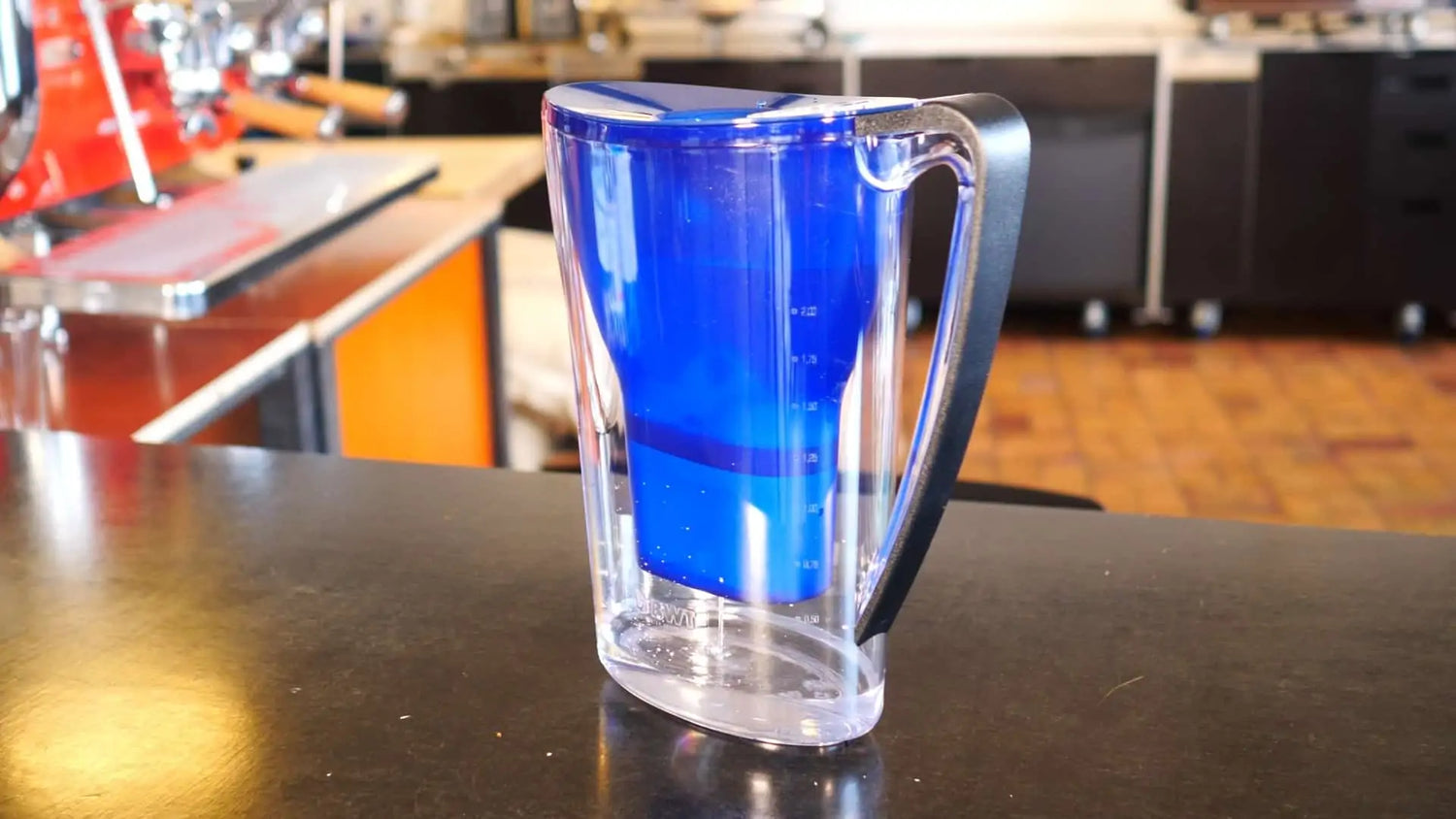
Table filter devices are inexpensive and widely available. Water is poured in and a maximum of 50% of the water is decarbonized. The other 50% simply flows through the activated charcoal filter of the device.
A quick example: From the tap we have drinking water with 16°dH total hardness and 12° dH alkalinity. After one pass through the water filter, the alkalinity is reduced to 6° dH, but the total hardness is reduced to only 10° dH. Since this is still far from perfect coffee water, we need a second pass.
After the second pass, the alkalinity is at 3°dH and the total hardness is at 7°dH. That's already good, but we only reach the perfect range with the third filtration (1.5° dH alkalinity and 5.5° dH total hardness).
In some cases, table filter devices require 3 or even more passes. Quite laborious!
The water filter with fixed water connection
A luxury is a water filter with a fixed water connection, i.e. a permanently installed under-sink filter. It has a higher and more consistent filter performance and filters the water directly to the desired value. Decarbonization occurs through ion exchange, which in turn changes the pH value of the water.
But is this luxury necessary? If you have hard water and prepare a lot of coffee, it's worth buying. 90% of machine defects are due to water that is too hard. Considering the expensive purchase price of a good espresso machine that you'll surely want to use for a long time, you should think about such a filter system. As a rule, it's cheaper to get an under-sink filter than to send your portafilter machine in for maintenance. In many cases, installation is simple, but can also be carried out by professionals.
Another advantage is the reduced limescale content of the water, which you'll also notice immediately in your kitchen, as white deposits will be barely noticeable.
Desalination systems are not an alternative!
In some homes, the drinking water system is connected to a desalination plant. This softens the water through ion exchange (calcium and magnesium are replaced by sodium), but the alkalinity remains. This imbalance in coffee preparation means that the coffee tastes bland and boring, because the interplay of balanced acids and bitter notes doesn't work. One way out here is to go into the garden, as the water hoses are usually not connected to the desalination system.
Concrete procedure for achieving your suitable coffee water
We're happy to help you achieve the right water hardness for you. Here's how to proceed.
- You measure your existing water hardness with a drop test or ask your water supplier.
- You estimate the amount of water you need per day.
- Send the total hardness and alkalinity (carbonate hardness) along with the water quantity and your type of coffee beverage to support@kaffeemacher.de
- We will get back to you as soon as possible with a concrete recommendation on how to achieve your target values.