





















In this article, we look at coffee and the coffee plant from a botanical perspective. How is the plant structured, what do roots, leaves and fruits do? And how do we describe it correctly within botany?
Everyone knows what feeling freshly ground coffee can evoke. Just the thought of it can awaken the desire for coffee. It's no wonder that it helps to always grind coffee fresh, because the aromas dissipate within the shortest time.
We put the ground coffee into a portafilter, a coffee filter or a French press, pour or press hot water over it and enjoy. But what are we actually drinking when we drink coffee?
We drink the dried, roasted, ground and brewed seed of a fruit of the genus Coffea.
In short form we simply call that coffee - but the differences between genus, species and varieties are great; many species we cannot drink at all, and different varieties do not smell and taste like the familiar beverage that we simply call "coffee".
100% Arabica - old school and meaningless
Coffee packages are still labeled "100% Arabica", which firstly does not do justice to the complexity of the product and secondly offers no added value in terms of information. Moreover, the distinction by species alone is no longer contemporary. The coffee plant is subject to climate change just like other organisms, and so we should expand our vocabulary to understand and describe the coffee of the future.
So that we can still drink coffee in the future, despite rising temperatures and unpredictable weather patterns, we need even more research on the further development of the coffee plant - and that includes a deeper engagement with the most diverse varieties and species.
Researchers have been intensively engaged for years in bringing new crossings from the laboratory into the field and scaling them. The reduced distinction between Arabica and non-Arabica (e.g. Robusta) falls far short of this.
However, botanical taxonomy, i.e. the classification of the coffee plant into categories, is not self-explanatory. These are reasons enough to take apart this important foundational topic.
Coffee Botany
At a lunch with agronomists, I once asked whether the coffee plant was a tree or a shrub. A witty fundamental discussion about definitions ensued, and by the end almost everyone agreed:
The coffee plant is a tree. Because trees generally have only one main stem protruding from the ground. Shrubs, on the other hand, have multiple woody stems that can also be cut individually.

Coffee trees in the agroforestry system in Marcala, Honduras.
From seed to sapling
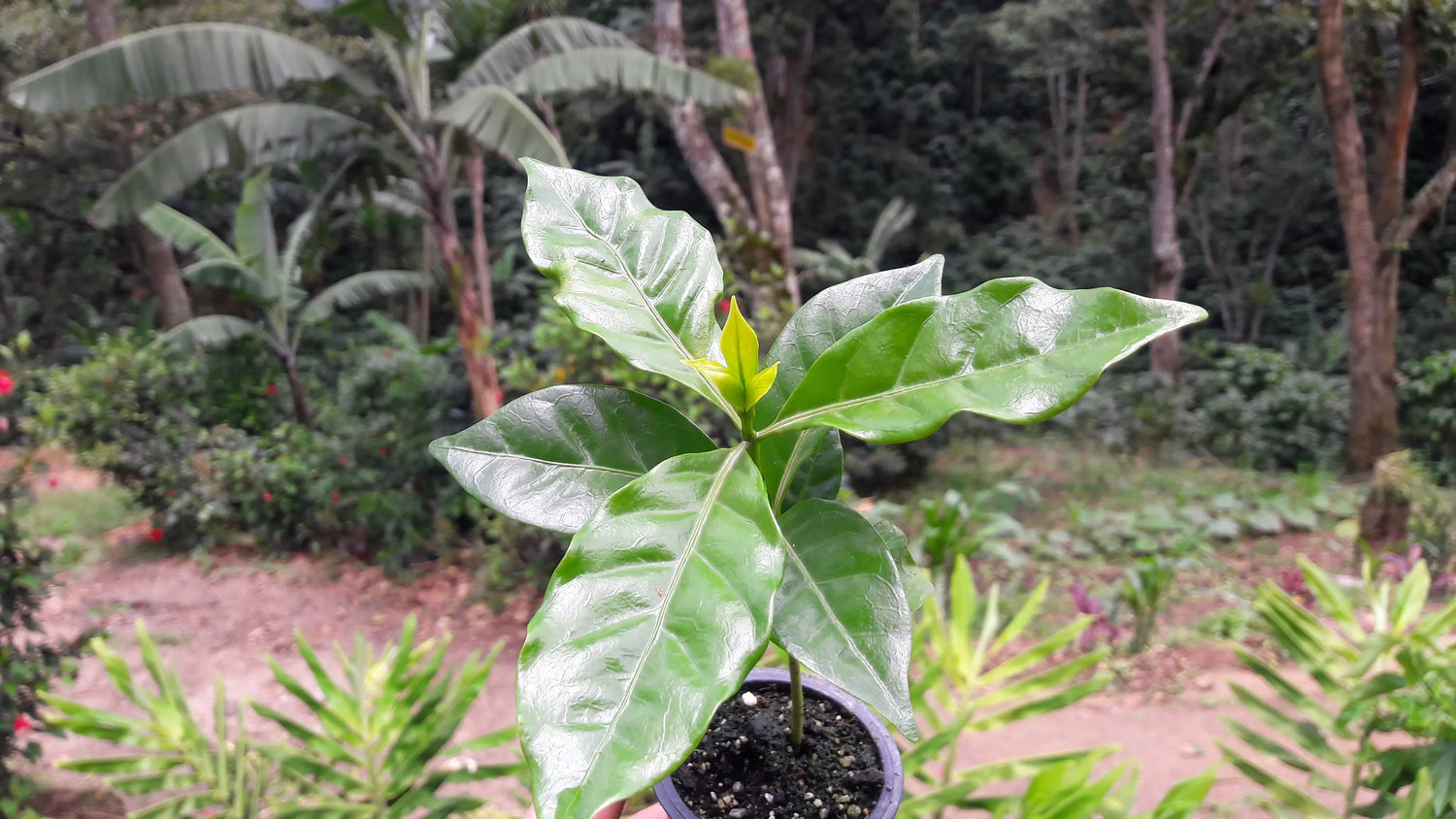
The coffee tree originates from the seed of a fruit. The coffee seed is the actual coffee bean, which can be separated from a depulped coffee cherry. This seed should be sown relatively fresh with a moisture content of over 50%.

The seeds are usually sown in a substrate of sand and loose soil, well watered and allowed to germinate. After a month, the hypocotyl has already formed, the lowest section of the shoot axis, between the still delicate roots and the cotyledons. The parchment, also called horn shell, still covers the cotyledons before they are shed shortly.

After about three months, the seedlings are ready to be transplanted into individual plastic bags filled with soil. At a height of about 40cm and a well-developed root system, they are planted out in the field after about 1 year.

From sapling to tree
It usually takes three years from germinating seed to the first small harvest. Hybrids, however, i.e. a plant resulting from a cross of different species, can produce fruit after just two years. This acceleration of the growth process brings more efficiency to coffee farm planning.
A coffee tree can bear fruit for several decades if it is well maintained. However, production performance gradually declines from around 20 years. The tree trunks become increasingly woody, fruit yield decreases. In addition, trees of advanced age may become more susceptible to disease.
Wintgens writes in his 2004 classic that a coffee plant in production is hardly older than 30 years. However, in conversations with trading houses and producers, it turned out that their plants were hardly older than 20 years, and that 30 years "some time ago" may have been correct. The climatic challenges facing coffee plants have become dramatic and they are subject to massive change.

On this farm in Santa Barbara, Honduras, it gets up to 33 degrees. For coffee production, that is too hot. The focus on agroforestry is becoming increasingly important.
Rather, conversations with producers revealed that more than 90% of their tree stock is younger than 15 years. The Norcafé cooperative in Peru encourages its members to replace plants after 15 years. The trees would then increasingly invest in wood growth and less in fruit production, so yield gradually declines. The trees would still produce fruit for another 15 years, but not in a ratio that would be efficient.
The root system of the coffee tree
The coffee plant is a perennial plant. Without a well-developed root system, the plant could not guarantee its nutrient and water supply and finally could not reliably produce fruit. For tree health, a good root system is a basic requirement.
Wintgens states that the taproot can extend up to 1m deep into the soil. Loose soils allow the root system of a single coffee plant to penetrate up to 15m3 of soil with its roots. (Wintgens, p. 7)
The task of the roots is clear: the roots absorb water and distribute it throughout the plant. At the same time, water serves as a solvent that transports gas and minerals into the plant's cells and organs. The root system functions as a store for carbohydrates and produces the plant's own growth hormones.
A variety of factors influence the form and development of a root system. The species and varieties, the amount of fruit, the resilience of the above-ground part, attacks by fungi or diseases, the distance to the next plant, soil composition and health, and the water content in the soil.
Just because we can't see the roots doesn't mean they shouldn't be in our awareness. The development of the root system in the coffee plant, and other trees, is impressive - and shows quite clearly what has happened, or is happening, above ground. Root systems are something like an EKG and a library at the same time.
The root types of the coffee plant
The taproot
In full development, the coffee tree has a taproot that penetrates vertically and up to well over half a meter deep into the soil. This root is the largest root and clearly shows why we speak of a tree. If this taproot is not set straight in young age, it can become bent, harden, and the tree will not grow as planned.
Lateral roots and fine roots
The lateral roots (axial roots) are the roots that penetrate deepest into the soil and develop up to 3m in all directions. The side roots run parallel to the ground, remain shallow, and depending on planting density may come into contact with neighboring roots. The fine roots or hair roots are roots of varying lengths distributed along the lateral roots. They are mainly responsible for supplying minerals to the plant.

Coffee Farm Training, Nicaragua. Agronomist Oscar shows a massive taproot.
Leaves
From the leaves we can recognize - as with other trees - which coffee species or variety we are dealing with. The size, shape, thickness and curves are all indicators that help us analyze the plant.
I remember well when Don Oscar, agronomist from Costa Rica, said at Coffee Farm Training 2019 in Nicaragua:
"Leaves are not just for photosynthesis. The leaves speak to us. The coffee tree needs the leaves to communicate with us. They show us how the coffee tree is doing right now."
Indeed - if you look at leaves deliberately, you see more and more details.

According to Wintgens, a mature coffee tree holds between 22 and 45 m2 of leaves. After about 35 days leaves are fully grown before they fall off at about 10 months and the tree grows new leaves.
Wintgens also writes that a coffee tree evaporates about 6g of water per square decimeter daily. Let's assume that a coffee tree has about 35 m2 of leaves, then that would be 3500dm2, times 6g of water = 21 liters of water.
According to Wintgens' figures, an average coffee tree thus evaporates about 20 liters per day.
And here we clearly see how important the water storage capacity of the soil is for coffee production. Canephora is usually irrigated artificially, as it is much more susceptible to moisture stress and needs regulated watering times so that the flowers develop as hoped.
From bloom to fruit
Coffee fruits are called coffee cherries - however, unlike a cherry we know, it is not the fruit flesh that is eaten and the seed discarded, but the opposite. In a cherry, two seeds generally lie opposite each other - they are the future coffee beans.

A flower shortly before opening (right) and coffee cherries about six months old in Nicaragua.
On a trip to Costa Rica, a producer once told me that he still had to visit his children. "There are so many of them now" - I didn't want to be indiscreet and ask the exact number. But it soon turned out that he meant his coffee plants by "niños". The analogies go even further, because most Arabica plants take about nine months from bloom to the production of ripe coffee cherries, while Canephoras take up to 11 months.
The coffee plant actually depends on stable weather patterns in order to develop well. However, these weather patterns have been shifting for years, which demands much flexibility from producers every year. Ideally, it would be dry after harvest, so the coffee tree feels stressed: the bud would then interrupt its rest period because it is forced to survive.
During the dry phase, the plant drastically reduces its metabolism. It narrows the capillaries and prepares itself for the first rain. When it comes, the plant is ready to quickly absorb water and cell division in the bud occurs just 3 to 4 days later.
Depending on the amount of rainfall, more or fewer buds are activated - several short and staggered rains result in less uniform ripening and ultimately mean that coffee cherries must be harvested at staggered intervals. In short: unstable weather patterns lead to more picking work.
Coffee species, coffee varieties & hybrids.
Coffee of the Arabica variety is still mostly drunk. For several years, the ratio has been settling at 40/60. 40% of coffee grown is Canephora (colloquially Robusta), 60% are Arabicas. At the same time, more and more coffee is being drunk, so the shares of both varieties are growing simultaneously, but so far remain in the 40/60 ratio.
Rising temperatures and rapidly changing weather patterns, however, will accelerate the increase in the Canephora share, as well as that of hybrids: a special form of crossing in which two genetically very different lines are crossed.
The hybrid "Marsellesa", for example, which we grow a lot in Nicaragua, is a cross of the varieties "Villa Sarchi" and "Timor Hybrid 823/2". These are two varieties that would rarely come into contact in the field in a "natural" way. Marsellesa was developed by CIRAD, the French agricultural research center, and tested over more than ten years in various Central American countries before the hybrid came to market.
At World Coffee Research you will find the most common cultivated coffee varieties catalogued and classified by origin.

While Arabica and Robusta have so far been probably the most common terms in the coffee field, that is likely to change in the coming years. Coffee production is massively affected by climate change, which is accelerating research into new hybrids and varieties.
To clarify the new terminology, we have collected and taxonomically established all the common terms: the classification into systematic categories. The first person to botanically classify Arabica coffee was Swedish botanist Carl von Linné. He created the foundation of modern botanical and zoological taxonomy.
Before Linné created the fundamental plant classification system in his 1753 Species Plantarum, coffee was first classified somewhat by Jussieu in 1713:
Jasminum arabicum, laurio folio, cujus femen apudnos coffee deciur (Arab Jasmine, with laurel type leaves, the beans of which we call coffee) (Wintgens 2009)
If we take Linné's system of plant classification and apply the coffee terms we know, the coffee taxonomy looks like this.
Coffee Taxonomy

Download poster as PDF
Coffee TaxonomyWhat's next?
In the next articles I will write about the differences between the most commonly grown species Arabica and Canephora, their future viability and what research contributes to this.