



























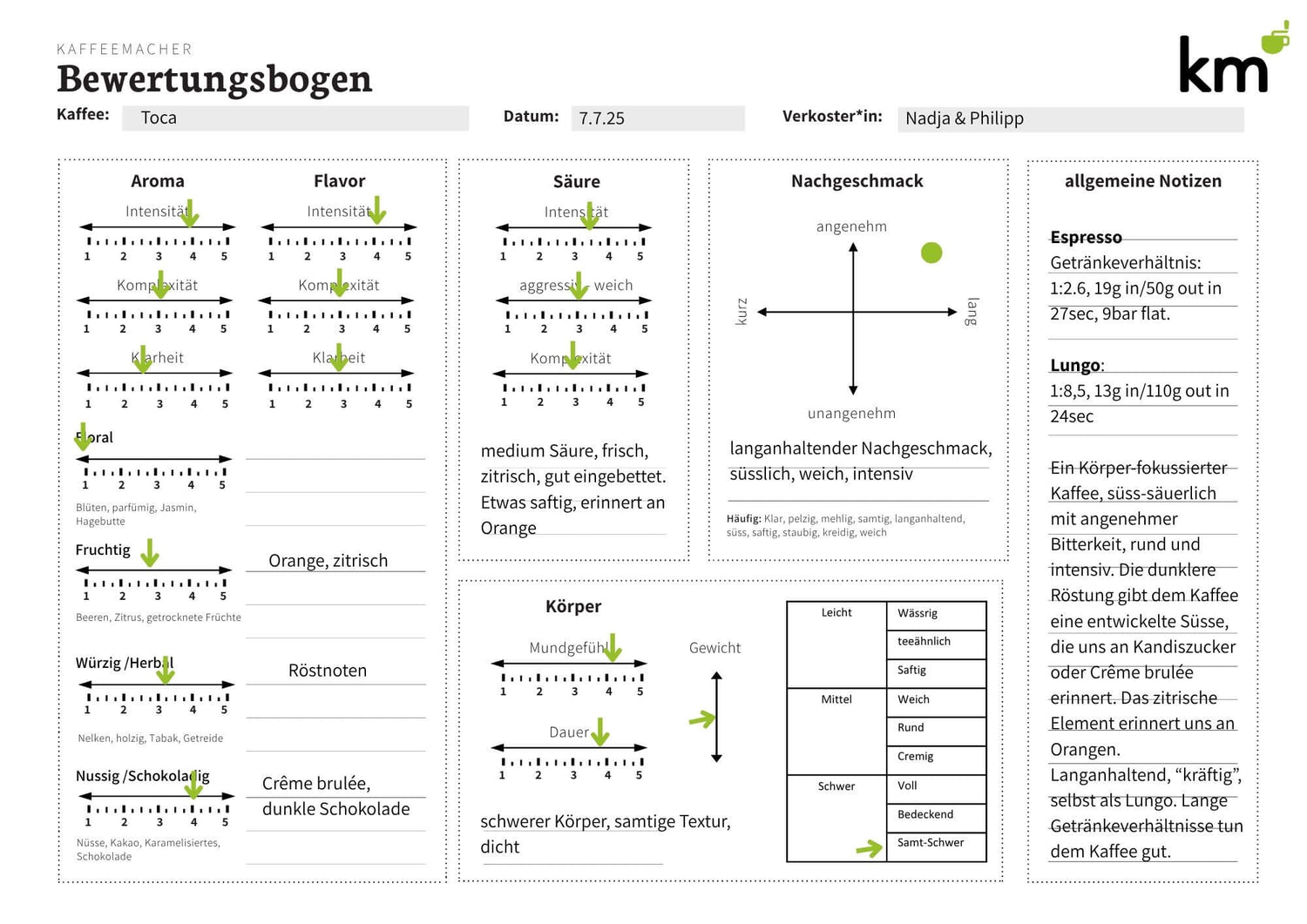

How can we describe a coffee precisely, clearly, and in a structured way without embellishing? By using evaluation forms, so-called score sheets, to help us. They are like a pair of glasses through which we view the coffee.
An evaluation form asks for specific attributes of a coffee. And when we focus on these attributes, it becomes much easier for us to describe a coffee accordingly.
Our Coffee Maker Score Sheet
You can download the score sheet as a PDF here and use it to evaluate coffees yourself.

Various score sheets exist in the coffee world. The SCA Score Sheet was considered the industry standard for decades, since Q-Graders also made evaluations using this score sheet. Since the SCA took over the Q-Grade program, the Coffee Value Assessment, or CVA for short, developed by the SCA now applies.
We ourselves became accustomed to the official score sheet. However, it was missing important information and, most importantly, the space to share our own observations. That's why in 2020 we developed our own score sheet, which we had been using internally until now, but are sharing here with you. It's meant to encourage you to look at coffees analytically yourself.
The individual attributes of the coffee evaluation form
Aroma
Aroma is the first attribute we evaluate, as it is most intense when the coffee is hot. The volatile aromas of the coffee are most strongly present in the steam, and once that dissipates, a coffee doesn't smell as strong. That's why: always evaluate aroma first.
Aroma here refers to orthonasal perception, that is, smelling while inhaling through the nose. We evaluate these properties by asking ourselves the questions listed below and making a mark on the scale of 1-5 each time.
Intensity
How intensely can I perceive the aroma?
Complexity
Can I smell different aromas at the same time? For example, strawberry and milk chocolate?
Clarity
Can I easily identify the aromas, or is it a jumble?
Flavor
With flavor, we evaluate the same categories as with aroma. Flavor is the combination of basic taste and aromas. That is, what we perceive retronasally when we take a sip of coffee, now feel the sweetness, acidity, bitterness, and can recognize that together with the aromas as we exhale. That is the flavor category.
The aroma categories
Furthermore, we assign the aromas to different categories, rate their intensity, and write down our observations on the line to the right.

Floral
Is the coffee floral, or does it remind me of flowers or perfume?
Fruity
Does the coffee remind me of a particular type of fruit?
Spicy/Herbal
Do I smell or taste notes that have a spicy, roasted, or grainy character?
Nutty/Chocolatey
Do I perceive "brown" aromas, everything that has to do with sweet, roasted, and chocolatey notes?
Acidity
Acidity is an essential component of coffee. However, we distinguish between intensity, quality, and complexity. Here too, we rate the individual attributes on a scale of 1 to 5 and provide a few comments below the scales.

Acidity: Intensity
Is the acidity less or strongly noticeable?
Acidity: Aggressive - Soft
Is it pleasant or disturbing? High note = pleasant
Acidity: Complexity
Can I describe the acidity positively? Tangy, juicy, sparkling, sweet, elegant, or is it simply "sour"?
Aftertaste
With the aftertaste, we look for a long and pleasant aftertaste that also leaves a pleasant feeling on the tongue. In a crosshair, we determine the point and mark it. We also comment on our thoughts.
Body
In this category, we distinguish between mouthfeel and weight.
Mouthfeel
How does the coffee feel? A low note would be dusty, scratchy, unpleasant. A high note stands for a round, soft impression.
Duration
How long does the positive impression last?
In the table on the right, we provide ideas for how the body's sensation could be described.
General notes
Here we collect our overall impression. Everything that doesn't fit into the categories, we describe here in complete sentences. Our goal is to write a profile for the coffee here: It has to be so good that when we read the lines, we know again which coffee it was.
Now we're curious how you'll work with it. If you have suggestions and experiences, please write them in the comments.

