



























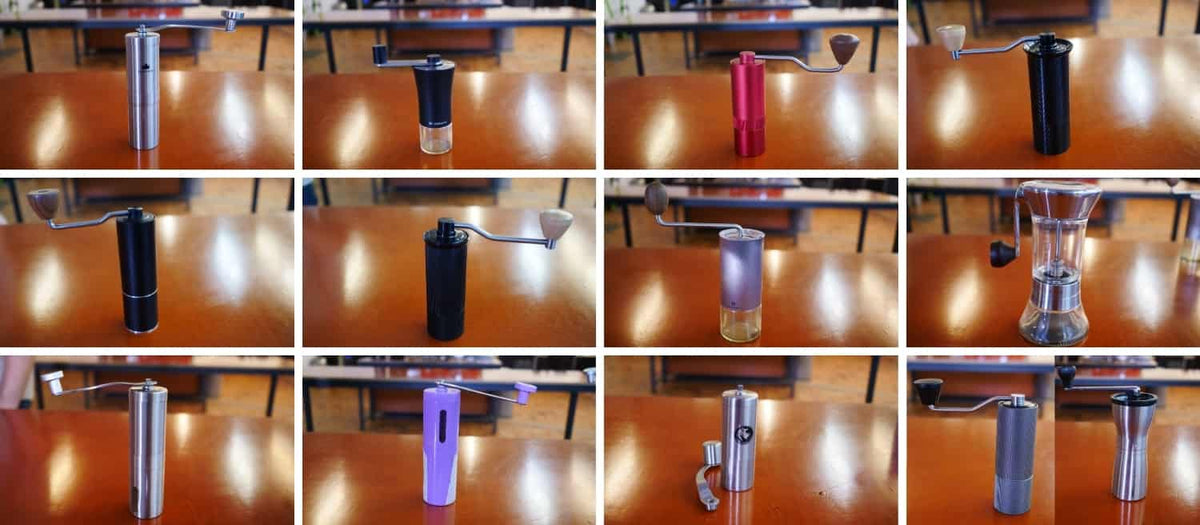
14 Manual Coffee Grinders Under €100 Tested – Which One Grinds Well for Filter Coffee AND Espresso?

Manual coffee grinders have several advantages over heavy electric coffee grinders. As a mobile, lightweight, and compact variant, they are the perfect coffee grinder for on the go, whether camping, hiking, or traveling. But there is another important argument in favor of manual grinders: for less than 100 euros, there are already some models that deliver relatively homogeneous ground coffee.
Suitable for filter coffee and espresso?
While many manual grinders do a good job for filter coffee, hardly any manual grinder grinds espresso-fine. Most electric mills fail in this discipline too. The grind size for espresso is so fine that it demands a lot from the material. This pushes both inexpensive burr sets to their limits, as well as the driving force—in this case the motor or the person operating the manual grinder.
Moreover, the ground coffee should not only be espresso-fine, but also free of larger particles and clumps. These tear holes when espresso is brewed under the pressure of the brewing water, allowing faster flow-through and thus uneven extraction. That doesn't taste good!
Advance notice: four coffee grinders under 100 euros passed the espresso test in our test, some of them quite well.
Why manual grinders make sense
We are often asked how to improve coffee quality at home. The first answer is simple: grind the coffee fresh. Freshly ground coffee is the first requirement for brewing good coffee. It doesn't matter whether filter coffee or espresso is to be prepared.
After grinding the coffee, it has a many-fold enlarged surface area. The consequence is that many of the most interesting aromas of a coffee evaporate just minutes after grinding. Moreover, the surface of the coffee bean is greatly enlarged and oxygen and light easily reach the ground coffee. As a result, the oils present in the coffee oxidize more quickly.
This is why pre-ground coffee often tastes rancid and lacks complexity. This is why investing in a coffee grinder makes so much sense. A manual grinder not only does good work, it is also significantly cheaper than its electric counterpart. Whether a manual grinder or an electric grinder suits you depends mainly on how much coffee you grind per day.
Remarkably enough: many inexpensive manual grinders do better work than some electric mills priced over one hundred euros.
The basic data of manual grinders
Felix Hohlmann performed the technical tests and testing. Did he know what he was getting into with this test? In fact, there is quite a bit you can compare when testing coffee hand grinders. This starts with the maximum bean capacity in the upper area, goes through the retention in the ground coffee collection chamber, and ends with the material quality, the burr set, and the adjustability. And of course, the grinders also had to prove themselves as filter and espresso grinders.
The following table summarizes the most important basic data.
| Test No. | Grinder name | approx. price (seen for) | Burr set | Settings | Material |
|---|---|---|---|---|---|
| 1 | VIENESSO Manual Coffee Grinder | 24.90 € | Steel (not lockable) | no | Stainless steel |
| 2 | Groenenberg Coffee Grinder | 25.00 € | Ceramic | yes | Stainless steel |
| 3 | Zassenhaus Buenos Aires | 30.99 € | Ceramic | yes | Lots of plastic – little metal |
| 4 | NITRIP Easy Clean Red | 72.49 € | Steel, good click system | yes | Stainless steel |
| 5 | Manual Coffee Grinder yobaih | 67.24 € | Steel, good click system | yes | Stainless steel |
| 6 | WishY Manual Coffee Grinder | 84.03 € | Steel, good click system | yes | Stainless steel |
| 7 | Nitrip Household Mini black | 50.09 € | Steel, good click system | yes | Stainless steel |
| 8 | Zassenhaus Quito | 79.90 € | Steel, good click system | yes | Stainless steel |
| 9 | Handground | 89.99 € | Ceramic | 8 settings | Plexiglas, stainless steel, glass |
| 10 | innislink Manual Coffee Grinder | 14.00 € | Ceramic | yes | Stainless steel |
| 11 | AXspeed Coffee Grinder | 14.99 € | Ceramic | no | Plastic |
| 12 | Rhinowares small for Aeropress | 46.42 € | Ceramic | no | Stainless steel, plastic |
| 13 | Hario Ceramic Coffee Mill Mini-Slim Pro | 49.99 € | Ceramic | yes | Stainless steel |
| 14 | Timemore C2 | 79.00 € | Steel, good click system | yes | Stainless steel |
The complete table with additional information can be found here.
Here are some notable observations. The Handground grinder is by far the largest grinder in the field. With 85 grams retention in the upper chamber and 60 grams in the ground coffee compartment. At 790 grams and 21 cm, it is anything but a good travel companion, especially since the ground coffee container is made of glass.
The smallest grinder is the Nitrip Mini Black at 14 cm and a diameter of 5 cm. With just 19 grams of retention for both beans and ground coffee, you can grind just enough coffee for a double espresso or 300 ml of filter coffee.

The three test winners of the manual grinder test
Four grinders are suitable both for grinding filter coffee and espresso, thus initially setting themselves apart from the rest of the field. However, if you're only looking for a filter coffee grinder, you'll also find good models among the other grinders.
Of the four grinders, we can unreservedly recommend three. The Nitrip Mini Black, the manual grinder Nitrip Easy Clean Red, and the Timemore C2 performed strongly in many respects.
The Groenenberg* grinder costs just 25 euros and is the best of the very affordable grinders under 30 euros. However, it leaves some things to be desired in terms of workmanship and handling. If you're looking for a best price-to-performance test winner, then for us it's the Nitrip Mini Black*. It costs around 50 euros, but excels in both material quality and ease of use.
Nitrip Easy Clean Red – top espresso, premium build, and eye-catching design
The red Nitrip Easy Clean Red stands out visually among the 14 test grinders. A closer look at the grinder reveals surprisingly high-quality craftsmanship. The entire grinder is made of metal and, weighing 500 grams, the manual grinder is among the heavier grinders in the field. With 25 grams retention in both the bean hopper and ground coffee compartment, the grinder has an ideal size for a manual grinder. This allows both a double espresso (approx. 18 grams of coffee beans) and coffee for 400 ml of filter coffee (24 grams of coffee) to be measured easily. The grinder's axle is multi-bearing and the guidance is also made of metal. The wooden handle is finely grained and feels nicer than the other handles of the coffee grinders in the field.

The steel burr set can be adjusted precisely via clicks. In our test, we ground 19 grams of coffee each and compared the grind consistency of the grinders. The Nitrip Easy Clean Red ground the coffee in 35 seconds at a normal "hand-grinding speed," the second fastest time.
We produced good filter coffee and the most delicious espresso in the field with the Nitrip Easy Clean Red. The espresso rating should not be overweighted, though. We set the grinder to 10 clicks, which allows for further adjustments both in coarser and finer ranges. However, extraction times jump by several seconds, so perfect grinder adjustment via grind size alone is barely possible. But this is a general disadvantage of manual grinders that hardly matters, especially when the extraction turns out as good as in our case.
There is really only one criticism of the Nitrip Easy Clean Red. The grinder's lid falls off a bit too easily. The principle of its smaller sister grinder, the Nitrip Mini Black, would have been better.
When we bought the Nitrip Easy Clean, it cost 55 euros. Currently, we've seen it priced between 70 and 80 euros. We're keeping an eye out and will link to it again when it's available. And we're trying to find the manufacturing factory and bring the grinder to the European market ourselves.

Timemore C2
We are honestly pleased that the Timemore C2 manual grinder ranks among the top 3 grinders in the field. Because Timemore is a genuine coffee equipment manufacturer, while Nitrip also sells cushions and fire extinguishers. For example, Timemore makes one of the cleverest scales on the market with dual weighing function.
The Timemore delivers very solidly, was responsible for one of the best filter coffees in the field, and also ground espresso-fine. The grinder is made of stainless steel and the axle is multi-bearing. At 465 grams and a height of 15.7 cm, the grinder ranks among the more robust and heavier manual grinders in the field.
The bean retention is 21 grams and the ground coffee compartment holds 27.5 grams of coffee. Like the Nitrip Easy Clean Red, the Timemore C2 also has a "lid falls off" problem. It lacks a magnet or other locking mechanism.
The steel burr set can be adjusted in steps and appears high-quality and sharp. For filter coffee we set it to 25 clicks and for espresso to 13 clicks. The Timemore C2 was the fastest among the 14 grinders in the field. 19 grams were ground in approximately 30 seconds. However, the burr set appears to be different now, as the grinder takes much longer for espresso-fine grind sizes.
The Timemore C2 has an external ribbed structure that facilitates a strong grip and prevents the grinder from slipping. The girth of the grinder is still comfortable for smaller hands.
Online we found the Timemore C2 priced between 79 and 85 euros.
Disclaimer and note: we now carry the Timemore Chestnut Slim 3 manual grinder. This grinder is even better suited for espresso.

Nitrip Mini Black
The manual grinder Nitrip Mini Black* can only be faulted for one thing: it cannot hold more than 18 grams of coffee in either the bean hopper or the ground coffee compartment. However, if you use the grinder primarily for yourself or as a companion for hiking or traveling, you will be very well served by the Nitrip Mini Black.
This grinder is also multi-bearing in a metal housing. The grinder weighs 290 grams and has a height of 14 cm with a diameter of 5 cm. This makes it the smallest and most compact grinder in the field. The fine grooves on the body provide a good grip and prevent the grinder from slipping out of your hand.
Unlike the first two grinders, the Nitrip Mini Black doesn't constantly lose its lid. It clicks into place securely and stays on even when you flip the grinder upside down. The wooden button is held firmly to the grinder handle by a magnet. This too feels premium and well-made.
Like the other two grinders, the Nitrip Mini Black is also well-suited for brewing filter coffee and espresso. Since this small grinder is more suitable for mobile brewing than any other, we prepared an espresso with the Flair. Very practical – here the bean hopper fits perfectly into the brewing chamber. Pouring the ground coffee powder was therefore very easy.
For filter coffee, we set the burr set to 23 clicks and for espresso to 11 clicks (for the Flair to 10 clicks). By the way, the grinder ground 19 grams in 35 seconds, making it one of the faster grinders as well.
The Nitrip Mini Black was at around 50 euros the least expensive of the three best grinders and is thus our best price-to-performance test winner.
How to adjust manual grinders using "clicks"
Once you've found a suitable grind size for filter coffee, you only need to readjust the grinder if you're switching to completely different roasts or coffees. For example, this might be the case when switching from a lighter roasted coffee to a dark one. In everyday use, filter coffee usually only requires minimal adjustments, as strength and extraction can also be controlled via swirling and dosing. For proper espresso adjustment, more precise tuning is important.
When a grinder is adjustable in steps and has a click grid, this greatly simplifies adjustment. Above all, it's easy to return to the original grind size. Adjusting the grinder by one step produces an audible click when turning. The zero point is the fully closed grinder (conical burr completely retracted). From there you count up to the desired grind size. For example, we set the Timemore C2 to 25 clicks to grind coffee for filter coffee. For espresso adjustment, our grinder was set to 13 clicks.
Grinders with "clicks" allow you to record recipes, switch coffees, and return to the old grind size.
Advantages and disadvantages of stepped and stepless adjustment on manual grinders
Very good professional grinders are either stepless or have a stepped grid with very small intervals. Stepless grinders offer the most precise adjustment since the setting is not bound to a grid. Examples include the EK43 or Niche Zero, both grinders suitable for both filter coffee and espresso. These grinders can be quickly changed from fine to coarse and in the finest increments, because a marked grid provides guidance.
With stepped grinders, adjustment is always bound to a grid. If the step increments are very small, this grinder can also be adjusted very precisely. In the espresso range, however, a stepless burr set is generally preferred.
Manual grinders with steps have advantages. This is mainly because the adjustment screw is turned multiple times when adjusting the manual grinder. With stepless grinders, you simply don't know "where you are" when adjusting if the grinder cannot be counted by clicks. In theory, a stepless grinder is also more precise with manual grinders. However, orientation is so difficult that we clearly recommend manual grinders with steps and "clicks".
Links with asterisks are affiliate links. If you buy a grinder through this link, you support us in our work. The grinder won't cost you any more and we fill our test machine fund. But: whenever possible and available, we recommend you buy a grinder locally from a small retailer or roastery. There you can get direct advice and have contact persons in the future. If a grinder is only available on Amazon and you buy it there, we're very pleased if you shop through our link. Thanks!

