



























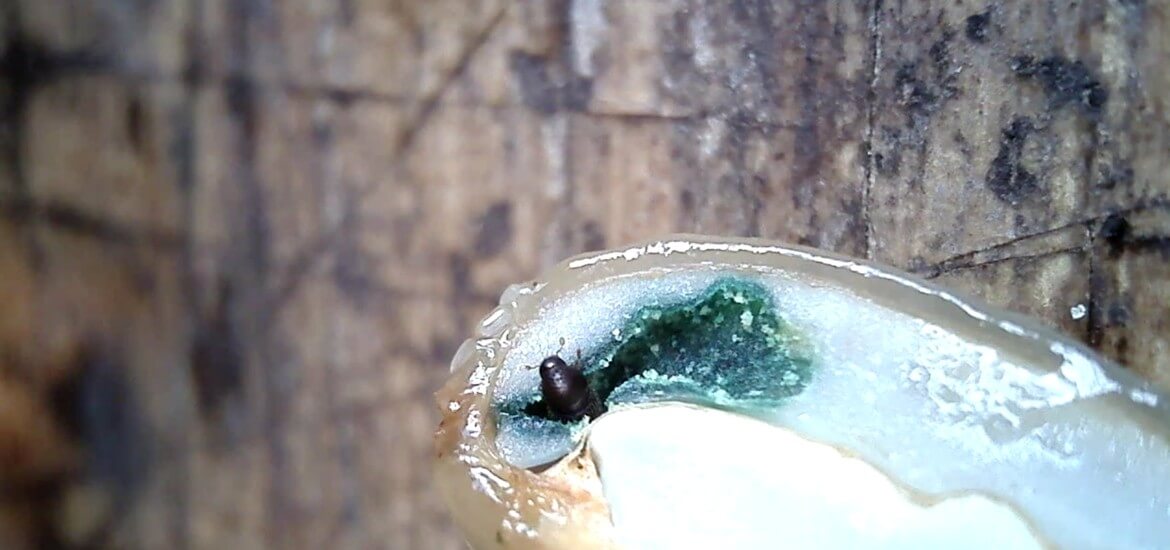

The coffee berry borer is the worst insect pest in coffee cultivation. The beetle known in Spanish as Broca, Latin Hypothenemus hampei and English Coffee Berry Borer (CBB), is responsible for annual losses exceeding 500 million US dollars (Infante, 2018). What sounds abstract in practice means the loss of large portions of the harvest, which repeatedly affects small producers in particular. The coffee berry borer eats its way into a coffee fruit, reproduces there, and destroys the coffee bean from the inside.
In this article, we report how the coffee berry borer reproduces, what measures can be taken, and what damage it causes.
Living in the coffee bean
There are these guests who don't leave the café. They are the first to arrive in the morning, occupy a spot with their computer, and type away until evening. They drink two large lattes spread throughout the day. The coffee berry borer is extreme in two ways. It lives completely inside the coffee bean and leaves it only, if at all, to fly to the next one. To make matters worse, the busy little borer reproduces on site. It doesn't drink two coffee drinks but in the end the coffee bean is completely eaten hollow from the inside.
Among coffee berry borers, the females clearly dominate. They preferentially bore into developing green coffee cherries starting 120 days after flowering. The entry point is usually the end opposite the stem. With its ovipositor, the insect lays up to 3 eggs per day over 20 days. After a rest period, the process starts again. Up to 120 eggs are laid in this manner by a single female coffee berry borer.
The mother borer and its busy offspring completely consume the cherry pit. Once fully grown, the offspring continue to reproduce eagerly among themselves. While the males never leave the cherry, the young females soon set out on their way to the next one. The move takes place when the old one offers no more substance to eat and reproduce. By flight, the coffee berry borer can travel distances of up to 500 meters.
Spread and activities
Originally from Central Africa, the coffee berry borer is now found throughout the world in almost all coffee-growing countries. It was discovered in Indonesia in 1908 and later in Brazil. From there it spread throughout South and Central America.
Studies show that the coffee berry borer spreads particularly well in lower elevations. Infestation of individual trees is more severe here, as is the general density of infestation. The same study also found that the spread in established coffee plantations is much higher than, for example, in wild-growing gardens with lower planting density.
The spread of coffee berry borers also occurs more distinctly on shaded plantations, as the insect prefers certain moisture levels. On the other hand, the natural enemy and fungus Beauveria bassiana also grows better in this climate, which acts as a natural insecticide.
Cherries left on the tree or those that fall to the ground are an incubator for the spread of the coffee berry borer.
Control of the coffee berry borer
Many factors play a role in controlling the coffee berry borer. In particular, planting density, climate, and farm management are important. To effectively combat the coffee berry borer, the annual cycle must also be carefully observed, especially flowering, cherry development, and harvest methods.
Various methods are suitable for control. Ethanol traps are useful for attracting and catching coffee berry borers. The alcohol in a cut-open plastic bottle simulates a certain ripeness level of coffee cherries for the coffee berry borers. But instead of a feast, the coffee berry borers face intoxication with no happy ending. However, the traps are less suitable for effectively decimating coffee berry borer infestations. They are better suited as an inventory of the actual spread status (which is then extrapolated).
The most important tool for controlling a coffee berry borer infestation is regular harvesting of underripe, overripe, and dried coffee cherries before the actual harvest begins. These selective tasks are labor-intensive and correspondingly costly, but essential for ensuring harvest quality.
The endoplasmic fungus Beauveria bassiana is a natural and organic agent for the effective control of coffee berry borers. By deliberately applying it to affected plants, the coffee berry borers are parasitized and killed from within.
Besides the fungus, there are some natural enemies of the coffee berry borer, such as other parasitic insects. This includes the African-origin colleague Cephalonomia stephanoderis.
For the final quality of coffee, it is crucial at what stage intervention occurs. If the coffee berry borer is stopped before reproduction in the cherry, the sensory impact is minimal. A single puncture alone is not considered a serious defect in the physical evaluation of green coffee, and the coffee can still be specialty coffee.
Multiple punctures and the loss of larger quantities affect the roasting of the coffee as well as aging. If multiple punctures are present, the sensory quality of a coffee is also extremely compromised.

Hawaii launches wasp experiment against coffee berry borer
In an innovative approach to controlling the coffee berry borer (CBB), a harmful insect threatening coffee plantations on the Hawaiian Islands, researchers are now focusing on the wasp Phymastichus coffea. This tiny insect, barely visible to the naked eye, could be the solution Hawaiian coffee farmers have been waiting for.
Phymastichus coffea is a parasitoid—an organism that ultimately kills its host (in this case the coffee berry borer). The wasp uses the coffee berry borer as a host for its larvae. This specific type of biological pest control has already proven successful in Central and South America, particularly in Colombia.
Since 2018, live specimens of the wasp have been permitted to be brought to Hawaii under strict quarantine conditions. Researchers have extensively tested the wasp to ensure it has no negative effects on native insect species. Tests have confirmed that P. coffea does not attack native insects and even shows potential parasitic activity against the tropical nut borer, another pest threatening macadamia nuts.
Researchers now plan to release thousands of these wasps in coffee-growing areas throughout Hawaii. The wasps are intended to establish themselves in the wild and maintain their populations independently. Over the coming months, they will be released on the Big Island and possibly also on Maui and Oʻahu.
Similar approaches have already been attempted in Colombia and other countries. A research project published in the Journal of Pest Science indicates that the wasp essentially parasitizes the desired coffee berry borers and not genetically more distant ones.
Conclusion on the coffee berry borer
Once again, the tragic aspect is that the coffee berry borer is a challenge that can be effectively combated with financial means on the farm as well as the necessary knowledge. Unfortunately, especially the former is often lacking, which is why quality and entire harvests are unnecessarily lost.
Controlling the coffee berry borer is one of the simplest measures to improve coffee harvest quality broadly. Particularly noteworthy: organic measures and targeted farm management are just as effective here and much cheaper than synthetic agents.
Sources and further reading
More on the Coffee Berry Borer, MDPI
Pest Management Strategies Against the Coffee Berry Borer, Journal of Agricultural and Food Chemistry
Biological control of the coffee berry borer: Main natural enemies, control success, and landscape influence, Science Direct
Vega, F. E., Infante, F. & Johnson, A. J. The genus Hypothenemus, with emphasis on H. hampei, the coffee berry borer in Bark Beetles: Biology and Ecology of Native and Invasive Species (eds Vega, F. E. & Hofstetter, R. W.) 427–494 (Academic Press 2015). Google Scholar
Observing the devastating coffee berry borer (Hypothenemus hampei) inside the coffee berry using micro-computed tomography, Nature
Damon A. A review of the biology and control of the coffee berry borer, Hypothenemus hampei(Coleoptera: Scolytidae) Bull. Entomol. Res. 2000;90:453–465. doi: 10.1017/S0007485300000584.<PubMed> <CrossRef> <Google Scholar>

