



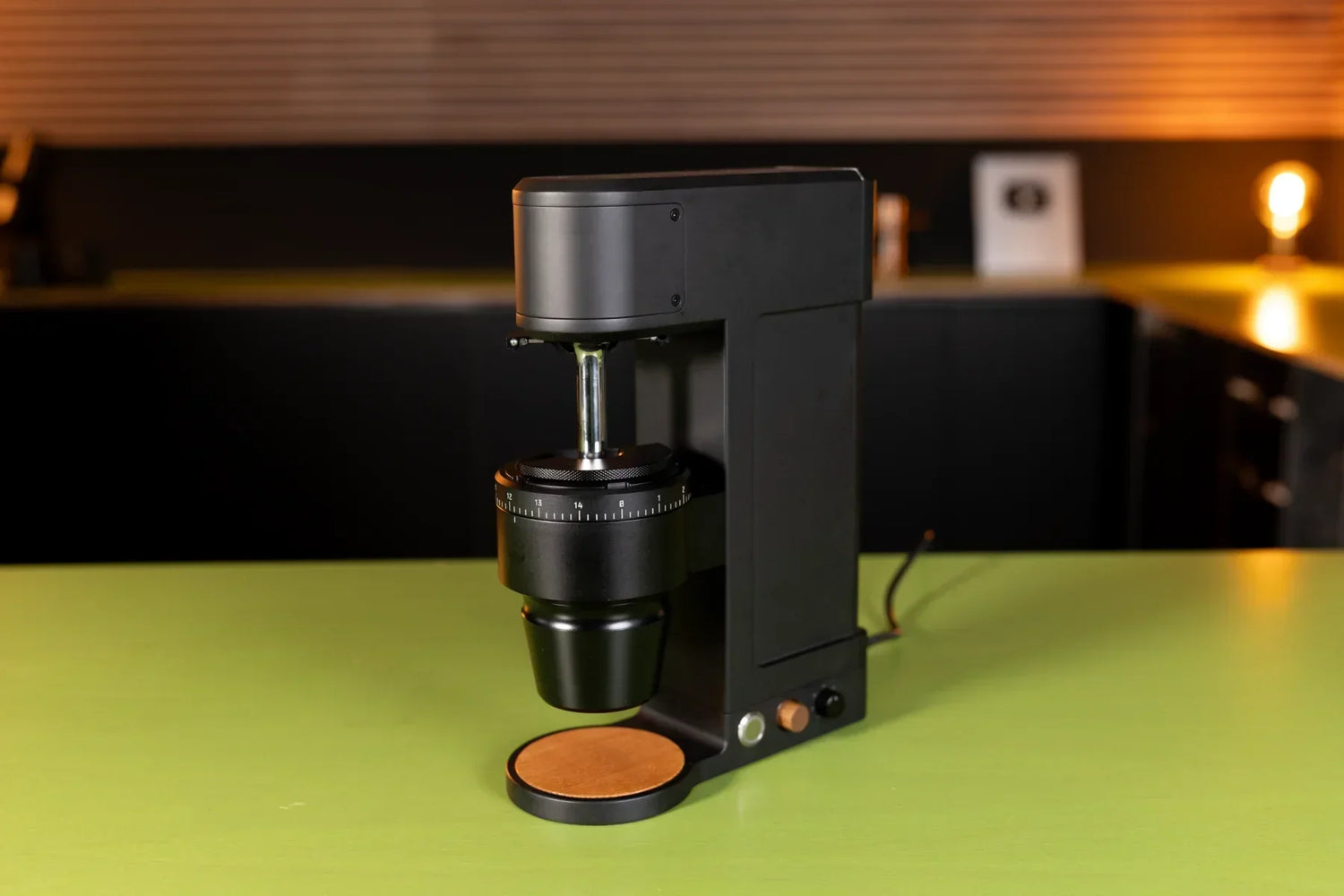

The Weber Key Espresso grinder in the MK2 version is a high-quality single dosing grinder from Weber Workshops. It costs around 2200 euros in stock in Germany! A considerable sum of money, although no surprise. At Weber Workshops, the elegant BIRD plunger pot also costs over 300 euros.
Every product from Weber is an investment, and every product we've looked at so far has been well-crafted and manufactured to a very high standard. And the same applies to the Weber Key!
And while the grinder does many things well, not everything convinced us. As you'll learn in this test, we believe that the Weber Key does not fulfill its main task well: The flavor performance in espresso preparation did not convince us.
Quality and Impression
The Weber Key Mk2 in your own coffee corner is a statement in terms of quality, aesthetics, and willingness to invest. It looks visually different from other espresso grinders on the market and also makes an impression in its workmanship. However, it's noticeable that Weber doesn't communicate the exact material of the housing anywhere. At least we couldn't find this information.
Technical Specifications
- Dimensions: Depth 248mm x Width 109.2mm x Height 349.6mm
- Weight: 9 kg
- Power supply: 90-240V (worldwide compatible)
- Power: 350W max
- 83mm conical burrs by Mazzer with TiN coating
- Variable speed range of 30-150 RPM
The grinder comes in white and black, and the wooden elements can be customized.
Weber has redesigned the grinder compared to model 1. Today's model has higher torque and should be able to grind lighter beans without any problems. We also had no issues with the grinder jamming even with very light roasts.
The Magic Tumbler was also improved, enlarged, and fitted with a different lid. We cannot say exactly what improvements this led to, however, since we only looked at the MK2 model. This test report is therefore based solely on the examination of the Weber Mk2.

Volume Weber Key Mk2
The Weber Key is the quietest espresso grinder we have measured so far. We measure only 67 decibels. This is a very low value, especially considering that many grinders are over 80 decibels.
As a rule, espresso machines are quieter than grinders. The Weber Key is one of the few grinders that is also quieter when grinding beans than some espresso machines.
retention, Speed, and Construction
In construction, the Weber Key resembles a large hand grinder. The conical 83-mm burr set is set in motion via a central axis. The Weber Key shares with a hand grinder its low retention. We measure a total of only 0.2 grams of absolute retention. That is really, really little, especially since we didn't even find any permanent retention. We've never had that before! The low temporary retention of 0.2 grams is technically already halfway into the portafilter. It gets stuck in the Magic Tumbler: on one hand on the wire agitator and on the other hand on the edge of the tumbler. Again: That's almost nothing. But it's still unpleasant because these 0.2 grams sometimes fall out of the grinder at a later point in time and then dust the surface around the grinder.
Due to its design and thanks to the low retention, the grinder is extremely consistent and reliably outputs the amount of coffee put in from shot to shot. Thanks to the design of the grinder, we can also quickly disassemble it without effort and clean it completely. However, the low retention makes this rarely necessary.
Like a hand grinder, the Weber also has slow grinding, which of course is related to the low rotation speed. If we put 18 grams into the grinder, it takes 25 seconds to completely grind the coffee at 90 RPM. If we fill the hopper and grind for 10 seconds, we get an output of 8.1 grams. This puts the grinder in the slowest category of all coffee grinders tested so far. This test is always performed with the same espresso and set recipe.
The slow grinding speed also means that the ground coffee doesn't heat up during grinding. We measure an average temperature of 30.92 °C across five consecutive shots, which we pull every 20 seconds. This means there's no risk that heating the coffee grounds will change sensory properties.

Particle Distribution and Espresso Performance
In the most important category of our test, the Weber Key shows a peculiarity that leads to a negative test result. After grinding each grinder, we take samples for comparative particle distribution analyses. To do this, we set each grinder to the Apas Espresso with the same recipe and take a sample (T4). We then adjust the grinder to Ristretto (T5) and Lungo (T6) and then return to the original espresso (T7). We send these samples to the Zurich University of Teacher Education (ZHAW). At the Coffee Excellence Center there, the particle distribution is measured.
In recent years, we have examined and compared over 60 grinders and compared the particle distribution curves with our sensory perception. Before testing the particle curves, we were already surprised by the taste of the espresso shots. We had the feeling that our coffees, which we know very well from daily brewing, were noticeably off. They tasted unstructured, the acidity was rather unpleasant, and balancing sweetness was missing.
This result matched the particle distribution measurements. The Weber Key delivers a very, very broad main peak of over 447 micrometers! For comparison: In the past, we've discussed that a main peak above 320 micrometers is broad and leads to less structured cups and less clarity in the coffee.
A broad main peak means that a grinder produces little precise ground coffee in one size. With the Weber Key, we find especially many particles in the coarse side area of the main peak. There is a pronounced right flank.

This is particularly evident when compared to other grinders we have recently measured. The Weber Key shows a particle distribution that we otherwise only know from very inexpensive espresso grinders. And no, that has nothing to do with the conical burrs. See, for example, the comparison with the Niche Zero in the graph above.
Extraction Comparison
To better understand the extraction behavior, we conducted several test series. We performed extractions with both a medium roast (Apas, Brazil) and a lighter roast (Limontitla, Mexico) at the same recipe and measured the TDS. As a comparison grinder, we used a relatively inexpensive grinder, namely the Eureka Specialità.
The extractions and the strength of the Specialità were significantly higher for both coffees. Especially with the darker roast, the extraction yield was on average almost two percent higher! The TDS was on average 0.7% higher. This is possible due to the more uniform grounds of the Specialità and the lower number of boulders (coarse particles).
A high extraction yield is desirable with high-quality coffees!


With the lighter roast, the difference was less pronounced, but still noticeable. We're also talking about around 1.2% more extraction yield here!
Conclusion: Who is the Weber Key MK2 the right grinder for?
The Weber Key is well-crafted. We see little reason why the grinder should not last several decades on a home barista bar. The low volume also expands its use. As the quietest grinder we've measured so far, the Weber Key makes a good impression alongside very quiet machines like the Sanremo You or Maro Model 1 in offices or medical practices, as well as in households that place great value on aesthetics and quality.
The retention is exceptionally low, and the grinder's consistency is very good. Switching recipes is also straightforward, although smaller steps would be desirable. It's important that you're aware of the slow speed. The Weber Key Mk2 is one of the slowest grinders on the market!
While the importance of speed is a matter of taste, we estimate the actual espresso performance of the grinder as limited. Especially with lighter specialty coffees, we were often disappointed with the espresso results. The huge main peak in the particle distribution is responsible for this. We otherwise only know such a broad main peak from very inexpensive grinders. As a result, our espressos were often inharmonious in flavor, less sweet, and could not compete with the results of other, also significantly cheaper grinders. What often led to unpleasantly dominant acidity with lighter roasts can express itself positively with some darker espressos. We would therefore rather see the Weber Key Mk2 in the area of darker roasts. This it shares with a grinder like the Pico by La Marzocco.
Since the Weber Key Mk2 did not convince us in terms of taste, this test report also concludes with a disappointed note. The high-quality workmanship and reputation that Weber Workshop has for creating great materials precedes it. In testing the Weber Key Mk2, these expectations were not met for us.