




Table water filters are a practical and simple way to filter good coffee water. As a rule, in almost all areas, the water that comes from the tap is too hard to make good coffee with. At the same time, hard water also endangers your own coffee machine, as it enables limescale formation.
With table water filters or other filtration methods, water can be filtered so that it tastes delicious and is also good for coffee machines and espresso machines.
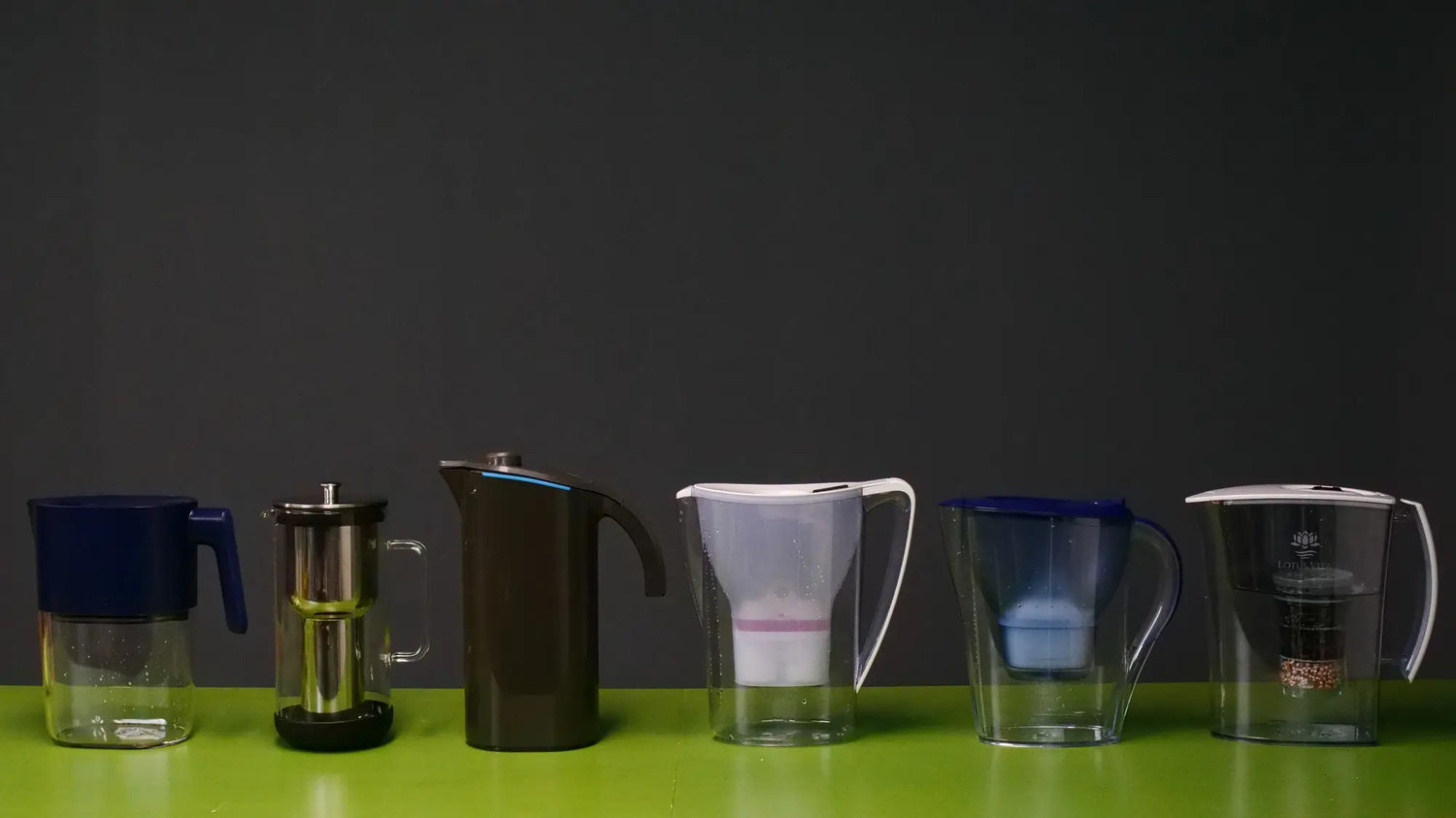
In this test, table water filters from BWT, Brita, Lotus Vita, LARQ, Aarke, Yucona and Peak were tested.
Good water values for making coffee
Perfect water for filter coffee:
Total hardness: 2 – 3 °dH
Alkalinity: 1 – 2 °dH
Perfect water for espresso:
Total hardness: 3 – 6 °dH
Alkalinity: 2 – 4 °dH
We have written more about the perfect water for coffee in our detailed blog post on "Coffee water". Another test summarizes the results of the most commonly used cartridge filters for espresso machines and automatic coffee makers. So-called water filter pads can also soften water, but require time.
To analyze your own water, we recommend you do a test with titration drops. In Switzerland you can get the BWT test kit from us and in Germany the Brita test kit from us.
Table water filters compared with water pads and cartridge filters
Cartridge water filters generally provide the best water filtration. They are inserted into the water tank. Due to the suction of the pump in the machine, the water is pulled through the filter with pressure or force. This achieves good filter performance.
Water filter pads lie in a water tank and there is no water movement. The filter performance is therefore only achieved over many hours. In our test, we tested the filter performance over many hours. Only after well over 20 hours did the water values move into the target range.
Table water filters position themselves between the cartridge filters and filter pads. The water runs through the filter inserts by gravity and is filtered in a few minutes. Some of the tested filters achieved good target values because they were designed for decarbonization. Other filters missed the target values, as the test shows.
We created two videos about table water filters. On the one hand, there is our main video with all details and additional explanations.
On the other hand, we recorded a second version that briefly and concisely summarizes the results in just a few minutes.
How was the test conducted?
The table filters were first prepared according to the manufacturer's instructions. Then 1 liter, 5 liters, another 5 liters and then 10 liters of water were filtered. After each filtration, samples were taken and measured with test drops to determine water hardness and with a conductivity meter.
LARQ Filter and Lotus Vita Filter
Both the Lotus Vita and the LARQ filter were recommended to us for testing by the coffee community. Both filters are presented to improve water quality in general, not explicitly as filters for preparing water for making coffee. Nevertheless, such a test is interesting and shows the characteristics of different water filters. Both filters effectively filter out total hardness, i.e., calcium and magnesium, from the water. However, they reduce alkalinity little or not at all. The hardness of our input water is 13 degrees German total hardness and 10 degrees German alkalinity. Although the total hardness is reduced, we have found too little filtering of the alkalinity to effectively filter water for coffee preparation.
We recommend both filters to effectively remove contaminants. The reduction of total hardness is sufficient to protect the coffee machine. The alkalinity is too high to brew delicious coffee.


Brita and BWT table water filters, Peak and Aarke
All four table water filters from Brita, BWT, Peak and Aarke are able to filter good coffee water. The filter performance of the Brita filter and the Aarke filter was in a good range, while the BWT filter did not filter as effectively. To achieve the exact target values, the BWT filter would need a second filtration with our raw water. The Yucona filter also fails to reach the goal with a single filtration and must be used a second or third time depending on water hardness.
The Peak filter is the most versatile filter as it allows a flow rate reduction to filter more or less. This is particularly interesting for raw water inputs of 10 to 15 °dH total hardness. For waters that come in at around 13 °dH total hardness like our water, a setting of 4.5 filter performance is definitely perfect. If you only have to deal with 12 °dH total hardness, you'll certainly also do well with a lower filter performance. This flexibility allows individual adaptation to local conditions - very nice!
Unfortunately, the processing quality of the Peak filter is not good. The pitcher looks cheap and unstable. The Aarke filter clearly has the advantage here. The filter is made of glass, the filter insert is made of stainless steel. The filter can be filled yourself and looks better next to a high-quality espresso machine as a filter.


Summary of Results
The water filters from Peak, Aarke, Brita and with reservations BWT impressed in the test. The Lotus Vita filter and the LARQ filter are primarily intended for filtering water of foreign particles and desalting the water. However, they do not sufficiently reduce alkalinity. The high retained alkalinity buffers the acidity of the coffee, which is important for the balance of a complex and delicious coffee.
The Yucona filter is indeed a decarbonizer, but has only low performance. Of the filters suitable for coffee, it shows the lowest filter effect in reducing alkalinity. Multiple filtration of the water is necessary to achieve the target values.

You can find all our articles on the subject of coffee and water here.