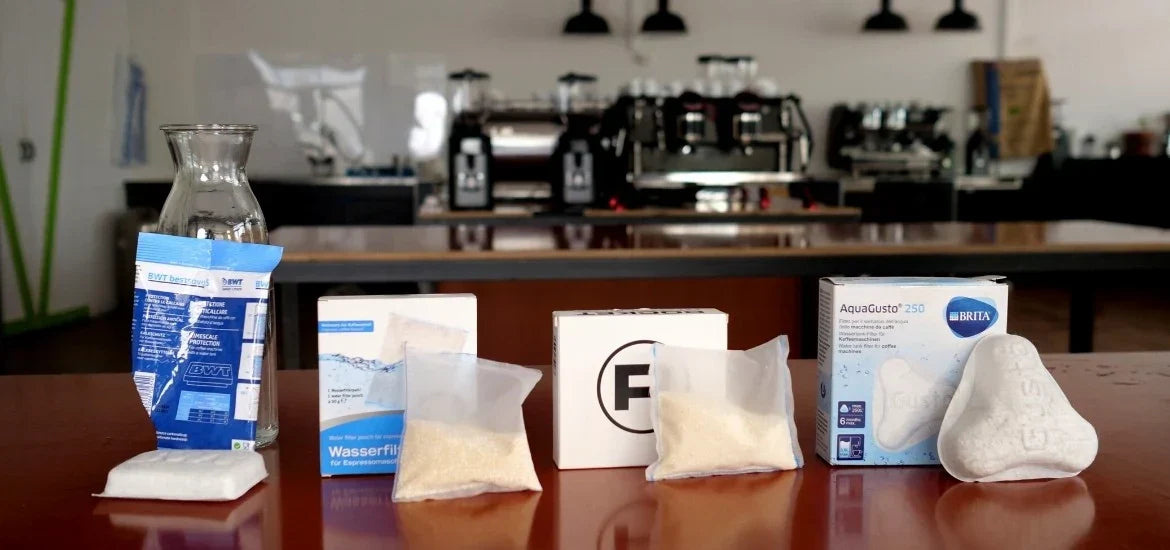
Water filter pads have one purpose: they are supposed to filter hard water. The risk of limescale formation in espresso or coffee machines is to be reduced, and the water is also to be treated for taste. We tested four water filter pads and the conclusion is sobering: all four fail to achieve both goals or only achieve them inadequately when used according to dealer instructions.
We tested the water filter pad from ECM, Rocket O.SCA.R 90, BRITA Aqua Gusto 250, and BWT Bestsave S.
Good water for making coffee
In many places, tap water at home is too hard to be able to prepare sensory good coffee. At least as problematic is that already moderately hard water causes limescale formation. We explained what good water for making coffee is in a detailed article and video. Here are the basic data again:
Perfect water for filter coffee:
Total hardness: 2 – 3 °dH
Alkalinity: 1 – 2 °dH
Perfect water for espresso:
Total hardness: 3 – 6 °dH
Alkalinity: 2 – 4 °dH
How you measure these values at home, what they mean, and how you change them, is also explained in the linked article. https://kaffeemacher.ch/kaffeewasser/
We were often asked whether the water can also be achieved with water filter pads or water filter cartridges.
The use of water filter pads
Water filter pads are rinsed according to manufacturer instructions and then placed in the water tank of the espresso machine or coffee machine. There, the water filter pads soften or decarbonate the water over time.
Different manufacturers provide different information.
ECM, for example, recommends a soaking time of 15 hours for a water hardness of 15. BWT recommends use overnight (8 – 10 hours according to the user brochure). None of the four manufacturers takes the initial hardness of the water into account. It is only mentioned for the durability of the pad (maximum number of liters that can be filtered over time).
In any case, the pads need time to develop their filtering effect. This is where we stumble for the first time. Because when do we typically refill water? When the espresso machine complains about insufficient water level or the coffee machine beeps annoyingly.
So we pour water and then brew the coffee. No one waits a night until the next brew or even 3 – 4 days, which our measurements suggest.

How effective do water filter pads filter?
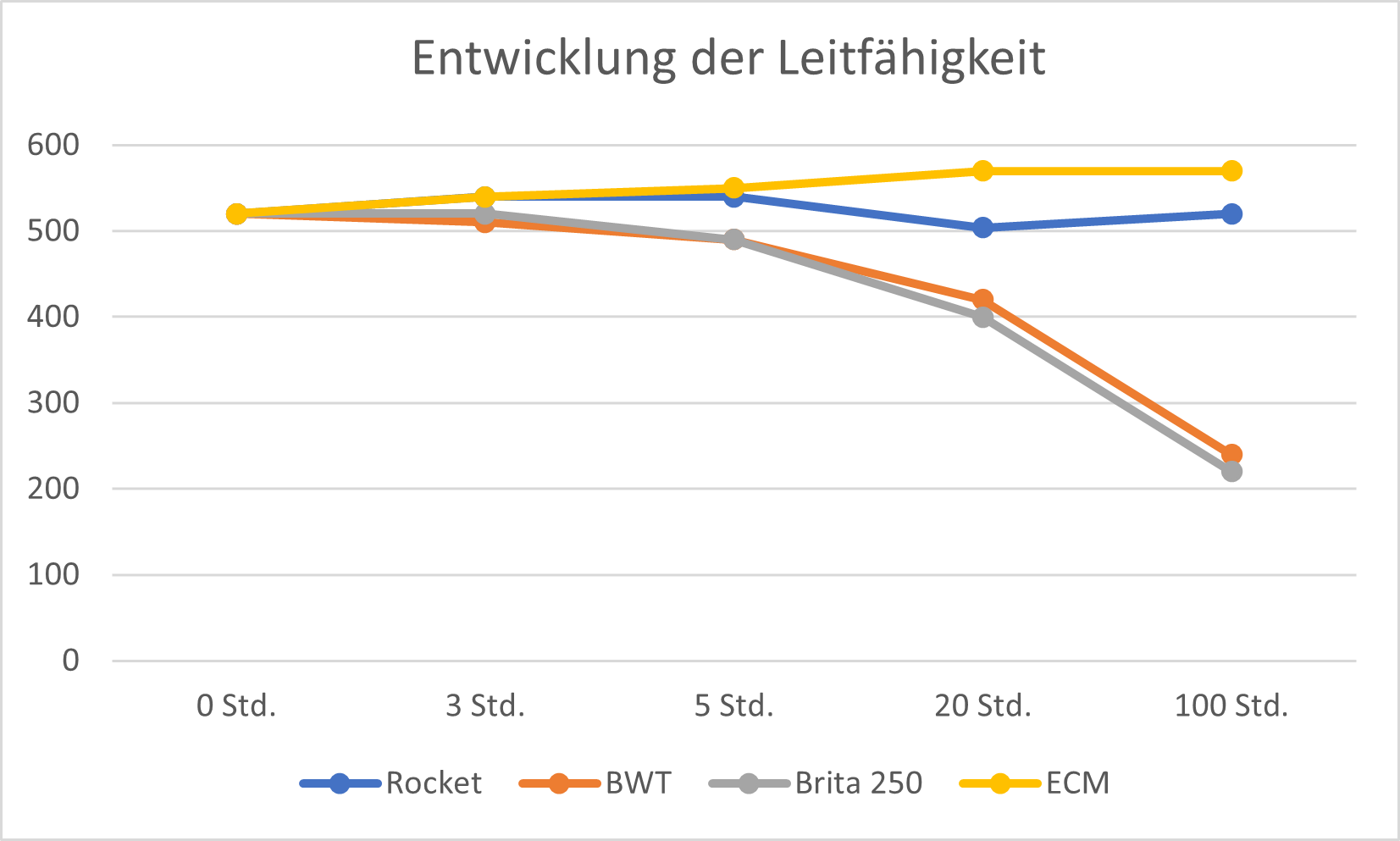
We placed one filter pad from each manufacturer in a water tank, which we filled with 2 liters of water. After 3 hours, 5 hours, 20 hours, and 100 hours, we took measurements of total hardness, alkalinity, and conductivity.
Total hardness developed as follows.

Total hardness development water filter pad
With all four pads, after 20 hours we were still not in the desired target range for espresso, or at an initial hardness of 16 GH °dH we were still far from it. After 100 hours, all water filter pads sufficiently reduced the total hardness, but not the alkalinity.

While the water filter pads from BWT and BRITA sufficiently reduced alkalinity after 100 hours, this value remained constantly too high for the water filter pads from ECM and Rocket. While these two pads soften, they do not replace bicarbonate to the same degree.
While the water is thus protected from limescale formation, it remains sensory problematic. High alkalinity sensory leads to a strong weakening of any acidity in the coffee. This is necessary, however, so that a coffee is balanced and doesn't taste bland.
Both manufacturers do not communicate this on their packaging.
NOTE: As long as the water filter pad is in contact with the water, the water is in the process and continues to be decarbonated or softened. An exact determination of water hardness is only possible if you let fresh water be in contact with the pad for a certain period. As soon as you top up water, as typically happens in the water tank, the values are again inaccurate.
Michel Aeschbacher
Water filter pads as false advertising
The slow filtering effect of the pads requires targeted use if they are to make sense at all. As described by manufacturers in the instructions, they are not effective and endanger your espresso machine, and also result in the coffee not tasting good.
The water filters from Rocket and ECM are, in our view, not suitable sensory for brewing good coffee. While they protect your machine when left in water for long periods, they do not reduce alkalinity.
The water filter pads from BRITA and BWT are theoretically usable, but must be used differently than described by manufacturers. It works best with a separate water pitcher, which you place with a water filter pad in the refrigerator and leave in contact for an appropriate length of time depending on the initial hardness. We have described how you can determine your initial hardness here.
Plug filters and water filter cartridges, which are inserted directly into the water canister, work better. Due to the flow suction, the filtering performance is significantly better. We have written a test article on this.
---
Backup info
Alkalinity and total hardness were measured with titration drop tests from BWT. 2 liters of water were used in each case and held at room temperature in the water tank with water filter pad. Conductivity was also measured additionally. The initial total hardness of our water is: 16 °dH total hardness, 13 °dH alkalinity, 520 conductivity
Development of total hardness, water sample taken from the bottom.
| °dh GH | 0 hrs. | 3 hrs. | 5 hrs. | 20 hrs. | 100 hrs. |
| Rocket | 16 | 16 | 13 | 9 | 3 |
| BWT | 16 | 14 | 13 | 11 | 6 |
| Brita 250 | 16 | 15 | 14 | 10 | 4 |
| ECM | 16 | 14 | 13 | 10 | 3 |
Development of alkalinity, water sample taken from the bottom.
| °dH Alkalinity | 0 hrs. | 3 hrs. | 5 hrs. | 20 hrs. | 100 hrs. |
| Rocket | 13 | 12 | 12 | 11 | 10 |
| BWT | 13 | 11 | 11 | 8 | 3 |
| Brita 250 | 13 | 12 | 10 | 7 | 2 |
| ECM | 13 | 11 | 10 | 11 | 11 |


Conductivity development.
| Conductivity | 0 hrs. | 3 hrs. | 5 hrs. | 20 hrs. | 100 hrs. |
| Rocket | 520 | 540 | 540 | 504 | 520 |
| BWT | 520 | 510 | 490 | 420 | 240 |
| Brita 250 | 520 | 520 | 490 | 400 | 220 |
| ECM | 520 | 540 | 550 | 570 | 570 |