





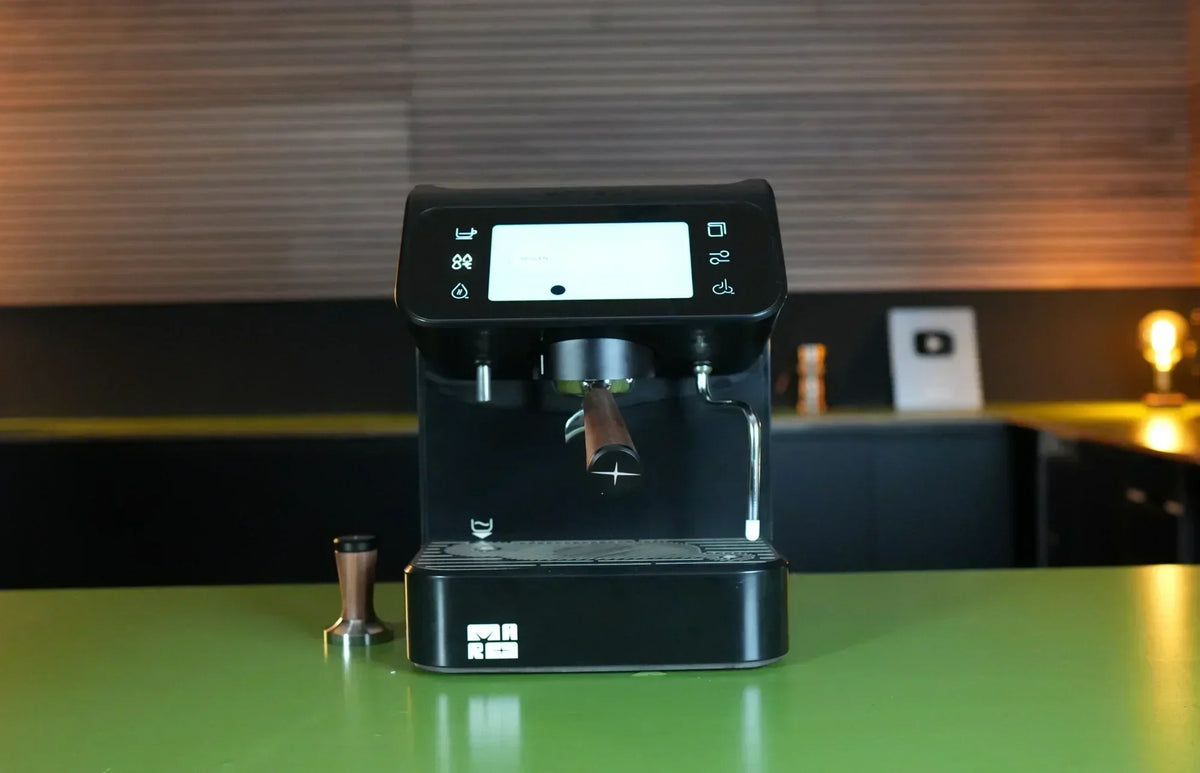

At first, second, and every subsequent glance, the Maro Model 1 is a deeply thrilling and innovative espresso machine. Maro is engineered by two young founders from Thuringia, Germany, who couldn't find their dream espresso machine on the market—so they built it themselves.
As cliché as that origin story might sound, Max Grimm and Robin Kuprat didn't just launch any ordinary machine with the Maro Model 1: in many respects, they created the best home espresso machine currently available on the market.
The Maro leverages modern sensor technology, ultra-fast heating elements, and smart algorithms to pull the ideal espresso shot. It represents the polar opposite of a traditional boiler machine. This seamless synergy between hardware and software is precisely what makes it so formidable—the founders simply aren't burdened by the industry's legacy constraints.
We don't throw around the title "best espresso machine" lightly. We have tested over 70 different espresso machine models and worked with more than a thousand home barista setups across our workshops. And to prove we're not bluffing:
- Its thermal stability ranks 3rd among all machines we have ever measured. Competitors require at least 15 minutes of warm-up time to achieve that.
- The Maro achieves this level of thermal stability in just 4 minutes.
- It is the quietest espresso machine we have ever tested.
- It ranks among the top three most energy-efficient machines in our test scenario.
- For espresso potential, it achieves a perfect score thanks to flow and pressure profiling—the Maro even emulates lever machine extraction behavior.
With that brief summary, let's dive into the review. In May 2026, we completely recalculated all test metrics using our updated testing protocol v2.3, taking into account the extensive software updates Maro rolled out since our initial evaluation.
Due to numerous inquiries, we have also produced an English version of our test video.
Maro and Us
We first tested the Maro espresso machine at the Swiss Coffee Festival in September 2023 and sat down for an in-depth conversation with founders Max Grimm and Robin Kuprat.
In April 2024, we received our own Maro Model 1 unit. As always, we purchased the machine independently for 3,999 Euros during the crowdfunding campaign (it currently retails for 4,999 Euros).(1) Since then, we have put the Maro under intense scrutiny, moving it continuously between our film studio, workshop room, and office setup.
Back in 2024, the Maro already ranked near the top of high-end home espresso machines. Anyone who bought one back then can confirm its excellence. Yet, early iteration quirks existed—mostly software-based rather than hardware. Over recent months, Max and Robin delivered massive software enhancements.
Because the machine is cloud-connected, improved motor algorithms, refined menu navigation, optimized heating cycles, and new features like Bluetooth scale syncing were delivered seamlessly over-the-air.
The first 50 Maro owners provided direct feedback, and Robin and Max listened and acted. We also shared feedback regularly, which was incorporated into subsequent software updates. This ongoing evolution is precisely why we completely re-measured the Maro for this comprehensive update.

Thorough Testing Takes Time
We purposefully took our time before publishing a final review. First, because the machine is highly complex and required exhaustive long-term testing. Second, because we wanted to give these young founders room to mature their platform. While a review in spring 2024 would have already yielded high scores, we agreed with Max and Robin to hold off until late 2024, updating the complete benchmark picture again in May 2026.
Some critics might question our close dialogue with the manufacturer prior to publishing this test. We want to address that directly before diving into the data.
Our ultimate goal across all reviews is to identify outstanding espresso machinery so you can brew exceptional espresso at home. When a manufacturer listens to feedback and improves their product, everyone wins. Most manufacturers only listen after a bad review or attempt to use us for marketing—something we strictly decline.
For complex, software-driven machines like the Maro, Decent, Unica, or Roxy, conducting a thorough evaluation without direct developer communication is impossible. When we can speak directly with engineers, we do. If a company routes us through marketing representatives instead, we pass.
Our testing rests strictly on measurable data and years of testing expertise, shared with total transparency. Maro never had preview access to our video or written review, and no financial compensation was ever exchanged.

Build Quality & Materials
The Maro Model 1 is built from a high-end material composite. The outer housing is crafted from HIMACS®, a solid surface mineral material composed of aluminum hydroxide, acrylic, and natural pigments. Renowned for longevity, hygiene, and scratch resistance, it is frequently used in luxury architectural interiors—smooth, warm to the touch, non-porous, and easy to clean. We know of no other espresso machine using this material.
- The stainless steel drip tray holds 750 ml. Carrying it when full requires steady hands. The stainless steel water tank holds 1.5 liters, is dishwasher safe, and can be removed from the front or refilled halfway pulled out.
- The edges on the internal stainless steel modules feel somewhat sharp. Handle with care when wet.
- The group head is machined from lead-free brass, aiding thermal conductivity for stable shot temperatures and fast warm-up times.
- The cup warmer tray is made of anodized aluminum and features adjustable heating power.
- The steam wand is plasma-polished with cool-touch insulation, making it safer to handle and easy to wipe clean.
- The 7-inch touchscreen is responsive and fluid—a standout feature compared to typical espresso machine displays.
- The Maro features a 2300-Watt thick-film heater (Fast Through Heater / FTH) by Ferro. It heats only the exact volume of water required per shot, maximizing energy efficiency, warm-up speed, and temperature agility.
- Water delivery is powered by an ultra-quiet Fluidotech rotary pump (model GB072) controlled via Pulse Width Modulation (PWM).
Dimensions measure 38.5 cm in height, 30 cm in width, and 33.1 cm in depth (44 cm depth including portafilter). Weight: 22.6 kg. Vertical clearance between portafilter spout and drip tray grate: 8.9 cm.
Build Quality Score: 9.0 / 10
Premium material selection with good to excellent craftsmanship. The drip tray, main body, and cup warmer offer fantastic tactile feedback with precise panel gaps. A minor deduction applies to sharp sheet metal edges around the interior water tank housing.
Acoustics & Noise Level: 10 / 10
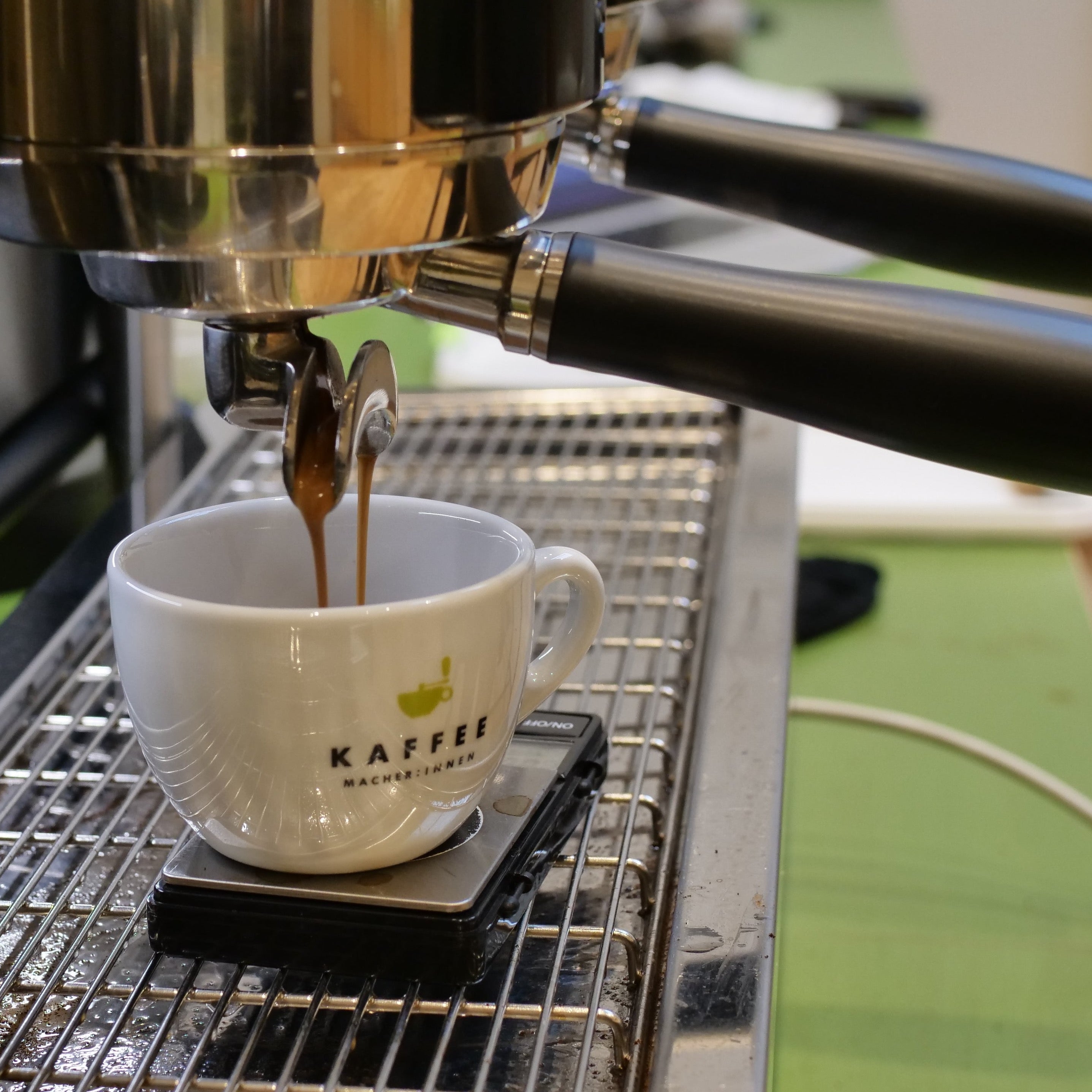
Is the machine even running? That question came up frequently during testing. Even while brewing an espresso while holding a conversation right next to it, you have to listen closely. The rotary pump is whisper-quiet, and internal dampening prevents vibrations. We measured just 48.8 decibels—the quietest reading we have ever recorded on an espresso machine. Full points.

Included Accessories
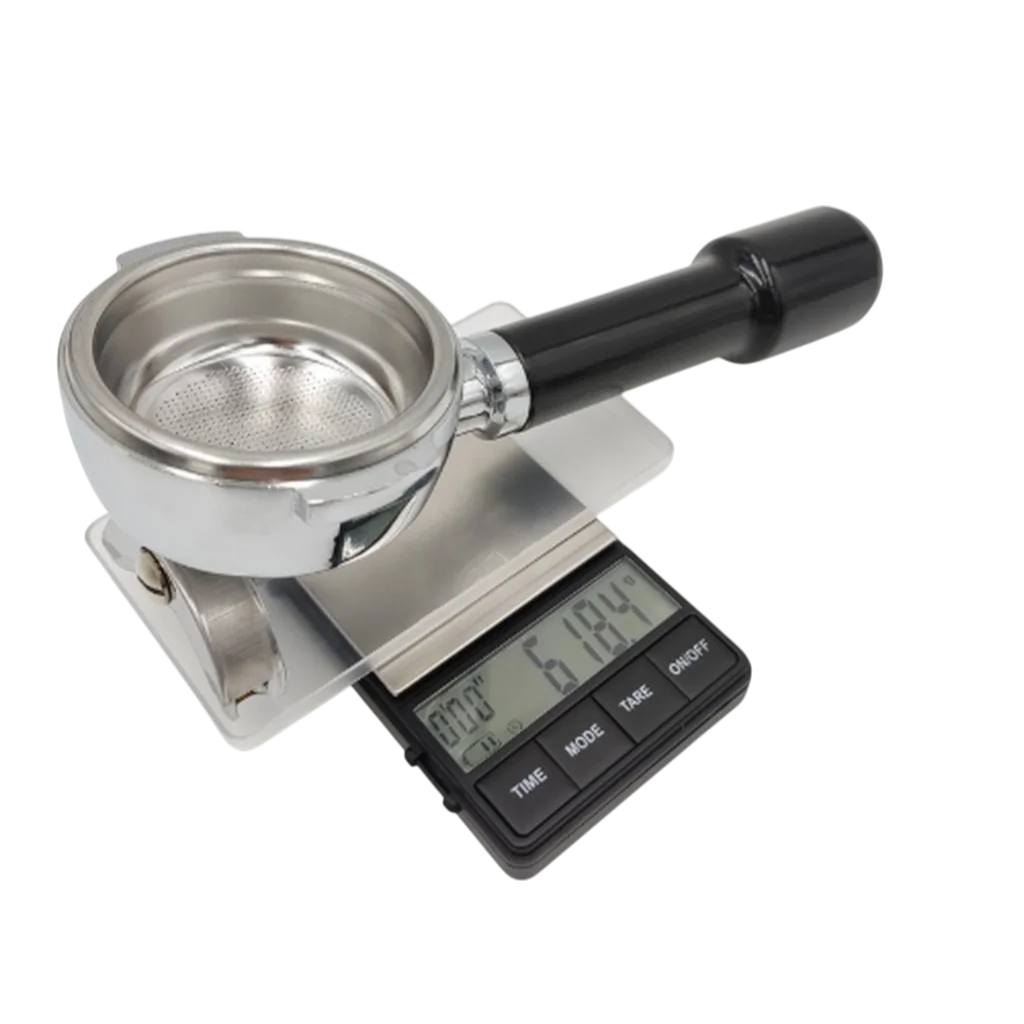
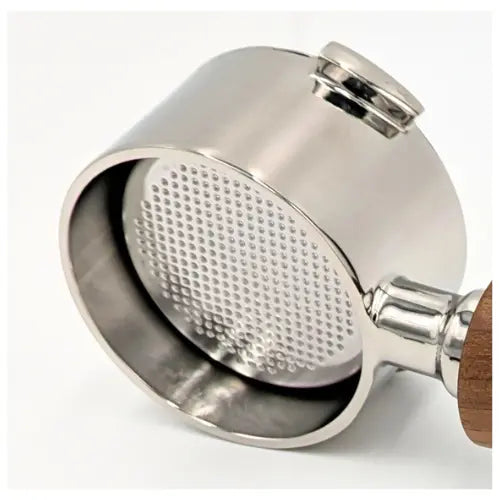
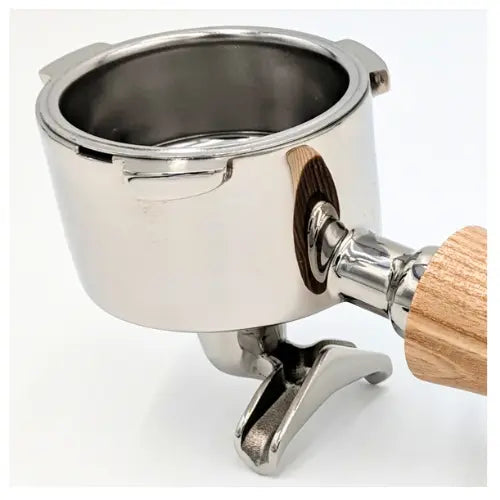
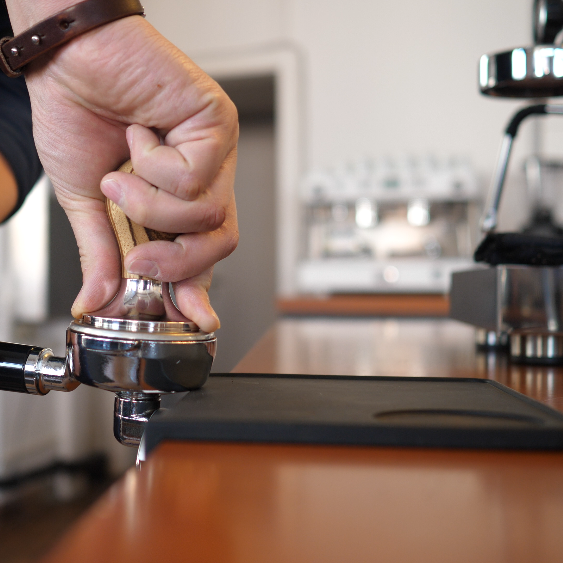
The Maro Model 1 ships with both a double-spout portafilter and a bottomless (naked) portafilter. Both are crafted from stainless steel with walnut handles. IMS Competition single and double filter baskets are included. The stainless steel tamper features a matching walnut handle and fits flush inside the basket (we measured 0.65 mm play between basket wall and tamper base).
The tamper includes a clever secondary feature: the top of the handle acts as a hex key used to raise the water intake mechanism inside the reservoir.
A complete maintenance kit is also included, featuring a blind filter disk, coffee degreaser, milk line cleaner, and descaling solution.
Accessories Score: 9 / 10
High-quality, thoughtful, and complete accessory bundle. Maro covers all essentials, though it stops just short of the over-the-top luxury accessories seen on a few ultra-flagship competitors.

Usability & Target Group
The Maro is simultaneously one of the most advanced, complex espresso machines on the market and one of the easiest to operate. It allows someone who has never touched a portafilter machine before to brew superb coffee from day one.
Bridging that gap is an extraordinary achievement. You decide at what skill level to enter and how far you want to take your espresso journey.
Three Operating Modes Structure the Experience
- Explorer Mode: Guided step-by-step like a smart kitchen appliance. Select a drink, and onscreen instructions guide you through doses and shots. A smart profiler algorithm automatically corrects fast-running shots to balance flavor in the cup.
- Expert Mode: Functions like a traditional high-end machine with PID control, volumetric dosing, and pre-infusion settings. You set temperature, pressure, and yield manually, with optional Smart Profiler assistance in the background.
- Extrem Mode: Unlocks the full capabilities found on top-tier profiling machines: custom flow and pressure profiling, stage transitions based on custom triggers (e.g., flow target limited by pressure ceiling, transitioning to the next stage upon reaching target yield or time).
Handy shortcuts streamline daily workflow: a double-tap on the purge button flushes the shower screen for a preset duration, while a single tap opens the cleaning and backflushing menu.
Recipes are saved by roaster and bean type. Shot profiles can be analyzed directly on the display or via the new Maro Home platform.
The shot screen displays real-time flow rate and indicates if Smart Profiler adjustments were applied—informative without being overwhelming. The Maro serves as an interactive learning platform that helps users grow into skilled home baristas.
Usability Score: 9 / 10
Highly responsive display, intuitive interface, three distinct skill modes, and seamless cleaning routines. The only detail keeping it from a perfect score is the absence of an in-tank water filter cartridge. Under our new test protocol v2.3, an integrated filter is a dedicated criterion because it significantly reduces descaling overhead in daily use.

Heat-Up Time
After just 4 minutes, the Maro indicates it is fully heated and ready to brew. This is among the fastest warm-up times recorded for a high-end espresso machine. While entry-level thermoblock machines can match that speed, they fall short across most other performance metrics. Boiler-based machines typically require 20 minutes or longer to achieve true thermal equilibrium. We test warm-up speeds under a rigorous, standardized protocol across all machines.
The Maro achieves this speed because it heats water instantly using a thick-film heater (Fast Through Heater / FTH). Similar to thermoblock concepts, the FTH allows far more precise and rapid temperature regulation. Simultaneously, a heating cartridge inside the brass group head actively heats the portafilter—preventing temperature loss during extraction.
Fast heat-up is useless without thermal stability, which we explore next. However, the Maro pairs rapid heating with world-class temperature consistency.
The Maro frees you from scheduling your morning routine around a 20-to-40-minute boiler warm-up cycle (common on E61 group machines). Deciding to pull a shot means brewing 4 minutes later. Despite this benchmark performance, we rate heat-up time at 9 out of 10 because the machine takes a full minute to boot up before kicking off the 3-minute heating cycle. Streamlining boot times could pull it even with the Zuriga, which heats up slightly faster but lacks the Maro's thermal precision and feature set.

Thermal Stability
Prepare for superlatives: the Maro Model 1 ranks among the top three machines for thermal precision and stability across all price points we have ever tested.
Our evaluation consists of two rigorous test series. The KM Protocol simulates home usage: immediately after warm-up, we pull 5 consecutive double shots spaced 1 minute apart, measuring standard deviation, intra-shot stability, and temperature drift. Next, the WBC Protocol evaluates back-to-back high-throughput commercial stability.
In the KM Protocol, the Maro achieved a standard deviation of just 0.516°C—ranking closely alongside the Dalla Corte Mina (0.43°C), Dalla Corte Studio (0.51°C), and Sanremo You (0.34°C). However, all those competitors require over 12 minutes to warm up.(3) The Maro achieves this precision 4 minutes after turning it on. When comparing shot stability specifically from second 9 to 25, the Maro claims the #1 spot overall.

The Maro also shined under the WBC Protocol, recording a 0.79°C standard deviation across 14 consecutive shots. For WBC testing, machines are left on for an hour to saturate thermally; for the Maro, this is unnecessary given its instant-heat architecture.
When left idle, the machine drops into an Eco standby mode, recovering to full brew temperature almost instantly when woken.
Unlike large boilers that must heat an entire reservoir to change temperature, the thick-film heater alters target temperature instantly per shot. To drop target temperatures by more than 10°C instantly, simply flush cold water through the portafilter to cool the brass mass.

Thermal Stability Score: 10 / 10
The Maro delivers elite thermal precision rivaling multi-boiler commercial setups, achieving it in just 4 minutes with instant temperature agility between shots. Full 10 points. Notably, we detected zero temperature offset bias.
Volumetrics: The Major Leap
Calculated volumetric accuracy was our main criticism of the Maro in 2024. Rather than using an inline flowmeter in the hot water line, the machine calculates yield using a cold-water flowmeter combined with a group head pressure sensor.
In 2024, shot yields drifted by 2 to 5 grams when changing coffee origins or flow profiles—unacceptable for a machine in this price segment. We rated it 4 out of 10 back then. Maro took that feedback seriously and reworked the platform.
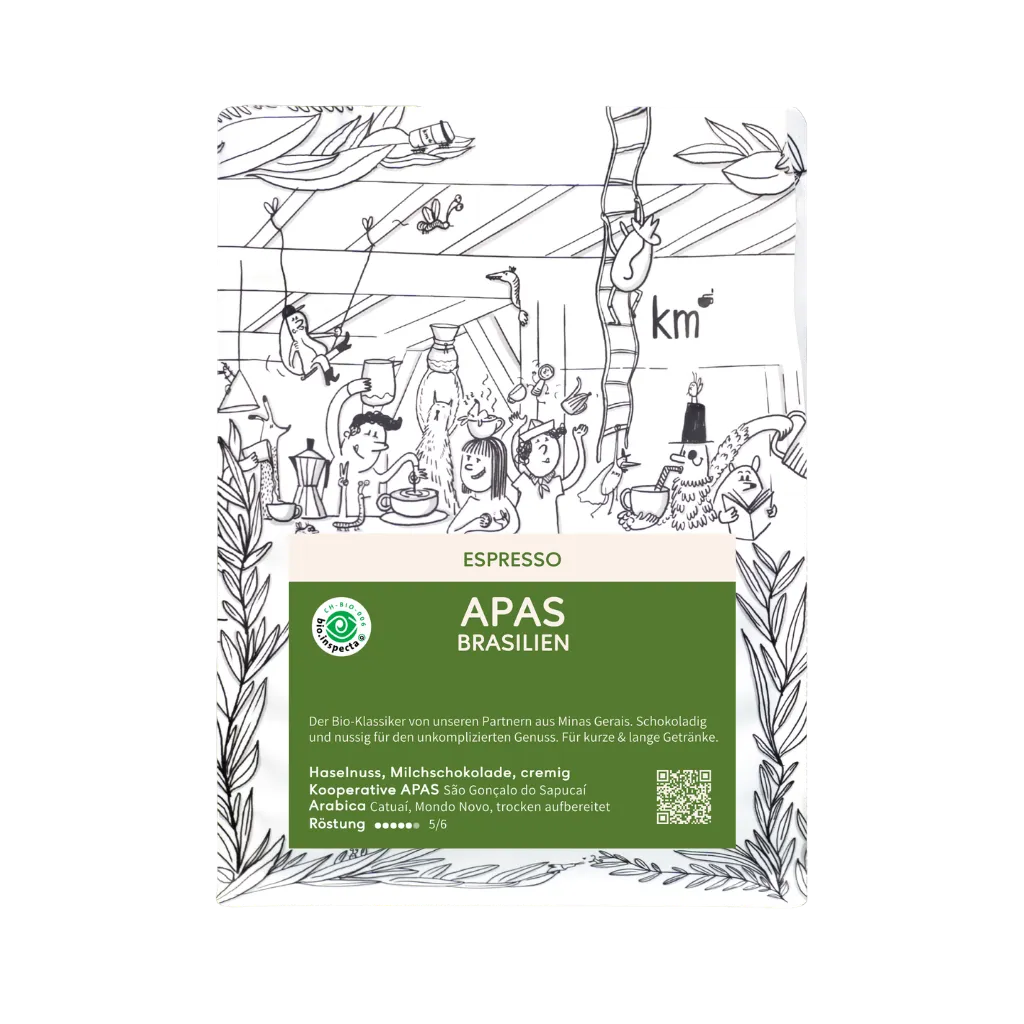
In May 2026, we re-tested volumetrics using our new stress test under protocol v2.3 (Apas Espresso, Mahlkönig E64 GbW grinder, 1:2.5 ratio, 45g target yield across 5 test stages: Scace resistance, reference shot, complex profile, coarse grind stress, fine grind stress).
First Measurement: Calculated Volumetrics Without Scale
Algorithm refinements vastly improved internal volumetric calculations without an external scale.

Average deviation across all five stages dropped to 1.50 grams. Reference shots and profiled shots were near-perfect. Extreme grind changes still cause slight variance, but overall accuracy now earns 7 out of 10 points without a scale (a 3-point improvement over 2024).
Second Measurement: Bluetooth Scale & Adaptive Learning Software
With Bluetooth scale integration unlocked, the Maro pairs directly with Felicita, Acaia, Bookoo, Difluid, and other smart scales.

Maro also implemented adaptive learning software: the machine evaluates previous shot data to auto-correct cut-off timing for subsequent extractions.
Average deviation dropped to just 0.37 grams across all stress stages. Reference shots landed consistently between 45.0g and 45.7g on a 45g target, maintaining incredible precision across fine and coarse grind shifts. This level of repeatability surpasses manual scale stopping, which is subject to human reaction delay and post-shutoff drips.
Paired with a Bluetooth scale and updated software, the Maro scores 9 out of 10 points. The final point is reserved exclusively for machines with built-in drip tray scales. The Maro relies on an external Bluetooth scale, which is equally precise in practice but requires additional hardware. This marks a massive leap from 4 to 9 points.
Even without a scale, stand-alone volumetric precision is now among the best on the market. Adding a Bluetooth scale delivers flawless precision that matches or exceeds commercial machinery.

Steam Performance & Microfoam Quality
The Maro steams a 0.6-liter pitcher for two cappuccinos in 30 to 35 seconds. After purging initial condensation, steam power builds rapidly. At full power, steam performance sits in the upper-middle tier of home espresso machines and can be adjusted precisely via the touch interface thanks to the 2300W thick-film element. The Maro maintains continuous steam pressure across back-to-back pitchers without drop-off because steam is generated on demand rather than drawn from a depleting boiler volume.
The cool-touch steam wand remains safe to handle during operation. We tested both the original tip and a new prototype tip; the prototype creates superior vortex rolling action in the pitcher. As the new tip will ship on upcoming production units, we rate steam performance at 8 out of 10 points.
Simultaneous brewing and steaming is not supported, but steaming immediately after pulling a shot is seamless. For home baristas and small offices, this is a non-issue.
Catering & High-Volume Capability
Can the Maro handle commercial catering at a school event or pop-up stand?
Thermal endurance is rock-solid. Temperature stability and steam power hold up effortlessly across back-to-back shots. In our protocol v2.3, it earns top marks for thermal stability under continuous load, backed by excellent WBC protocol scores and a large drip tray. However, limitation exists: simultaneous brewing and steaming is impossible, the water tank cannot be refilled while brewing, and there are no direct plumb-in or drain-line options.
An unexpected catering observation: the machine is almost TOO QUIET. In a noisy event environment, the lack of pump noise or immediate tactile startup cues left us briefly wondering if the shot had initiated.
High-volume commercial catering isn't its primary design focus. Under protocol v2.3, it scores 5 out of 10 points in catering suitability. For occasional party catering it performs fine, but commercial setups are better served by plumbed, large-boiler commercial machines.(4)

Power Consumption
Combining instant warm-up times with direct thermal transfer makes the Maro Model 1 exceptionally energy-efficient. It doesn't waste energy heating ambient room air or maintaining 0.5 to 1.5 liters of standing boiler water just to brew an 80 ml shot. It heats only the exact volume needed per shot.
We measured just 0.06 kWh for five double shots including the initial warm-up phase. For comparison: an energy-efficient thermoblock machine like the Ascaso Steel Duo PID Plus consumes nearly double (0,12 kWh). A heat exchanger machine like the Lelit Mara X consumes 0.28 kWh (4.5x higher), while the La Marzocco Linea Mini R consumes 0.38 kWh. Only the Zuriga scores slightly lower at 0.058 kWh.
When factor in milk steaming, the Maro's efficiency advantage widens further: heating up and preparing two cappuccinos required just 0.0568 kWh (compared to 0.24 kWh on the Ascaso Steel Duo PID Plus and 0.579 kWh on the Linea Mini R).
10 out of 10 points.

Espresso Potential
We extracted truly world-class espresso shots from the Maro. Across Explorer, Expert, and Extrem modes, the hardware and software provide everything required to maximize cup quality for any experience level.
Sensors embedded directly in the group head measure pressure and temperature precisely where extraction occurs. Pulse Width Modulation (PWM) pump control allows precise flow adjustments ranging from 1 ml/s up to 8 ml/s in Extrem mode.
Custom pre-infusion duration, pressure profiling, blooming shots, turbo shots, lever machine emulation, or our signature Kaffeemacher Lungo are easily programmable.
Water dispersion across the shower screen is exceptionally uniform thanks to Maro's patented internal distribution block, complemented by high-grade IMS filter baskets.
Under our updated protocol v2.3, combining thermal precision, profiling agility, hygiene, and sensory evaluation yields a perfect score: 10 out of 10 points (weighted x3 in overall scoring—the most important category).
One minor gripe: the machine experiences a slight delay (~4 seconds) between pressing start and water hitting the puck. Minimizing this pre-start delay would be a welcome improvement.
The Brewing Modes
Switching between modes requires just two taps on the display. This flexibility makes the Maro ideal for shared households where users possess varying barista skill levels.
Explorer Mode
Explorer Mode offers step-by-step guidance similar to a smart kitchen appliance. Choose from six guided drinks: Espresso, Cappuccino, Americano, Café Latte, Latte Macchiato, or Flat White.
Selecting Flat White displays instructions regarding required cup and pitcher sizes, recommends coffee dose, visualizes extraction, and guides milk steaming. After brewing, it asks for taste feedback—if your shot tastes overly sour, the machine suggests recipe tweaks (e.g., extending extraction yield).
Customized recipes are saved by coffee bean (e.g., Apas). In Explorer Mode, Smart Profiler runs continuously in the background—if a shot channels or runs too fast due to a coarse grind, it throttles flow rate to rescue cup balance.

Auto-corrected shots taste significantly better in the cup than unassisted fast-running extractions.
Expert Mode
Expert Mode functions like a high-end PID machine with volumetric dosing and optional Smart Profiler assistance. Set temperature, dose, target yield, and shot time directly, with full control over pre-infusion duration and peak pressure.
Onscreen graphs display real-time flow (g/s) and pressure, concluding with a post-shot analysis summary.

Extrem Mode
Extrem Mode unlocks limitless profiling capabilities. A preset library includes 6-bar or 9-bar flat profiles, Lever Emulation, Long Pre-Infusion, Slow Ramp Up, Blooming Shot, and Constant Flow.
Custom profiles are structured into multi-stage sequences. Each stage defines a pump behavior until a target condition (exit trigger) advances the shot to the next stage or completes the extraction.
Stages can be flow-driven or pressure-driven, with secondary safety limits (e.g., 8-bar pressure primary target with a 4 ml/s flow ceiling). Exit conditions can be triggered by time, yield in grams, or flow rate across virtually unlimited stages.

Pulse Width Modulation & Pump Control
Traditional rotary pumps operate at constant voltage, relying on an Expansion Valve (OPV) to bleed off excess pressure when water hits puck resistance. The Maro takes a fundamentally different approach, using real-time sensor feedback and Pulse Width Modulation (PWM) to control pump motor speed directly.
Real-Time Closed-Loop Sensor Array
- Inline Flow Sensor: Measures water flow immediately after the pump and prior to the thick-film heater, providing real-time flow rate feedback to the microcontroller.
- Group Head Pressure Sensor: Monitors real-time pressure directly above the puck, detecting resistance changes and dynamically adjusting PWM motor signals.
This closed-loop system prevents pressure spikes that cause channeling, enables precise low-flow profiling, and reduces power consumption.

Maro Home: Database, Profiles, Community
Maro Home is a web-based platform that syncs directly with your machine.
Shot Database
Every shot pulled is logged automatically, recording coffee origin, dose, yield, brew temperature, shot time, grind size notes, and real-time pressure/flow extraction graphs. Users can overlay past extraction curves to evaluate profile tweaks.

Lifetime machine statistics (total shots, water volume processed, cycles since last backflush/descale) are also tracked.
Community Profile Sharing
Custom extraction profiles can be published directly to the community hub or downloaded to your machine with one click. We regularly upload our custom extraction profiles for Kaffeemacher roasts.
Community Forum & Maro Academy
The platform includes user forums, bean recommendations, and instructional video content via the Maro Academy channel on YouTube.
Maro Coffee Engineering
Maro Coffee Engineering GmbH is based in Suhl, Germany, founded by Max Grimm and Robin Kuprat. They hand-assemble every unit in-house, backed by engineering partnership and manufacturing support from Profectus GmbH (specialists in electronics and circuit board manufacturing).
Who is the Maro Model 1 for?
Let's first clarify who the Maro is not for:
- Purists who love traditional, purely mechanical E61 Italian machines.
- Commercial cafes or high-volume catering (due to lack of simultaneous steaming/brewing and direct plumbing options).
- Setups with strict power limitations (requires 2300W peak power).
Who will love it?
The Maro adapts seamlessly to any barista skill level. Guided workflows make it exceptionally beginner-friendly, while Extrem Mode offers profiling capabilities rivaling the most advanced machines on earth. It is equally suited for home baristas, tech enthusiasts, shared apartments, or modern office setups.
Our Wishlist for Future Updates
- In-tank water filter adapter: The only missing usability detail for a 10/10 usability score.
- Faster shot start: Reducing the ~4-second delay between pressing start and water delivery.
- Dark Mode UI: A dark display theme option.
- Integrated Drip Tray Scale: Built-in scale integration for the ultimate 10/10 volumetric score.
Score Breakdown Overview
Maro Model 1
Individual category scale 0 – 10, weighted to a total score of 0 – 100. Learn more about our scoring methodology in our Test Protocol v2.3.
Verdict: Maro Model 1 Espresso Machine
Updated under test protocol v2.3, the Maro Model 1 achieves an overall score of 88.7 out of 100 points, earning our Excellent rating. Software updates and Bluetooth scale integration elevated volumetric accuracy from 4 to 9 points, while Maro Home seamlessly connects the user community. There is very little room left for improvement.
The only factors holding it back from a higher total score are its high price tag and limited commercial catering capability.
At 4,999 Euros, its price-to-value rating lands at 4.3. Buyers seeking purely economical setups can find cheaper machines that pull great espresso.
However, for home baristas seeking maximum technical performance with a 5,000 Euro budget, the Maro Model 1 has virtually no equal. Rivals like the Linea Mini, Faemina, or Sanremo You sit in a similar price bracket, but none offer the profiling agility, instant heat-up speed, and smart assistance found in the Maro Model 1.
Two young founders from Thuringia have leapfrogged traditional industry giants still attached to legacy boiler architectures. We are thrilled to have acquired an early unit, and we look forward to its continued evolution.
Footnotes
(1) For exceptionally expensive machinery, we occasionally pay a loan fee and return the unit post-testing. We never accept free primary review units. If a machine performs poorly, we allow manufacturers to provide a second unit to challenge our findings.
(2) e.g., also utilized in the Sanremo You.
(3) Sanremo You: 15 minutes; Dalla Corte Mina: 20 minutes.
(4) Let traditional boiler setups keep catering as their home turf!
Disclaimer: We purchased the Maro Model 1 independently. This review and update were not requested or commissioned by Maro. Maro received no preview access to our video or written content, and no compensation was exchanged.