




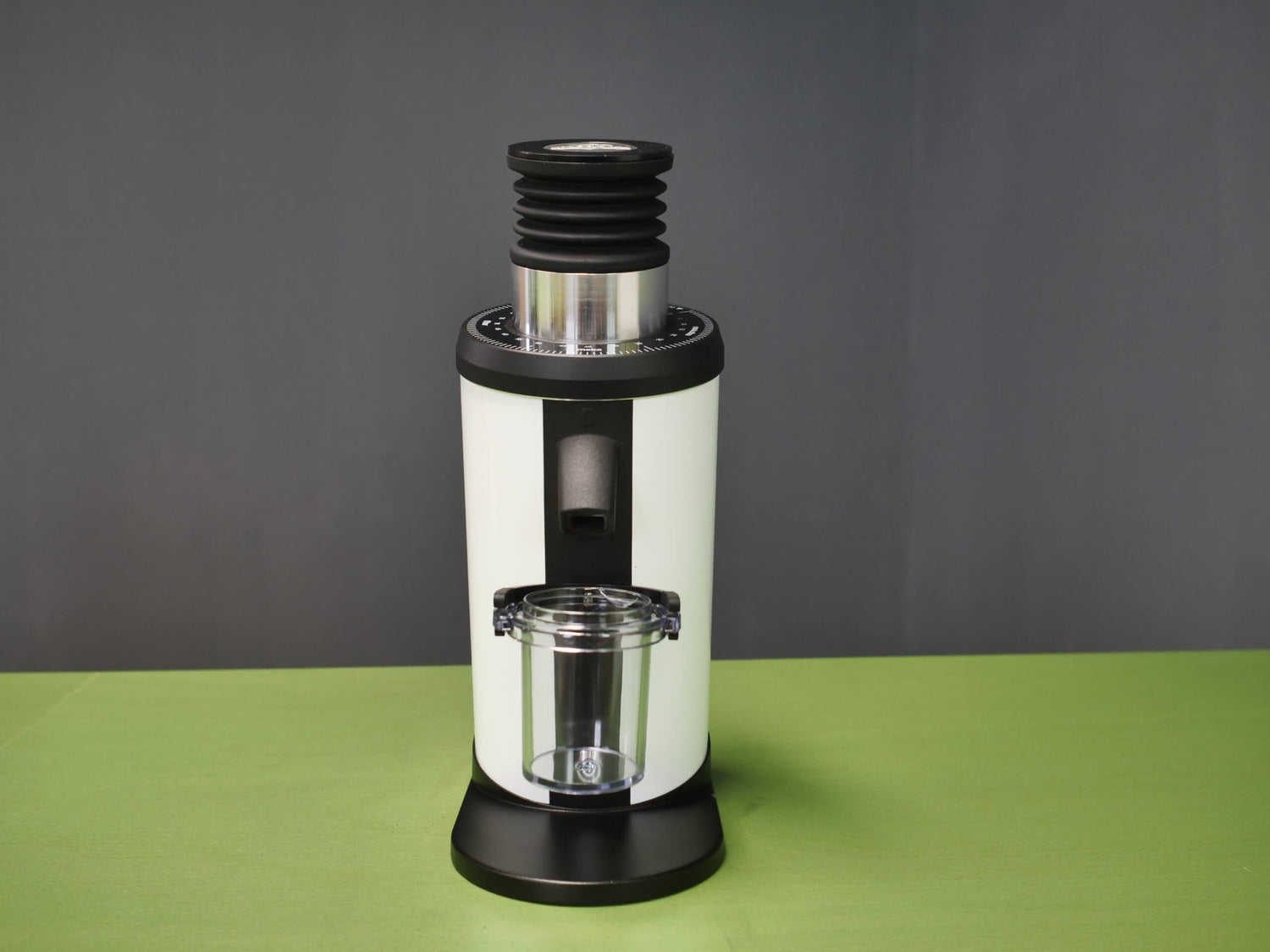

Single-dose espresso grinders fascinate us. Accordingly, our Niche Zero test turned out very positive. However, the Niche – not least since Brexit – burns a hole roughly 800 euros deep in your wallet. We wished for similar performance for less money. And to cut to the chase: the G-Iota, which is also offered as the DF64 in many places, fills exactly this gap. The DF64 costs half the price of the Niche Zero, but doesn't need to hide when it comes to performance.
To the current test report of the DF64 Generation 2.
In our test report, we examine the grinder from every angle, offer a few tips, and even venture a first comparison with the 23 other espresso grinders we're currently testing. Here's the comparison with grinders in the same price range.
In the meantime, we've published an upgrade video for the G-Iota. We've tried quite a bit. Among other things, we installed SSP Multipurpose burrs, which do really good work. This makes the DF64 even better.
For Austria and Germany, Bohnendealer* is the importer of the G-Iota. Unfortunately, there is no official importer in Switzerland.
Single Dosing – What Is It?
Espresso grinders are experiencing their 2nd evolution today, which has now also arrived in the home market. The 1st evolution was the step from "bean hopper" or "dispenser" to on-demand grinding or "grind on demand". Instead of grinding larger amounts of coffee in advance and keeping it in the dispenser, coffee was ground directly into the portafilter. This was a first step toward greater freshness and less oxidized coffee.
Today we're going through the 2nd evolution, with the step toward single-dose grinders. After all, a large portion of the coffee was still exposed to oxygen and light in the bean hopper. The single dosing or single-dose principle is penetrating the market, and here's how it works: a home barista weighs out the desired amount of coffee, puts it into the top feed area, and grinds directly into the portafilter.
This makes it possible to switch between coffees. For guest A, a decaf can simply be brewed, while guest B prefers a fruity espresso. The coffee stays fresher longer because it's stored in the perfect container. For the home barista, weighing the coffee opens up an understanding of brew ratios and the opportunity to experiment with recipes.
What a single-dose grinder must be able to do:
The grinder should have no dead space and should expel all ground coffee.
The brew recipe must be easily adjustable, and the grind setting should deliver the same particle distribution even after being changed and then returned to the same marked positions.
In short, consistency and precision are important!

The bellows on the DF64 ensure that the grinder has no dead space.
DF64 as a Single-Dose Grinder
The DF64 meets the necessary criteria for a good single-dose grinder very well. It does so using some aids, like the bellows, but ultimately the grinder achieves its goal.
If the DF64 is used without the bellows, it has a dead space of 1.5 grams of coffee. While this is a good result compared to many traditional grinders, it's not acceptable for a single-dose grinder. By using the bellows, the dead space can be reduced to nearly 0 grams. We recommend that after grinding the main amount of coffee, use a few strokes of the bellows to remove any remaining coffee powder from the area behind the flapper. Caution: this can result in a powerful burst that also scatters some coffee powder on the table. With careful strokes, however, we were usually able to avoid this. This reduces the residue in the grinder (dead space or grind retention), and the coffee put in – for example, 18 grams – is consistently ground out again.
The grinder also impressed with its precision. For us, it was easy to adjust the grind setting and return to the same grind size. In fact, the grinder lacks a good grind setting indicator. Creative minds have developed marking pointers for 3D printers that work well and can be ordered on platforms like Etsy* as well.
A corresponding update could improve the grinder further and make operation easier. However, we had no problems resetting the grinder to the same grind size. In fact, when adjusting and resetting, the grinder was more precise than many other grinders in our test series.
So we can confirm that the DF64 or G-Iota has everything that makes for a good single-dose espresso grinder!

Espresso Performance of the DF64
We enjoyed the espressos from the DF64. They were well-balanced and various characteristics could be brought out nicely. The particle distribution of the grinder was in the solid average range.
Espresso data (T4):
- X50: 318.30 Micron
- Fine peak: 20.78 %
- Main peak: 247.58 Micron

Operating the DF64/G-Iota
We've already covered the operation of the DF64 in the section on single-dose capability. In general, the grinder can be adjusted precisely and well. The large grind adjustment wheel runs very smoothly and allows stepless adjustment. The large diameter provides a slow gear ratio for the effective grind adjustment. This is very positive, in contrast to grinders like the Eureka Specialità, where the small adjustment wheel often overshoots the point.
The grinder has no other adjustment options. There's an on and off button. That's it.
Not part of the classic "adjustment" and scope of operation is the alignment of the espresso grinder. Some users report that their DF64 arrived with burrs that didn't sit perfectly on top of each other. As a result, the ground coffee has a less precise particle distribution, and the burrs also become dull more quickly. The position of the burrs can be checked and adjusted independently. We'll make a video about this. However, there are already several instructions on the internet under the keyword grinder alignment. With our DF64 model, the burrs were perfectly aligned.
When using the bellows, we recommend careful and controlled pressing so that the grind size doesn't shift in the process.

Side view of the G-Iota with transparent dosing cup that fits directly onto the portafilter.
Size, Weight, and Appearance
Elegant, narrow, and heavy – that's how the G-Iota stands next to our Decent Espresso. It's available in various color patterns. We purchased and tested a black and white model (like all grinders, we bought these grinders ourselves for testing purposes). The grinder is one of the heavier models in the price segment up to 500 euros. The grinder weighs 13 kilograms and stands very firmly and solidly. 30 mm height, 130 mm width, and a depth of 225 mm create a harmonious picture.
The grinder comes with a transparent dosing cup. The dosing cup fits nicely into the portafilter holder. Our cup got a small crack when we tapped it out. Benjamin and Michel disagreed on the cup's assessment. While Michel would swap the cup for a metal one, Benjamin appreciated the transparent design. Especially for learning and training purposes, the transparency is interesting, making it easy to see how the coffee powder distributes in the portafilter.
Not only does the dosing cup fit into the holder, but so do all standard portafilters from companies like Rocket, La Marzocco, or Slayer. With portafilters that have larger side protrusions, there is wear on the rubber grips. However, these can be easily replaced.

Conclusion on the DF64 - G-Iota
The G-Iota is a really good grinder that impressed us in almost all categories in our test. Only in terms of speed does the grinder rank among the slower models with just 19.1 grams output in 10 seconds.
The grinder's noise level is at 83.2 decibels, which is in the mid-range. Operation is easy and very precise. The bellows reduce dead space to zero. This makes the grinder not just very good for single-dose grinding.
In terms of value for money, the G-Iota impresses with a purchase price of around 400 euros. As you can also see from our video: we're very impressed with the DF64. A really good espresso grinder and a very interesting choice as a single-dose grinder.
And that's not all: if you want to improve the grinder further, you can achieve even better grinding results by switching to 64-series SSP burrs. Whether that's necessary and whether we can spot the difference in a blind tasting is something we'll deliver to you as a result and video. A direct comparison with the Niche Zero and Eureka Single Dose is also planned.
Upgrade Video for the DF64 G-Iota
► SSP Red Speed Burrs at Bohnendealer*
► G-Iota Grind setting indicator on Etsy*
► Beveled Improved dosing cup holder for DF64, G-IOTA on Etsy*
► G-Iota Dosing Cup Holder 51 mm on Etsy*
*This is a commission link. If you order through this link, it won't cost you any more. We receive a small commission. This helps us buy more test equipment and publish new tests. Thank you in advance! We also refer here to a shop that we know well and from which we know that it provides good service.