Transparency Report 2025/26: What's Behind Our Green Coffee Prices
 Philipp Schallberger
Since 2020, we have published our green coffee prices on our website. Numbers alone tell us little, though. For this reason, in our first transparency report 25/26, we are presenting them together with the context behind them for the first time: how we buy, what prices on the exchange do to our partners, and what stories lie behind three of our coffees.
This article contains the complete transparency report 25/26. If you'd prefer to read the designed version with all the images in one go, you can download it here: Transparency Report 2025/26 (PDF).
Context, not just numbers
We are a transparent company and communicate a lot through our various channels. So far, we have delivered the context for our prices separately from the numbers – on our website, on YouTube, and on social media. We have reported what we do, but also what we don't do. Now, for the first time, we are bringing the context together with the numbers.
In just over eight years as a roastery, with a broad product range and direct relationships with coffee producers, we have learned a lot – and we continue to learn. Through our own experience running a coffee farm, through coffee trips, and countless conversations with producers, roasters, and traders, numbers take on meaning. Without context, they say little, and that is always a shortfall when looking purely at the FOB price. Behind every number is a story. We tell three of them here: that of Farmers Coffee (Brazil), that of Yulma Argueta (Guatemala), and that of BridAzul (Nicaragua).
Coffee is a people's business
When a coffee producer told me in Kenya in 2013 that "coffee is a people's business," I already believed him. But I could never have imagined that today, even though I work with coffee, I deal with people much more than with the coffee itself.
Since 2017, we have been roasting commercially. Back then, we set up a roastery in the basement of a residential building, bought coffee from friendly traders, and simply got started. Our product range was manageable, yet we had the ambition to want to know everything about the coffees we purchased. We sought contact with importers who could tell us more about the background. We wanted to understand what the FOB price was, and especially what it meant – and what it didn't.
As a young company – since January 2017 as an independent limited company – we had to devise a strategy: being economically successful in the long term and staying close to producers while paying fair prices for green coffee. Because good coffee is the result of good relationships. For the majority of our coffees, the beginning was an encounter with a producer. From the encounter developed conversations, and when things clicked, green coffee samples followed. If we liked them, a first import followed. And from one first import came joint projects – always in a way that worked for both sides.
This report is a testament to its time. When we publish it again in a year, I hope that many of the names mentioned will appear again. We dedicate a substantial amount of our time to relationship building. Actually, we work with coffee, but even more than that, we're in the people's business.
— Philipp Schallberger, on behalf of the sourcing and roastery team. Basel, June 2026.
Thinking long-term in short-term times
The past five years have been extremely eventful when it comes to green coffee. The pandemic, supply shortages, the coffee exchange at an all-time high, and growing challenges for coffee farms due to climate change have required all participants in the coffee chain to remain highly agile.

Photo: Tatiana Gomez
In the Sierra de Zongolica in Mexico, since 2021 we have been working with Ensambles on the Toca project. The young cooperative Citlal Kaffen stores its coffee in parchment in an old beneficiary that was closed in 2013. Now they have put it back into operation. This beneficiary was once a chicken farm – and also a church for the surrounding communities.
How we think about our role as a roastery
We exchange information daily with our production partners. They are far away, but they are what makes it possible for all of us to drink coffee. With them, we learn what it takes today so that we can still drink coffee tomorrow. Three formats show how we think about our work:
From Source to Sip – the roasting film
In our roasting film, we take you on a journey from the coffee origin to our roastery in Basel. We show what goes into a cup of coffee, and we start where the coffee comes from. Because without coffee producers, there would be no coffee roasteries. A film by Larissa Bürgi about the people and the story behind the coffee.
Our 10 Coffee Commandments
Pointed and ambitious: In our 10 coffee commandments, you'll find ten striking statements that sum up our work as a coffee roastery.
APAS and the Brazil Coffee Trip 2026
The APAS film is a tribute to the APAS cooperative and to the relationship we have been building with them for several years. On the Brazil coffee trip 2026, Benjamin, Philipp, Gabi, and Larissa traveled 1500 km through Minas Gerais and Espírito Santo: to bioproducer Marcia, to the cooperative export lab Copervass, to the APAS cooperative, and to Farmers Coffee. What comes out is a different picture of Brazil than the one that usually sticks in your mind – and conversations about partnership that you can't have via WhatsApp.

Visiting the Brioschi family in Pedra Azul, Espírito Santo.
What we purchased in 2025/2026
The coffee harvest year differs from the calendar year because harvests occur at different times depending on the region of the world. We chose June through May as our reporting period because we also make many contracts in the first half of the year.
The complete purchasing data can be found in the PDF
| Key figure | Value 2025/26 |
|---|---|
| Share of partnerships 3+ years | 37 % |
| Ø SCA quality score | 85.8 |
| Origin trips 2025/26 | Ethiopia, Brazil, Mexico, India |
| Number of producers/cooperatives | 43 |
| Countries of origin | 16 |
| Contracted green coffee | 129,110 kg |
| Ø FOB price (USD/lb), unweighted | 5.76 USD |
| Ø FOB price (USD/lb), weighted | 4.81 USD |
| Ø Relationship duration | 4.52 years* |
- We explicitly do not include coffees from our adventure line here. These coffees are often one-time purchases and aim primarily at excellent quality in the cup.

In the mountainous region around Villa Rica, César Marin produces specialty coffee with his family on a farm that operates without external inputs. They produce all fertilizers and plant protection products in-house according to regenerative practices. This makes them immune to fluctuations in the fertilizer market. What they are not immune to – and this is no farm – is coffee price fluctuations. Even though we repeatedly bring up fixed prices, we haven't been able to establish any yet. A fixed price could help cushion the fluctuations.
The green coffee prices from 2025 to 2026
In early January 2025, the C price – the global futures reference price for Arabica on the New York ICE exchange – was around 330 US cents per pound of green coffee. On February 12, 2025, Arabica reached its absolute all-time high: over 442 cents per pound, more than five times the long-term historical average. The previous record high was from 1977.
| Time | C Price (US cents/lb) | Classification |
|---|---|---|
| Early January 2025 | ~ 330 | already significantly elevated |
| February 12, 2025 | > 442 | absolute all-time high |
| Early June 2026 | ~ 250 | almost halved from the high |
Three causes behind the historic price increase
In summer 2025, the price first stagnated and then slowly fell. US tariffs caused uncertainty on all sides. This led to short-term, strong fluctuations – and especially caused producers to wait before selling coffee at all. Speculation capital slowly withdrew, and prices fell in autumn 2025.
Spring 2026 brought the turning point. Brazil's 2026/27 harvest is likely to become the largest ever measured, with an estimated 66.7 million bags – 18 percent more than 2025. Exchanges react quickly to news, so positive reports from Brazil immediately affected the price: in early June 2026, the C price fell to around 250 US cents, almost half the high from 15 months earlier.

Heading uphill in the Sierra de Zongolica, Mexico
What do these fluctuations mean for us?
We move with prices in an overall movement, up and down – at least with producers who use the C price as a reference. On top of the C price comes a differential, an individually designed premium. Some producers set the price for us, still others ask us what we're willing to pay. It's a mix of approaches.
All producers know the movements on the New York exchange very precisely, because these influence the respective national coffee price. What happens in New York affects the national price in Mexico, from which regional prices in Chiapas, Veracruz, or Puebla are then set. Prices thus arise from regional prices, mixed with quality premiums, ecosystem services, and a perceived markup. A price discount for us occurs where we have purchased long-term.
What do these fluctuations mean for producers?
The C price swung between 270 and 440 US cents per pound over the last 18 months. For producers, that means: sell or wait? Those who fix too early leave money on the table; those who wait too long risk a crash. Producers have also realized how speculation works, and they can influence prices by holding back their coffee.
Especially Brazilian farmers were reluctant to sell in early June 2026, even though the harvest was underway. That's because every investment decision – new plants, fertilizer, labor – requires planning security that simply doesn't exist right now. The Iran war and inflation are causing additional costs for fertilizer and logistics, so decisions are being made hesitantly by our partners too.
Coffee producers have gotten used to fluctuations because the vast majority tie their prices more or less strongly to the exchange. But this recent extent of fluctuations has led to a lot of uncertainty. So producers in Brazil, Mexico, India, and Indonesia sold more coffee to their domestic market than exported. Local sales generate quick cash, while exports and payment take several weeks.
Three stories behind the numbers
Farmers Coffee and the Compadre (Brazil)
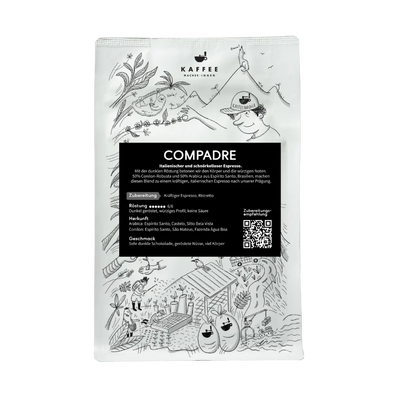
In 2023, Philipp visited Farmers Coffee in Venda Nova do Imigrante on a recommendation from algrano. "They have drive," it was said. Farmers Coffee is called that because all four founders are sons of coffee producers. At their first visit, they had just begun buying and marketing coffees from producers in Espírito Santo. Their education at the renowned IFES university, their openness, and their youthful drive helped them grow quickly.

The Romão family contributes the Arabica portion to the Compadre.
In 2024, they visited us in Switzerland, and we discussed how we could work together. That's how the idea of Compadre Espresso came about. Because they buy from and export from Arabica and Conilon Robusta producers, they were able to assemble the blend according to our idea: a 50:50 blend, which Farmers Coffee mixes for us before export and fills into coffee bags as a pre-blend. They established a new process for this and fully committed to the project. The coffee has gained traction, and in 2026, we visited them again in a small group – as well as the family that provides the Arabica portion for the Compadre.
Farmers Coffee is extremely customer-focused and sees roasteries as partners that they want to understand. We share all numbers, inform each other about projects and business performance – the trust is there. Partners like Farmers Coffee show how much fun it is to work with strong, networked companies that themselves stay close to producers.
Yulma Argueta and the Amigo (Guatemala)
Yulma Argueta didn't start producing coffee until she was 40. Coffee producers are usually born into a coffee family and take over the operation at some point. Yulma's story was different. With her family, she ran a farm in Baja Verapaz, Guatemala, that focused on horse breeding and lumber production. But coffee was always her passion, so she started planting a few hectares relatively late. She sold her first harvests on the local market – she wasn't even really aware of the quality of her coffee.

Yulma with Nadja and Philipp at the World of Coffee in Geneva, 2025
She came into contact with Grounds for Empowerment, an online program that created a network of Latin American female producers during the pandemic. Philipp gave a workshop on storytelling back then, and Yulma was there. She shared her biographical story with the group. It was an emotional moment that created a connection. We stayed in touch, and a year later she sent us samples. The washed coffee from 1800 m above sea level was very good, but we couldn't find an export partner who would have taken on the effort for a few bags of green coffee.
It worked out in 2025: Yulma was able to export coffee outside Guatemala for the first time. We roasted her coffee for the Amigo filter coffee. It was also well received by other roasteries, so we were able to help her expand her network. To make it possible for the coffee to be exported with as little effort as possible, we networked her with various exporters; she decided on algrano. In 2026, we bought from her a second time. We see it as our responsibility to continue networking partners so they can diversify. Because that's how we grow together.
BridAzul and Doña Margarita (Nicaragua)
When we took over Finca Santa Rita in Nicaragua in 2017, the BridAzul team was just beginning to conduct various fermentation experiments. They tested hundreds of processes and stabilized them until they had their handful – with which they continue to rank in the top 10 at Cup of Excellence competitions multiple times. In one of these processes, the cherries are sorted in a water channel, placed in rainwater barrels, sealed, and fermented for four days. After that, they dry in the shade. The hours in the barrel and the length of drying produce different sensory profiles.

One of these BridAzul called "Lucid Dreams" – a coffee that was a dream, but whose taste notes were so clear to see. Each year it shows notes of sour cherry and passion fruit, is heavy and juicy at the same time. We were delighted, but wanted to name the coffee after a person, as we do with all our coffees. Since our partner on-site didn't want to appear on the package, we named it after a former owner of our Finca Santa Rita: Doña Margarita. The name worked, as did the coffee.
Each year, BridAzul refined the process and limited the cherries used to two farms – Santa Rita and a neighboring farm – which made the coffee increasingly homogenous. Today we serve it in our cafés for three months. There are regular customers who wait a long time for this period and otherwise ask: "When is Doña back?" When a coffee gets a nickname, it's on its way to becoming a classic.
How we buy coffee
"Start with the end in mind" is our guiding principle before we even think about a specific green coffee. First we ask ourselves: What purpose should the green coffee serve? Which beverage, which extraction method, which customer group, which flavor profile, and what price point? Once these questions are clarified, we first search within our existing network of producers. Best case scenario, we buy various coffees from the same producers.
Diversifying the origin
In recent years, we have positioned ourselves more broadly geographically and structurally. We long had a large Brazil share in our portfolio and still do, but we're diversifying within Brazil across different regions (Minas Gerais, Campo das Vertentes, Matas de Minas, Espírito Santo). Indian coffees are newer to our product range, and the share of Colombian coffees – measured by Colombia's global importance – is still very small. With this diversification, we're preparing for possible supply disruptions. Especially with larger volumes, we've become more risk-averse and stock up on regularly roasted coffees, because some surprise is always waiting.

Sorted and packaged coffee is loaded into containers in Nicaragua.
Diversifying importers
We typically buy through carefully selected importers with whom we share much in common. We've been working with algrano since 2017 and source most of our coffees through the platform. In Mexico, we work with Ensambles; This Side Up gave us access to coffee from India. We're connected to Falcon through a long-standing friendship; with Plot Coffee, we were in Ethiopia, where they're well networked. We rely on Belco in Colombia. Especially with micro and nano lots, we work with specialized importers who have a clear specialty. So we've greatly broadened our importer network.
Ordering as early as possible
We try to give our partners a volume idea six to eight months before the coffee arrives so they can plan. Early ordering is followed by a contract, which we also sign as soon as possible. Regularity and predictability lead to necessary stability and security on both sides.
Pricing
Pricing is as individual as the coffees themselves. Broadly, there are three paths:
We prefer it when producers name their price and explain it clearly. Very low prices make us suspicious, as do fabulous prices that no longer reflect production costs but rather brand value. To get as close as possible to a "right" price, it takes open conversation – so that both sides can say the price was fair. Negotiating prices is as much part of our work as refraining from speculative practices.
Contact and visits
We have visited all the producers of our most-purchased green coffees – from one-time to regular visits. Throughout the year, we're in regular exchange, sometimes more superficial, sometimes more profound, as a partnership is. Not every delivery runs flawlessly: delays happen, sometimes damaged coffee bags, rarely also cancellations because, for example, a community lot can't be mixed. In the coffee industry, there's always a challenge somewhere. But we've learned that there's always a solution. And when we find it together with the producers themselves, we're working on the foundation of a strong, future-proof relationship.

Year after year, we visit the Toca project, which strengthens trust.
Time differences, calls, and trips
A romantic long-distance relationship works when there's regular exchange. A partnership long-distance relationship follows the same principles. WhatsApp seems to be the favorite tool of coffee producers; we write emails when it comes to concrete contracts. You have to imagine this: we sometimes discuss six-figure amounts, agree on volumes and prices via WhatsApp – and right at the end, there's still an email to cement the chats.
Since we source much of our coffee from Central and South America, we communicate with Yulma, César, and others when it's late afternoon here. One of our running jokes: "The Latinos are awake now, time to chat!" What's important is that we stay in touch not just before and during harvest but especially afterward – between harvests. This in-between time is our strategic communication time: the pressure is off, we can recap, and look to the future together. Harvest communication is like a 90-minute soccer match: focused and fast. Between harvests, it's like training – more time, more space. That's why we typically schedule our trips during the season between harvests.
Trust before control
Much of what happens in our daily work as an SME occurs through direct communication, personal exchange, and mutual trust. Less happens through certifications and formal control – internally and externally. On one hand, because we know our partners directly, we exchange with them, and visit them; on the other, because they themselves forego certifications and we as buyers don't necessarily insist on them. Trust before control is our approach. For that, it takes exchange – and proximity.
The proximity framework by Edelmann et al. (2020) distinguishes four types of proximity:
In organizational, social, and cognitive proximity, we're closely calibrated with many partners; institutional proximity remains more informal in nature. To secure ourselves externally here, third-party certifications (Fairtrade, EU/CH-Bio, Demeter) would help. But for now, we won't lead all our partners to such certification. If they wish it, we support them – as we have with APAS and are working on with Toca.
We also systematically evaluate what role our producers' own guidelines can play for us. Participatory Guarantee Systems (PGS) are local, alternative quality assurance systems. They certify producers through the active involvement of all stakeholders and are based on physical, social networks, direct exchange, and trust – a bottom-up approach that can adapt to the specific ecological and social conditions of a region. When we buy coffees without knowing the exact background, they are at least certified coffees – like a bio-certified Robusta lot through InterAmerican. We don't sell coffee in classical retail and therefore aren't bound by third-party certifications that are often required in food retail.
How we understand sustainability as a company is in Sustainability at the coffee makers. We disclose our measured CO₂ footprint of the roastery in Our CO₂ footprint, and how many emissions are generated in cultivation is shown by the analysis Environmental impact of coffee cultivation using our Finca Santa Rita as an example. We explain the coffee path, exchange, FOB, and seals in overview form in Coffee market: trade, seals, transparency.
What are our plans?
For a long time, it was a running joke among us to ask each other: "Come on, let's talk about growth again. How do we think about it?" We are a company in steward ownership, we own ourselves, and don't have to meet any investor-mandated goals. We set them ourselves, grow organically, and invest where we see opportunities for development. We have no growth pressure – we have growth desire. Because when we grow, our partners grow with us. If we sell more Amigo with coffee from Yulma, Yulma can supply us more, and we become economically more important to each other.
That strengthens a connection that leads to more retention on both sides. The limit is mutual dependence, which we must avoid. We put common growth at the center of our first Producers Conference in late June 2026. It's called in effect Growing Together. Our plans include growth, but not just in numbers, but also on an interpersonal level. We prefer to work longer term with the same producers rather than roast more volume no matter what. Rather continue learning more from each other than make promises that are too big. Strong growth also requires that we can support it – that the team handles it and the infrastructure allows more volume. We develop these scenarios at our pace so we remain reliable partners on one hand and a specialty roastery with high quality standards on the other.
In short
The coffee market has experienced extremes over the past 18 months – from an all-time high of over 442 US cents to almost half that at around 250 US cents. What carries through all the fluctuations are relationships: order early, talk openly about prices, diversify, and stay close to the people. This report is like a relationship in transition and will continue to evolve. If you have input or wishes for the next edition, please write to us at roesterei@kaffeemacher.ch.
Responsible for content: Philipp Schallberger, Kaffeemacher AG, Güterstrasse 140, 4053 Basel. Published in June 2026.