












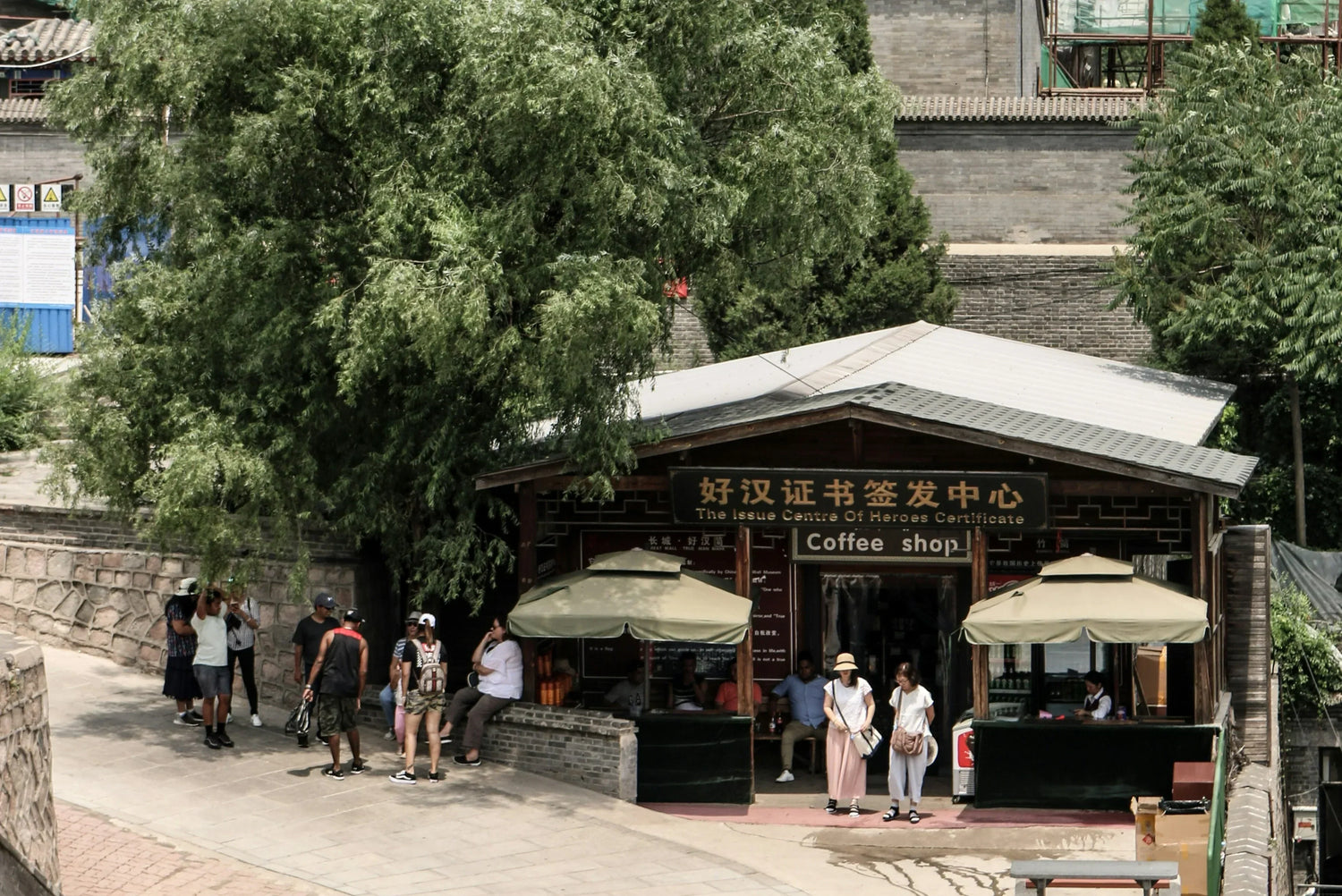

"Just imagine," a speaker opened his presentation a few years ago at a coffee conference, "if the Chinese discovered coffee. Can you imagine the scale?" What sounded very hypothetical and intangible to many just a few years ago grabbed the industry's attention with a headline at the end of 2023 and shook the coffee world: the tea nation China has had more coffee shops since the end of last year than the previously undisputed leader of to-go stores, the USA. Let's go through this step by step.
Which country has the most coffee shops?
The origin and pivotal moment for the modern coffee shop is often dated to 1966, when Peet's opened in Berkeley (San Francisco Bay Area), laying the foundation for the giant Starbucks that would later emerge from it. Coffee, often regarded as the sobering agent of nations, also had a decisive impact on the work ethic of the population. Because in the 19th century, it displaced alcohol from the menu and became, for example in Switzerland, a companion to the equally young morning potato dishes.
Coffee to go became a synonym for the United States.
And so coffee culture in the consuming West underwent another transformation. While in the 1860s people celebrated the first sale of roasted coffee in 500g bags initiated by John Arbuckle, thus making life easier for housewives of the time (as it said in numerous coffee bag advertisements), or praised the invention of the Melitta filter, the espresso machine, or instant coffee in the first quarter of the 20th century, people now wanted to provision themselves even more independently, even faster, even more uncomplicated in the 1980s. With Starbucks, a giant was born that continues to have enormous influence on the entire coffee value chain. The USA had been the undisputed leader in the number of coffee shops ever since. Coffee to go became a synonym for the United States.
Is coffee drunk in China?
Back to my presentation and the question "Can you imagine the scale?" The silence in the room suggested that until then only a few had dealt with it (or wanted to), and the question of scale didn't really burn anyone's fingernails. At the end of last year, the tea nation China itself gave us the answer to this question. The Chinese drank 5 cups of coffee per person in 2023. Modest, it seems, when we compare it, for example, to Americans, who consume 363 cups per person annually. A quick back-of-the-envelope calculation shows us the following comparison:

If the Chinese in the future drank just a quarter as much coffee as Americans, they would already equalize per capita consumption and drive world consumption up by nearly 15%. The appetite of China's Y and Z generations for Western lifestyle is driving coffee consumption at record pace. The following figures make us sit up and take notice again. At the end of last year, almost 50,000 coffee shops were counted in China. Of these 49,691 stores, 58% opened in 2023! The Chinese chain Coti alone created 6,004 outlets. To put it bluntly: for the first time, the USA was knocked off its throne as the leader in coffee shops. And this happened in the birthplace of tea, which now has more coffee shops than the birthplace of coffee shops itself.

Is coffee grown in China?
Well. Tea and coffee thrive in similar cultivation conditions. Both need sufficient water, adequate heat, and similar soil composition. However, coffee is much more susceptible to cold temperatures. These prerequisites for successful cultivation are found in China, which is responsible for a third of global tea production, in the southwest of the country. In the Yunnan region, 95% of national coffee thrives. Hainan (Island) and Fujian play a role in the Robusta market. An impressive 60% of the coffee produced in Yunnan comes from a single area, from Pu'er.
At the end of February 2024, Sucafina, a Swiss green coffee trader, opened the largest wet mill in Yunnan. At the same time, the largest one that Sucafina operates worldwide. The state-of-the-art wet mill is equipped with solar water heaters and can process over 15 million cherries in one hour, among other things. With 4.2 million 60-kg bags of green coffee, China, the tea nation, is the ninth-largest coffee producer worldwide. Further impressive figures in a country where coffee was hardly appreciated just three or four years ago. China's export volume of green coffee roughly covers Swiss consumption.
What impact does this have on the economy?
The growing appetite for coffee among people from the Middle Kingdom has already led to groundbreaking announcements. For example, the Australian Open recently announced that Luckin Coffee will be the official coffee partner in China and Southeast Asia. As the largest Chinese chain since 2017, Luckin Coffee has more shops than Starbucks, the previously dominant player in the coffee shop market.
Luckin Coffee displaces Lavazza as Australian Open partner
And this despite Lavazza being the partner of all four Grand Slam tournaments since 2015. That the Australian Open chose Luckin Coffee as partner might raise eyebrows with some. After all, the chain made many negative headlines around fraud and insolvency in 2019/20. The COO had falsified sales figures in the millions, which ultimately led to delisting from the stock exchange. Despite the fraud scandals and insolvency, Luckin Coffee has fought its way back. Through stricter internal controls, they want to regain the trust of investors and customers. For the organizers of the Grand Slam tournament, apparently convincing enough.
A few days ago, we received news that Luckin Coffee made a deal with Brazil for 120,000 tons of coffee with an estimated value of 500 million. For the harvest year 2024/25, that's about 5% of Brazilian green coffee. For comparison: In 2023, Brazil exported coffee worth 280 million dollars to China, i.e., to the entire country, not just to one chain. In 2023, Luckin Coffee opened 16.5 coffee shops per day. You have to let that sink in.
And now?
The appetite of young generations in the Asian market for coffee is enormous. And not just for hot drinks, but especially for cold beverages. Almost daily, coffee news reaches us from the Middle Kingdom as well as the entire Asian region. The Philippines and Malaysia are experimenting with the Liberica and Excelsa species, Vietnam is producing specialty Arabica, India and China are refining their post-harvest processes and bringing coffees with high SCA scores to market. Together, people are driving coffee consumption upward with manifold power. Top quality is sought after and appreciated and paid for accordingly as a prestige object. A favorite variety is Geisha, which particularly scores with its tea-like character and delicate, floral notes.
The appetite of young generations in the Asian market for coffee is enormous.
The preference for coffee preparation has also changed. Cappuccino has become the most popular drink and has replaced instant coffee, which was highly valued until then. The increased appetite for milk drinks brings with it another interesting figure. As recently as 1949, there were 120,000 dairy cows. Nowadays there are 13 million.
Their consumption behavior will also be felt in our latitudes. Especially in the tourist regions, in whose cafés we will increasingly welcome guests from Asia. Those who offer coffees without overwhelming bitterness and without flavors of burnt rubber and toast will be able to win over these curious and open visitors.
With them, the demand in restaurants and hotels will likely change as well: it takes not just more coffee, but also better quality and different flavors adapted to the Asian palate. As they say: you do the math.