




























Freezing roasted coffee makes sense when done correctly. Otherwise, the statement still applies: "Coffee should not be stored in the refrigerator or freezer!"
When freezing makes sense, what needs to be considered to keep the coffee delicious, and what should absolutely be avoided—we explain all of this in this article and video. Since there are now initial research results on the topic, we incorporate these findings as well as our own tests. Over several months, we froze and tasted coffees of various qualities. These were then professionally tasted by three Q-graders.
Why freeze coffee beans?
Freezing roasted coffee primarily serves to extend shelf life and preserve aromas as well as possible. The slowdown of oxidation processes plays an especially important role, as these otherwise cause coffee to lose complexity. Oxidation occurs when the oils within the coffee come into contact with oxygen. The result is rancid, bitter, and other so-called "off-tastes" that make coffee increasingly unpalatable. Other aging processes also cause coffee to taste less complex, its acids become more aggressive, and the flavor becomes flat.
Freezing can slow these processes. Additionally, research shows that grinding frozen beans can improve grind quality.
Best practices for freezing coffee beans
1. Packaging:
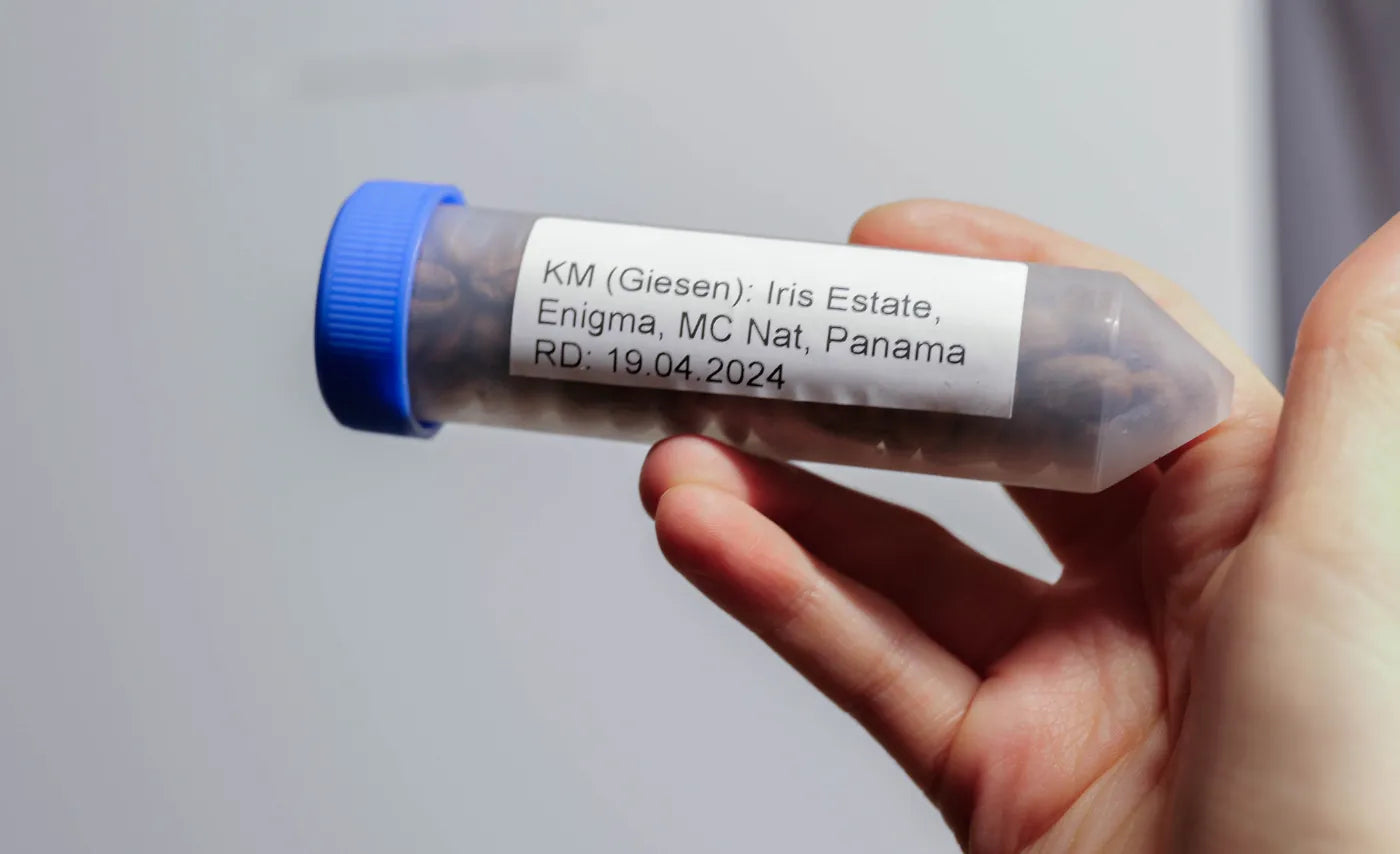
- Airtight containers or vacuum packaging are essential to minimize moisture and oxidation. We recommend choosing containers that match the amount of coffee needed to brew ONE espresso or filter coffee. This sounds elaborate, but we're serious. You should absolutely not freeze an entire bag or larger airtight containers, but only what you consume for one coffee. Why? Each time you open it, new oxygen reaches your coffee, which negatively affects the coffee's quality.
- Remember: Coffee should be frozen in small portions to avoid multiple thawing and refreezing cycles. A container, like our tubes, should, however, always be completely filled. We want to prevent the coffee from having access to much oxygen, with which it can react and age.
- We use these small tubes that we found on Amazon*.
2. Timing of freezing:
- Ideally, beans should be frozen as soon as they reach their peak of freshness and quality.
- We recommend waiting about 5 to 10 days for filter coffees. For espresso, 8 to 20 days is a good window.
3. Temperature:
- A temperature of at least -10 °C, preferably -18 °C, is necessary to effectively slow the aging process.
- Self-defrosting freezers are problematic because temperature fluctuations can occur.
4. Handling after freezing:
- Beans should be ground directly from the frozen state, especially for espresso.
- For filter coffee, brief thawing of 1–3 minutes can be useful.
- Opening the packaging should be avoided until grinding begins.
5. Shelf life of frozen coffee
- Coffee can be frozen for at least six months without significant quality loss.
- Longer storage times are possible, but some aroma components may still degrade.
- It remains difficult to compare frozen coffee with fresh coffee, as aromas can change subtly.

Effect on grinding and extraction
Scientific studies show that frozen coffee beans are more brittle, which affects grinding quality:
Colder beans lead to finer and more uniform particle distribution. The number of very fine particles (fines) increases, which can affect extraction. In some cases, the grinder may need to be set somewhat coarser. Depending on the grind size and brewing method, these changes can result in a sweeter or slightly more acidic coffee.
What speaks against freezing?
- Loss of aroma compounds: Even though freezing slows oxidation processes, it cannot completely prevent the loss of volatile aromas. Nevertheless, it allows you to preserve the quality of the coffee and its nuances over a very long period.
- Not every coffee benefits: The more complex a coffee is, the more complex it remains. The starting point is always the starting product, which is logical.
- Change in taste profile: Despite perfect execution, coffee continues to age and changes flavor. You will always notice subtle taste changes.
- Effort and cost: Proper freezing requires additional effort and possibly vacuum packaging equipment. However, for those accustomed to single-dosing routines, it's not so complicated. Instead of going directly into the grinder, the coffee goes into the retention container. During brewing itself, the effort is even less because everything is already weighed out.
- Moisture retention: Improperly stored coffee beans can absorb moisture from the environment and lose quality. It should be carefully weighed and packaged, and contamination should be avoided.

We recommend not eating the frozen beans but instead preparing them as filter coffee or espresso.
Mistakes to avoid
- Freezing too large quantities at once – better to freeze in small portions.
- Forgetting to label – who wants to drink a generic blend when they're looking forward to Panama Geisha?
- Using unsuitable packaging – airtight containers or vacuum packaging are mandatory.
- Using self-defrosting freezers – temperature fluctuations impair coffee quality.
- Thawing and refreezing coffee multiple times – consume beans once removed immediately.
- Using incorrect grind size settings – frozen beans behave differently when grinding. For filter coffee, this plays a lesser role. With espresso, however, the shot must be right. When in doubt, use a "forgiving" brewing profile.
Findings from our freezing test series
We drink frozen coffees daily and use the technique mentioned above. To compare aging, we tasted coffees repeatedly over the course of a year. We compared the sensory evaluation with the original sensory evaluation. After six months, the sensory impact on taste is marginal. After one year, we notice a slight decline in complexity. Some coffees showed slightly more acidity, others became somewhat flatter. However, the rating only decreased by one to two points on the score sheet. Coffees that were more heavily processed lost significantly in complexity. After 1.5 years, the effect intensified. Nevertheless, we still drank fantastic coffees.
We also conducted a "short-term test." The goal was to determine whether freezing makes sense over a shorter period as well. For this purpose, we froze two coffees in different ways and left another bag of each coffee unfrozen.
The filter coffees used were Amiga and Ichamama. The tasting was done by three Q-graders and the German barista champion Felix Hohlmann.
Both coffees were stored for two weeks using five methods and then brewed as follows:
- Tubes, ground frozen, brewed immediately after removal from the freezer
- Tubes, whole beans frozen, ground immediately after removal from the freezer and brewed
- Vacuum packaged, whole beans frozen, removed from the freezer the evening before brewing, ground the next morning and brewed
- Vacuum packaged, whole beans frozen, ground immediately after removal from the freezer and brewed
- Stored in bag, then ground and brewed

Even over a period of two weeks, the results show that freezing can be worthwhile. Especially with the fruitier coffee, the Ichamama, all frozen variants were better than the coffee from the bag. With the Amiga, the more classic and slightly darker roasted filter coffee, the coffee from the bag still ranked third.
In both scenarios, coffees ground immediately after removal from the freezer taste good. With the Ichamama, however, removal from the freezer the evening before was also delicious.
The coffee should not be ground before freezing. With both coffees, this coffee ranked fourth and thus a worse position.
With the more classic filter coffee, the coffee should not be removed the evening before.
Conclusion on freezing roasted coffee
Freezing roasted coffee can be an effective method to maintain freshness and quality. However, it requires the right approach:
- Airtight packaging,
- small portions,
- tubes or vacuum-sealed bags filled to the brim to enclose as little oxygen as possible,
- the appropriate freezing temperature and prompt use after thawing.
Freezing and grinding frozen coffee changes particle distribution and particle surface. Researchers have measured a narrower main peak and a higher proportion of fines.
Freezing is a great way to preserve special coffees from extraordinary vintages and outstanding roasts. Specialty coffee enjoyment is always a battle against aging and the passage of time. Freezing slows this down and gives us more time. And so it is a great option for those who want to give central importance to special flavor notes and the best coffees in their coffee hobby.
* This is a commission link. If you order through it, it doesn't cost you more, but we receive a small commission that we reinvest in test machines or test materials.


