



























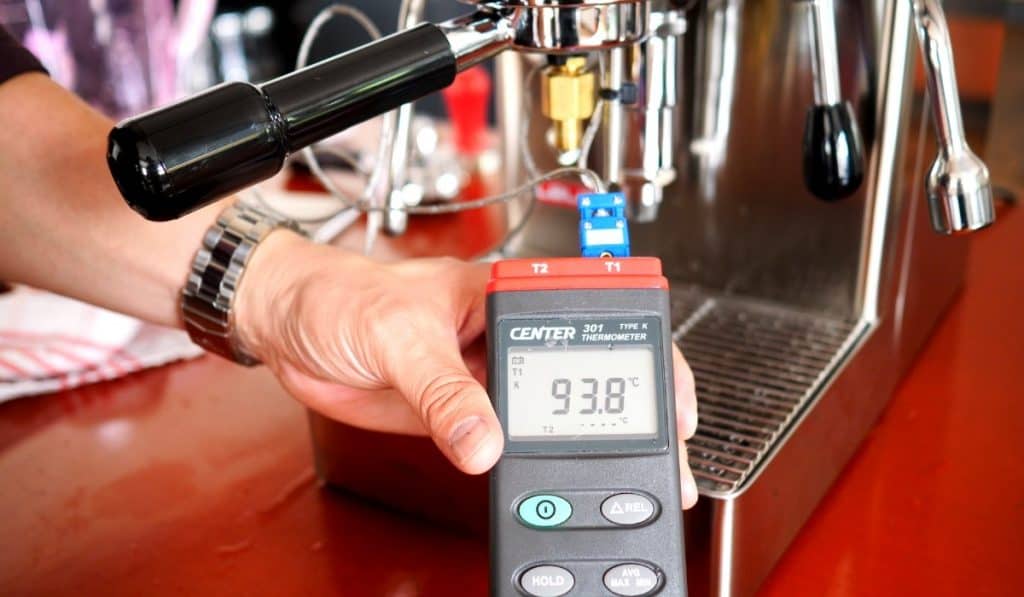
In href="/en/blogs/kaffeewissen/espresso-temperatur"our last post, we tested various espresso brew temperatures and their influence on taste. Here we show you how and where the espresso brew temperature is measured, and how you can measure the temperature of your machine at home.
The perfect brew temperature for espresso is between 91° and 95°. For a darker roast, we recommend the spectrum from 91° to 93°. For lighter roasts, we recommend 93° to 95° espresso brew temperature.
Try this at home and set different brew temperatures to check sensorially what tastes best to you personally. But the question here is where exactly we measure, and how precise the whole thing is.
Espresso and brew temperature – plenty of room for discussion
Since I've been involved with coffee, brew temperature has always been worth a long conversation. Different brew systems and brew group designs significantly change the consistency and influence of temperature. As a result, there are often no clear statements about what spectrum the optimal brew temperature falls into.
Despite this, or precisely because of it, we tackled this topic and first examined the sensory changes and strength or extraction. Rightly so, questions followed in the blog and in the comments on the YouTube video about this:
- where do you measure the temperature?
- how consistent is such a machine?
- how precise are these measurements?
To answer these questions, we first need to understand the design of boilers and brew groups and their influence on temperature.
Espresso brew temperature in thermoblock machines
A thermoblock heats the water as it flows through a tube within the block. This also means that in small thermoblock systems, the inlet temperature is decisive.
Fresh tap water is usually cooler than water that has been sitting in the machine tank for a while and has adopted the ambient temperature. The two water temperatures are different and need to be heated for different lengths of time. So in this case we end up with different brew temperatures again.
We recommend always using fresh water to keep the starting conditions constant. The larger the thermoblock, the fewer fluctuations you can expect. In sophisticated systems, like we see with the Decent Espresso Machine, the thermoblock performs more consistently than a boiler system. This works because the brew group is preheated by an additional heater and numerous temperature sensors control the water supply.
With the thermoblock, measurement is done with a thermostat that often switches on and off in the 5-6 degree range. So it might start heating at 104°C and stop at 110°C. Temperature fluctuations can also occur here.
The temperature measured in this way is the temperature in the block and not the actual brew temperature. Depending on the design, this is then between 87°C and 93°C.
Caution – too cold brew temperature with the thermoblock if…
if the group rinses just before extraction. Because: before extraction, the thermoblock stays at around 104°C. If you start the brew and the boiler heater switches on at that moment, you'll start the brew at around 87°C and finish at a hotter temperature. That's why we recommend rinsing thermoblock machines right after removing the portafilter and thus before grinding, so the thermoblock can heat up again. Thermoblock machines are generally more inclined to be too cold than too hot.
Procedure for brewing with thermoblock machines
- Remove the portafilter
- Rinse the group briefly, short water extraction
- grind and fill the portafilter
- extract
After step two, the thermoblock heats up quickly and you'll achieve the higher brew temperature.
Thermostat and pressostat instead of PID
In almost all boiler machines without temperature control (PID), the temperature is regulated by a mechanical thermostat or pressostat.
The thermostat
Let's start with the thermostat, as this is rarely used and usually found in cheaper machines. As soon as the boiler cools down a bit, it signals the heater to heat again. Since we generally have much more water in a boiler than in a thermoblock, boiler machines are significantly more consistent in temperature. The thermostat also regulates temperature in approximately the 5 degree range.
The pressostat
Somewhat more precise, and therefore also installed in most dual boiler machines without PID, is the pressostat. This also passes the signal to heat to the heater, but regulates it via pressure. With both methods, measurement is taken in the steam area of the boiler.
With a boiler typically installed with 1.5 to 1.8 liters capacity, the temperature fluctuates slightly with both systems. In the functioning of a so-called heat exchanger, the cylinder inserted in a classic dual boiler, temperature fluctuations remain within limits. Adequate rinsing before brewing also helps here to reduce the temperature of the thermo-syphon system (design of a Faema E61 brew group, in which water circulates permanently) in front of the brew group, so that you don't extract the coffee with too hot a temperature and make it more bitter than it actually would be.
Here too, the principle applies: the larger the boiler, the more consistency. With a 3-liter boiler, there is much more water, which then loses significantly less temperature, especially during extraction. Also at the moment when the pump pumps cold water from the water tank into the heat exchanger. The results in the cup are thus significantly more consistent. With the Basilea with PID and a 3-liter boiler, we measured a temperature fluctuation of less than 0.4 degrees – this is championship level!
Where do we measure with temperature-controlled machines?
There are big differences between dual boilers with PID and dual or multi-boilers. How these machines are built and how they work, we discussed in detail in this post.
Dual boiler with PID
Let's take the next step in the price segment and move to dual boilers with PID. Now we no longer measure mechanically via pressostat or thermostat, but via a sensor. This allows precise measurement and precise control of the heater. Often, heating systems in dual boilers without PID either heat fully or not at all. As soon as a sensor is installed, the boiler heater maintains the temperature more consistently, either through full heating or targeted heating bursts.
PID measure correctly
Measurement is then taken in the steam area. That's why with PID machines you always have to convert the displayed temperature according to the operating instructions.
An example: 124°C displayed boiler temperature can correspond to a brew temperature of approximately 92.5°C. But always refer to your machine's operating instructions, as this varies from manufacturer to manufacturer.
Even with PID devices, we'd recommend rinsing right before brewing, as the water can heat up very strongly in the brew head here too, and you'd start the brew at a very hot temperature.
Dual or multi-boiler
With luxury models featuring dual or multi-boilers, we measure in each boiler separately. This allows for very high steam temperature, independent of a differently set brew temperature. But here too, the principle applies: the larger the boiler, especially the coffee boiler, the more consistently you'll be able to brew.
New systems in professional gastronomy are taking things even further. To achieve consistency of less than 0.5 degrees temperature fluctuation during brewing, today's brew groups are actively heated to make them even more consistent. This results in a multi-boiler machine with two coffee boilers per brew group and active boiler heating. Fluctuations are thus minimized to 0.1 to 0.2°C and are therefore negligible.
Measuring espresso brew temperature at home
To measure the brew temperature on your own machine, you need a temperature probe that you insert deep into a portafilter spout. Then you start an extraction without coffee – it's important that you always do this with a hot portafilter. There are also portafilters with built-in thermometers. We use these for our tests, for example, because this also creates resistance against the pump.
If you want to take the measurement with coffee, the water will of course lose a lot of temperature at the beginning of the brew, since the coffee is at ambient temperature in the portafilter. You'll notice a significant increase during the brew.
But don't forget to drink your coffee while you're busy measuring.

