





Barista and latte art championships have become established and are now a familiar concept to many. The championship in coffee roasting, however, is still a small niche. Yet it is the championship where only craftsmanship counts and no show is required. Taste is at the center and the learning factor is high.
It smells, it crackles, and then Sofia opens the flap door on the Giesen roaster and lets the beans fall into the cooling sieve. The roaster from the Kaffeemacher:innen roastery team has just roasted her last batch for the 2024 championships. The coffee she selected is packaged and two days later tasted by a professional jury.

Sofia roasts her blend at the Swiss Roasting Championships
Sofia achieves the highest score and becomes Swiss Roasting Champion 2024, closely followed by Raúl, who finishes second with only one point behind and also roasts in our team.
For only the second time since 2019, the Swiss Roasting Championships have taken place. 14 participants competed for the title. Experienced roasters from primarily micro and nano roasteries participated.
In 2013, the first Roasting World Championship took place in Nice. In 2025, the world championship will take place in Houston, where Sofia will represent Switzerland.
The real challenge
When someone roasts coffee, they normally do so on a familiar machine. After a few years, you know its peculiarities and exactly how to handle them. This way, you develop a relationship with your own roasting machine and are reluctant to switch to a new system.
At the roasting championship, however, this was recently the case: Participants roast on a machine unfamiliar to them. At the 2024 Roasting Championship, this was an electrically powered Giesen 6kg roaster located at Blossom Coffee in Zug.

Raúl checks the roasted beans on the Giesen 6kg roaster
Those who already had experience with Giesen coffee roasters may have been able to familiarize themselves with the system faster than someone roasting on a Giesen machine for the first time.
However, the setting was new for everyone, and that made it interesting. Although as a participant – I as the author participated myself – you master your craft, the setting influences you and creates some adrenaline. Time must be kept in mind, every handling is monitored, every gram is weighed by the observers.
The process
The championship is divided into three parts:
- Green coffee analysis
- Production roasting
- Cupping
Green coffee analysis
In assessing green coffee quality, all participants receive a bag with 350 g of green coffee. This must be checked using the provided materials for density, size, moisture, smell, and color. Subsequently, participants must examine the coffee for defects and categorize them.
Primary defects are serious flaws that can have a direct impact on sensory characteristics. A black, infected, or completely fermented bean, for example, can give the coffee a metallic or medicinal taste.

Green coffee hand-sorted, Cuauhtémoc, Finca la Capella, Mexico
Defects in the second category, so-called secondary defects, don't necessarily taste different from intact beans, but in large numbers can negatively affect the taste. Likewise, half beans, a secondary defect, roast differently and may therefore taste different than intended.
Within one hour, participants sort and analyze the green coffee. The correct measurement and classification of defects is evaluated. I repeatedly hear from judges that coffees are occasionally over-sorted, meaning every cosmetic blemish is treated as a defect.
It can be helpful here to keep in mind that coffee is a natural product. Or you can remember a maxim from green coffee analysis:
"Ugly is not a defect."
Single origin and blend
Participants receive four Arabica coffees to choose from. They should roast one of them as a single origin. Three of them should be mixed into a blend, with each coffee representing at least 10%.
At the 2024 Swiss Championships, it was exclusively about putting together a blend. We received three green coffees in advance. The origin and processing method were also communicated.
These were a pulped natural from Brazil, a yellow honey from Costa Rica, and a washed coffee from Tanzania. We had to create a blend from these three coffees.

"Number 2 it is" - choosing the blend
It is generally not advisable to mix coffees with different densities or different post-harvest processes. But that was exactly the task here, and that made it exciting. All participants faced the same challenge.
We roasted the coffee on a sample roaster, tasted it, and described it as follows:
- Brazil: hazelnut, medium body, some cups slightly icy, citric
- Costa Rica: yellow fruits, apple, lots of body and silky texture, many quakers
- Tanzania: blackberry, citric, high acidity, medium body, silky texture
Normally we would not mix these three coffees, but that was the task. We all decided to reduce the Brazilian portion to the minimum of 10%. Sofia and Raúl chose the same blend: 60% Tanzania, 30% Costa Rica, 10% Brazil. Juan and I chose: 50% Costa Rica, 40% Tanzania, 10% Brazil.

We worked together as a team and gave each other feedback
The evaluation
An expert jury tastes the coffees in a blind cupping without knowing who roasted them. Various attributes of the coffee are evaluated:
- How intense and complex are the aroma and flavor notes?
- How intense is the body and how pleasant is the texture?
- Are acidity and sweetness in balance, and does the acidity structure the cup?
- Is the coffee long-lasting and does it leave a sweet impression?
The jury's evaluation and comparison with the roasting profile result in the final score. Without tasting the production coffee itself, participants must anticipate based on sample roasts on a sample roaster how the coffee will taste in the end.
This was a tricky task because we had to base assumptions on vague conjectures. We knew how the coffees tasted on the sample roaster, but whether the result on the unfamiliar machine came out exactly as desired was the challenge.
If the roasting profile and the description of the sensory characteristics match the observations of the judges, a high score is achieved. Both Sofia and Raúl achieved this.
The Giesen roasting machine
Roasting was done on a Giesen roasting machine. From 2013 to 2023, Giesen sponsored the world championships, which was logistically demanding as multiple small roasting machines had to be transported worldwide. Since 2024, Stronghold electric roasters have been used. These machines represent a changing of the times: they are fully electric, filter exhaust air, and are therefore a popular alternative in coffee shops where roasting is done live.
Me against myself
What I particularly appreciated about the championships were two things:
First, the exchange with other participants. Since everyone had the same starting situation, there were no secrets or advantages. Everyone roasted according to their philosophy and put together blends according to their own taste. The atmosphere at the championships was open and collegial – ideal for exchange and learning.
Second: At the roasting championship, it's only about taste and predicting how the coffee will taste. There is no jury watching for the show. You only compete against yourself. If the coffee wasn't roasted well, you are responsible for it.

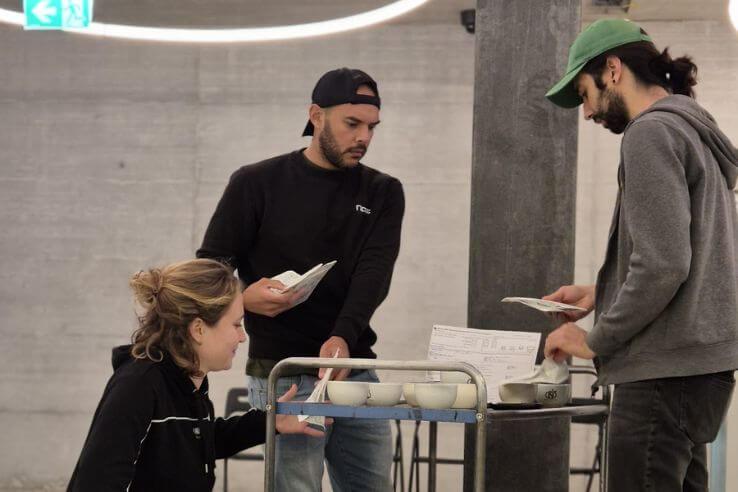
This character-building competition is emphasized by giving all participants the opportunity to taste the coffees of others in a blind cupping after the championships. It was a nice moment when I stood at the cupping table with other participants and we tasted the cups together, which were labeled with codes.
We agreed on which cups we particularly liked and which we liked less. I had two favorites in this blind cupping: Sofia's and Raúl's.

from left to right, Dario Stoop from Coffee Architects, Sofia Heuri, Raúl Rivero