



























Are bacteria in coffee machine water tanks dangerous?

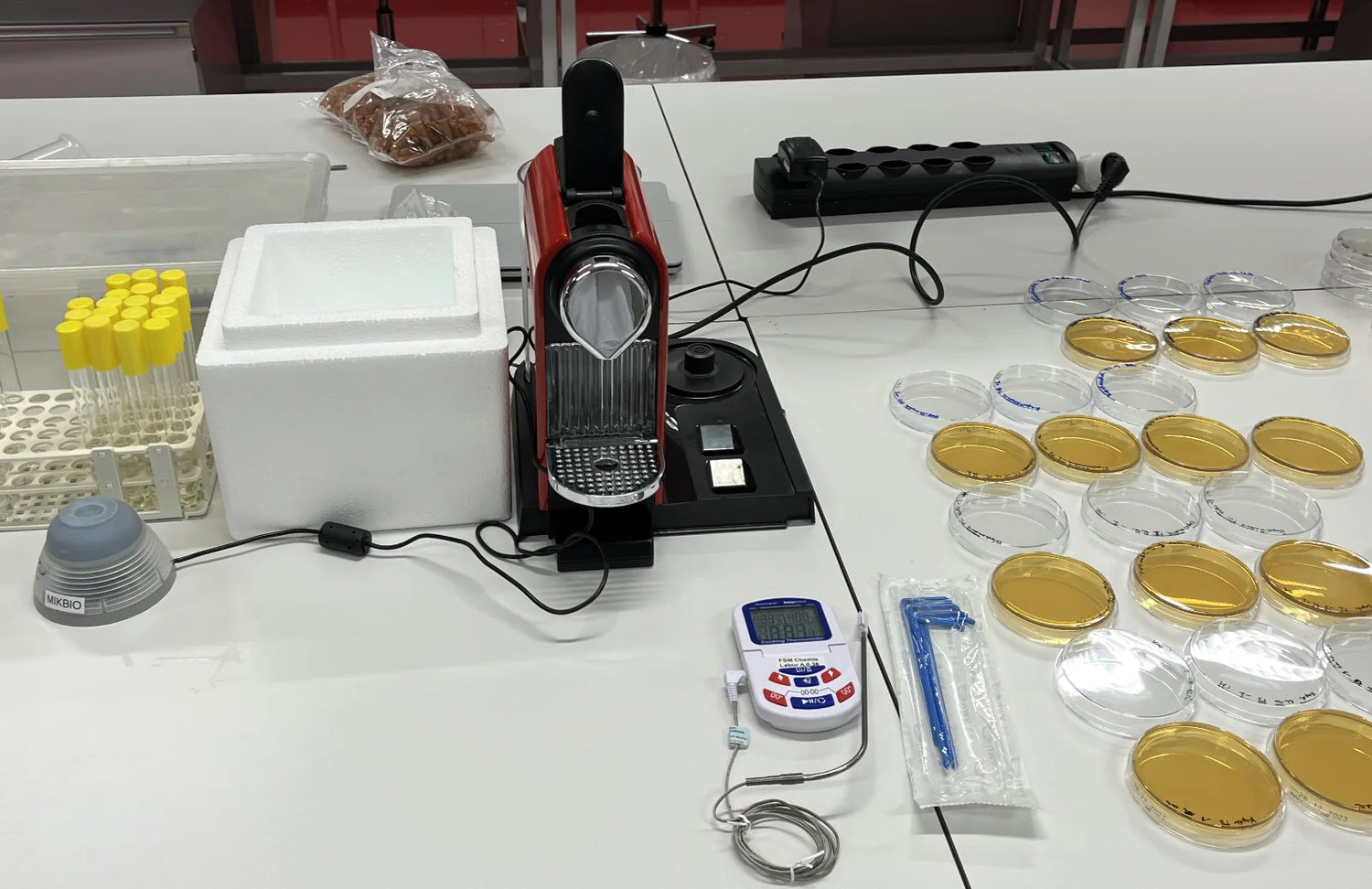
In the water tank of a coffee machine, bacteria can form that may potentially be dangerous to humans. In collaboration with the Bern University of Applied Sciences, we wanted to find out what effect heating in the boiler has on bacteria. Since different types of coffee machines heat for different lengths of time and intensity, the three most common heating types of coffee machines were examined.
- Boiler espresso machine, dual boiler (Quickmill Lucca)
- Thermoblock capsule machine (Nespresso capsule machine)
- Thick film heater (Sage Barista Pro)
The three types of coffee machines differ in the way they heat. The boiler espresso machine heats the brewing water over a longer period of time in a boiler. Depending on the machine, this holds between 150 ml and 1 liter of water. Since the brewing temperature should typically reach 90 to 94 degrees, the brewing boiler is also heated to this temperature.
A thermoblock heats coffee via flow-through heating. The block itself is usually made of aluminum because it has high thermal conductivity. The outside of the block is wrapped with electrical heating elements. Tubes run through the block through which the brewing water flows. With the thermoblock, heating occurs indirectly.
The thick film heater is also a flow-through heater, but differs in construction from the thermoblock. These consist of a thin ceramic or metal plate to which a layer of conductive material (the "thick film") is applied. This film forms the heating elements and is capable of transferring heat very efficiently. The water flows over or through the plate with the thick film, which is electrically heated. The heat transfer occurs directly from the heated surface to the water. This enables very fast and efficient heating.

Comparison of thermal inactivation rates of different coffee machines
Summary of the semester project by Lucien Guerdat, supervised by Prof. Dr. Raymond Place (Bern University of Applied Sciences)
Surely you've wondered whether the bacteria in the water tank of coffee machines are sufficiently killed by the brewing units.
To answer this question, the coffee makers and Bern University of Applied Sciences conducted scientific experiments together. The inactivation rates of three different types of bacteria in a thermoblock capsule machine, a boiler machine, and a thick film heater were investigated. Since the coffee machines were to be used again after the experiments and no one could be endangered, only bacterial strains were used that showed no pathogenicity factors (Escherichia coli, Streptococcus thermophilus, and Lactobacillus bulgaricus).
These three species have comparable heat sensitivity to bacteria that actually occur in water tanks but could be pathogenic (e.g., Pseudomonas aeruginosa). It was found that the boiler machine had the highest inactivation rate, followed by the thermoblock coffee machine and the thick film heater. In summary, it can be said that in all machine types, bacteria are killed many times more than they typically occur in water tanks of household and commercial coffee machines. It was additionally found that if at all, bacteria were only found in the first cups drawn. It is therefore recommended to discard these.
It should be noted that biofilm formation through regular use of the coffee machines was not investigated. Due to the potential formation of biofilms, it is therefore essential that coffee machines (including water tank), regardless of construction type, are cleaned regularly and thoroughly. Additionally, it is advisable to regularly replace the water in the tank with fresh water in order to brew the most delicious coffee possible.

Table 1 Escherichia coli contamination of the boiler machine

Table 2 Escherichia coli contamination of the capsule machine (thermoblock)

Table 3 Escherichia coli contamination of the thick film heater machine
Coffee maker comment on the results
With the thick film heater, traces were sometimes found in the first cup drawn. Also, a slightly lower temperature was found in the cup. With thick film heating, the water runs relatively quickly through a highly heated channel in the metal plates pressed together. It appears that the temperature of the thick film heater was not sufficiently high on the first draw. It should be noted, however, that the water was drawn without the resistance of the espresso, so it tended to flow through the portafilter faster than it would in everyday use.
With almost all machines, however, we also generally recommend using the first draw to warm up the portafilter and only the second for espresso extraction. If this is done, according to the study results, no residue of bacteria remains in the coffee or brewing water.
As part of the semester project, the effect of contaminated water on the taste of coffee was not investigated. While the water and espresso are safe to drink according to the study. However, we cannot make any statement about the taste impact.


