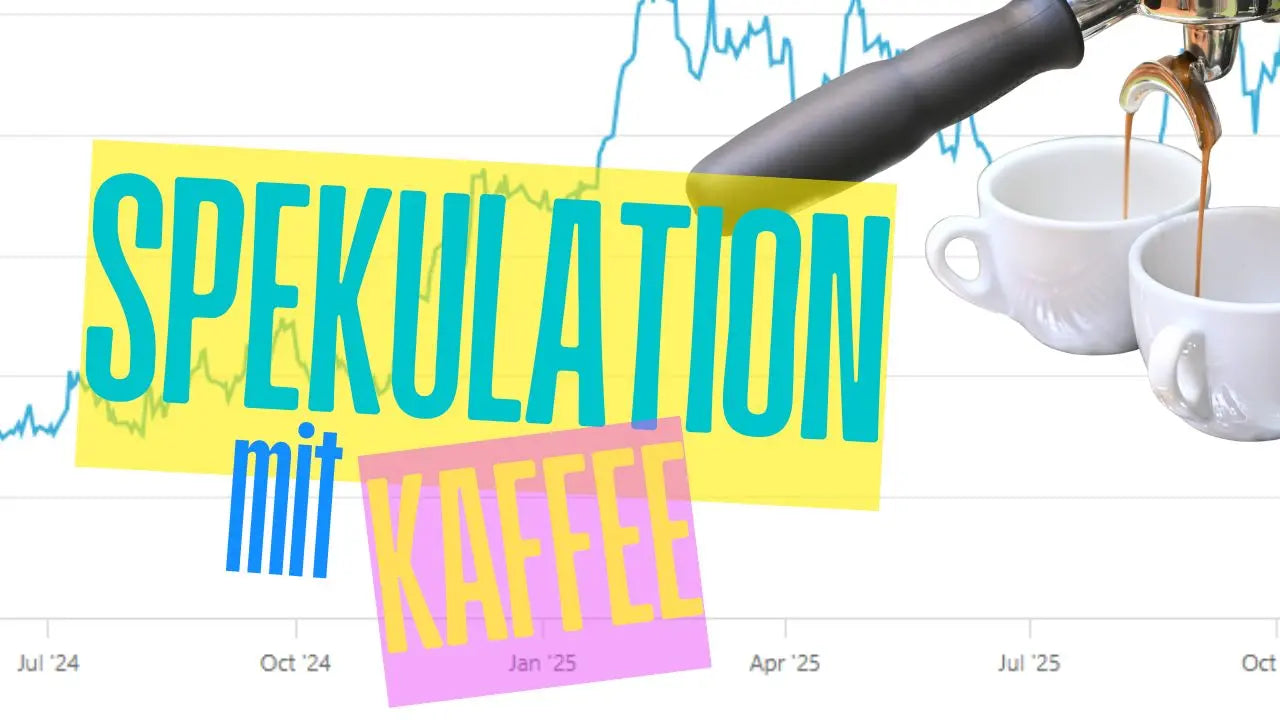

In fall 2024, coffee prices rose to record heights and remained as high as never before throughout 2025. Why exactly? I made two videos about this and identified the origin in Brazil's poor harvest, only after that in excessive speculation. (Video from January 2025) and an update in November 2025.
In between, I repeatedly read and heard that this unprecedented increase was the direct product of commodity speculation and that many of the strong fluctuations could not be explained rationally.
Attributing all the movements to "speculation" was not convincing enough for me and, above all, not precise. Until then, I felt the word more than I understood it. I wanted to know more and embarked on an intensive learning journey.
At the beginning of this learning journey, I really only had one question:
- Who sets the coffee price?
- And why does it sometimes move so sharply up or down, even within a single day?
I wanted to know if it's really true what you hear again and again: That speculation distorts prices. That investors drive the market. That speculation is the catalyst for upward or downward movements.
And I also wanted to know whether we're making life harder for ourselves than it needs to be. Whether the idea that "the speculators" are to blame is correct. Or whether with this idea we're just avoiding understanding a more complicated system.
"Speculation is to blame!"
Since the rise in raw coffee prices on the exchange (the so-called C-Market) in November 2024, I have dealt with the subject as intensively as never before in my coffee career. First, it was about understanding exactly what was happening, how we as a coffee roastery could orient ourselves, what it meant for producers, and how we could develop a vision together.
And at some point I heard more and more that all this was just the work of "the speculators." When the Lavazza CEO said in summer 2025 that 80% of the movement came from hedge funds, I nodded first, but then became skeptical—and especially curious. "Speculation" doesn't really explain anything, it mainly stirs up emotions.
"Speculation often serves people as an explanation when there is a lack of explanation."
So I sat down, listened, and asked questions. With people who trade coffee. With people who produce coffee. And with analysts who have observed commodity markets for decades.
The deeper I went, the clearer it became: There is no simple story. But there are many layers.
What is speculation? About futures, shorts, and longs
I wanted to understand the mechanics behind coffee price formation and speculation on coffee. So I spoke with Heinz Zimmermann, emeritus professor of financial market theory in Basel. He said a sentence that would accompany me repeatedly later:
"Speculation is not the problem. Excessive speculation is the problem."

Because: Speculation serves a function. It is part of the counterparty to producers who sell futures to protect themselves against falling prices (to hedge).
An example:
If twelve producers want to protect their harvest and sell futures (a future is a contract that stipulates that someone must buy or sell a certain amount of coffee at a certain price in the future), but only three roasters want to buy, then an imbalance arises. Speculators fill this gap. Or as Heinz Zimmermann says: "Producers want to get rid of risk. Speculators take on risk."
When producers hedge heavily (protect themselves against falling prices) and sell futures, more open positions are created. And these must be bought. These can be so-called commercial actors, such as traders or roasters. If these don't buy, however, speculators step in. In stock exchange language, they now go long, while the producers protecting themselves go short.
For there to be a balance here so that the market functions at all, supplies must meet demand. And speculators take on these open positions.
How do speculators make money?
The interest of speculators is purely monetary in nature. For them, it's not about the physical product coffee, but about making financial gains.
This gain is realized when there are changes in the coffee market. Whether prices go up or down is secondary: the gain results from the change in price.
Someone who buys at a lower price and sells higher makes a profit, as does someone who expects falling prices. Then speculators go short, selling a future at a high price that they don't yet own.
If the price falls later, they buy the future back cheaper. Here too, the difference is the profit.
This movement, or volatility, is the magnet for speculators. But too much volatility is also not attractive to them, Judy Ganes told me.
When speculation becomes too much: excessive speculation
I wanted to know from Judy Ganes who actually speculates? Judy Ganes worked on Wall Street for a long time and has been following commodity markets for decades. She says:
"Speculators are the scapegoat. Always."

She doesn't believe the thesis that private investment funds destroy the market. She says speculators amplify movements, but they don't create them. Everything begins in the cash market, in physical reality.
Excursus: the cash market: Real, physically available raw coffee is traded here. In contrast to the futures market, the cash market is about immediate delivery and actual demand today, not in the future.
Judith further explains that speculation can be an amplification of already existing trends. And at the same time, I see it through Heinz Zimmermann's lens: Amplification is not harmless. Amplification can do more damage than the trigger itself.
If a frost is threatening, that's a so-called fundamental factor. But if billions flow into the market within minutes because algorithms recognize a correlation, then the market hasn't just reacted, it has overreacted.
Heinz puts it soberly: "The volatility is higher than what would be fundamentally necessary." And that's the point where speculation becomes excessive speculation.
How volatility feels at the coffee origin

Volatility, the constantly changing state, is interesting to some extent for speculators on one side. Roasteries become hesitant when buying, because a small price shift can have a large impact on order placement for a customer. For producers, on the other hand, volatility is a nerve-wracking and tearing experience.
The coffee is about to be or has just been harvested. But at what price do I as a producer sell the coffee now? More specifically: When do I sell it if the price constantly changes? And who buys it and when?
Many producers in recent months were ready to sell coffee, but the buyers didn't want to buy. So it happened, as César Marin reports in the podcast, that producers had two harvests on hand and waited for someone to buy their coffee.
César also says that the coffee price determines whether a producer in Peru can finance their harvest. It determines whether a cooperative loses loyal members or whether an entire region gets new buyers who show up with cash that nobody expected.

Miguel Guevara
High volatility is difficult for everyone involved in the coffee chain because it doesn't allow long-term planning without a lot of risk.
Miguel Guevara from our partners at Ensambles in Mexico assesses the situation for small producers like this:
"La gente de cereza se la pasa revisando diario la bolsa."
The producers who sell coffee in cherries check the New York coffee price every day. "Every day." Producers who sell their coffee in parchment/pergamino live in a different time axis. There, prices are adjusted more slowly and volatility arrives dampened. "But it always comes."

Excessive speculation and the resulting volatility doesn't just rapidly change the macro level and the C-Price, it changes the pace at which people on the ground make decisions. But above all, it creates uncertainty: Whether producers sell today or tomorrow and whether they remain loyal to a cooperative or not.
And that's a stark contrast:
On one side, we have market participants who make short-term decisions at a screen, but whose effect affects thousands of kilometers away in coffee-growing countries. What's striking is that a decision at a screen is made quickly, but agriculture is slow. It takes three years for a coffee tree to bear fruit at all. So two completely different worlds stand opposite each other, but are connected by the coffee market.
"Coffee doesn't wait"
One of the sentences that stuck with me on this journey came from producer and friend César Marin from Peru. He said: "El café no espera." Coffee doesn't wait.
When I heard that, I didn't yet know how central this sentence would become. But it suddenly stood representative of everything that can happen in the coffee market when prices rise or fall in the shortest time.
César told me what it was like in his region around Villa Rica in 2025. The harvest was in, the coffee cherries were ripe, but nobody wanted to buy.
"There was coffee," he says. "But nobody bought coffee."
Producers had picked and processed coffee, but there were no buyers because the collection points in the region were closed. And so there was this stalemate: The sellers (the producers) wanted to sell coffee because prices were high. The buyers (such as the collection points) didn't want to buy coffee because the price was too high for them.
At the same time, new buyers suddenly appeared, from whom nobody knew whom they represented. Collection points that paid 450 to 470 cts/lb per pound of parchment—these were never-before-seen prices. César says: "I believe these were companies from Colombia, Honduras, and Brazil." Companies that couldn't buy enough coffee from their own markets and therefore came to Peru to meet their demand.
Why the industry can't just watch
I also spoke with people who buy coffee in large quantities: the procurement director of a large European retailer, as well as the raw coffee buyer of one of Europe's largest roasteries. When it comes to quantities, the leverage up and down is greater.
"Volatility can destroy your accounting," says the procurement director.
"If you buy 20,000 tons of coffee and the price fluctuates by twenty or thirty cents in a short time, that's millions of dollars." The raw coffee buyer confirms this statement:
"There are always winners and losers. But the problem is not the price. The problem is the speed."
He gave me this example: If competitor A makes a contract for raw coffee at $4.25/lb (approx. $9.37/kg) and competitor B buys at $4.10/lb (and the competitor at $4.00/lb (approx. $9.04/kg), then that determines competitiveness and thus the award of contracts.
The industry is trying to adapt. Procurement now sits much more closely with sales and the finance department. And the customer themselves is also included in the planning.
The sharp fluctuations and high prices have meant that there is more money in the market than ever before. Traders too are reaching their limits, since in their commercial function they first buy coffee and later sell it. They also borrow the money for this. The money supply has increased significantly since November 2024. David Neumann also comments on this in this podcast episode.
Why speculation is necessary—but remains dangerous at the same time
After this long journey, I don't stand here and say: Speculation is the problem. But I do say: Excessive speculation is a problem. And a serious one at that.
Speculation is necessary so that producers can protect their prices. Without speculators, there would be no functioning futures market. But when capital inflows become too large, when models blindly amplify trends, when liquidity doesn't stabilize but accelerates, then producers, traders, cooperatives, and roasters become extras in a market that moves faster than any real decision.
It's often said that the market is always right. I would say: The market always has a result. But whether it's right shows itself later.
And this "later" is often the next harvest.