












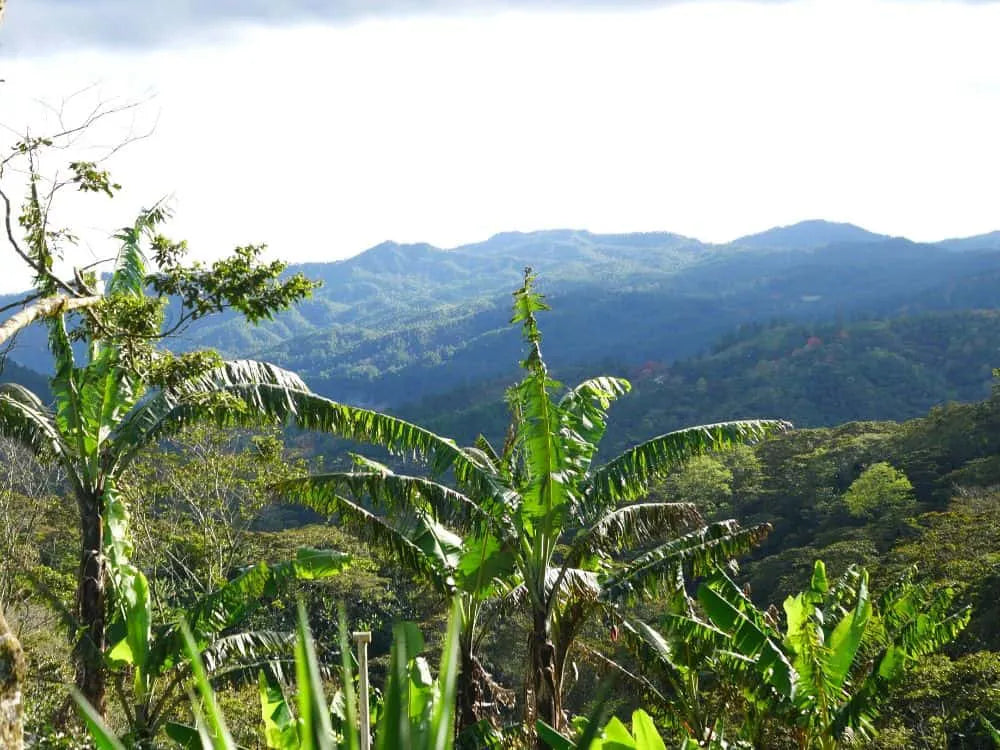

Since 2017, we have been co-owners of the coffee farm Santa Rita in northern Nicaragua as coffee makers. Together with agronomist Roberto Castellano, we run the small finca in Tablazon, Dipilto, around 30 km from Ocotal in the Nueva Segovia province.
Why do we do this as coffee makers?
As coffee makers, we teach coffee knowledge in our courses from plant to cup. We are knowledgeable about everything from green coffee purchasing through roasting to the beverage in gastronomy or at home. We have worked with these coffee processing areas for many years. We know agronomy and cultivation well – through travels, further training, and literature. In the future, we can also share first-hand insights from cultivation.
At the same time, our goal since founding the coffee makers has been to create connections across the entire coffee value chain, enable exchange, and attempt to balance value creation. With our commitment, we want to stabilize a small finca and contribute to its development.
How does the ownership model work?
We consciously decided to become stakeholders in an existing coffee farm rather than buy a farm and operate it under our own name. There are several reasons for this. As stakeholders in an existing farm, we can help enable necessary investments and make developments possible. The exchange with our partner Roberto allows us to learn from each other and benefit from our respective experiences.
We are 50% co-owners of the farm, share the costs of investments and ongoing expenses equally. We share losses and profits.
We ensure that liquidity is available throughout the year when it is needed to undertake necessary measures and investments. This prevents coffee from being pre-sold or important farm work from not being done. This often leads to poor quality or crop failures. In fact, this chain of events is one of the major problems on coffee farms.
What are the goals for the finca?
We want to produce outstanding coffee with the finca. At the same time, we want to serve various needs and markets. The potential of the finca is enormous. Today it already produces a variety of qualities in a range of 80 – 88 points.
It is important to us that we work as ecologically as possible and create a healthy cycle on the farm that contributes to soil health and ensures vibrant fauna and flora. It is an experimental field that Roberto and we look forward to exploring together. For Roberto, working with ecological projects is nothing new, by the way. We will report on that soon.
A healthy cycle for the finca also means that we want to create secure jobs for farm employees and temporary workers from the community, appropriate wages, good sanitary conditions, access to education and insurance. This is also an experimental and learning field where we want to move forward step by step.
Considering the points mentioned above, the farm should become a stable, self-financing finca. This is important to us! This is not about sponsorship. We want to try to structure the farm so that it is entrepreneurially successful and can also serve as a model for other co-owned fincas.
How is the finca specifically managed and how are tasks distributed?
The finca is strategically led by Roberto Castellano and the coffee makers (Benjamin and Philipp leading for the coffee makers).
At the operational level, the coffee makers in Nicaragua are represented by Tim Willems, who is both quality manager on site and acts as the extended arm of the coffee makers in our name and with our authorization. Roberto and Tim, supported by a professional accountant who also handles central training and inventory tasks on the farm, manage the employees. Previously, one family lived on Finca Santa Rita. A second family is now also moving to the finca. They belong to the new farm manager of the finca, who is taking up his position on site in the coming days.
As coffee makers, our task, apart from providing input and exchange from a distance, is to contribute to the visibility, marketing of Finca Santa Rita, and the distribution of green coffee. We develop goals and plans together with the crew on site regarding which varieties we produce and how we want to further develop the finca.
A concern of Roberto's and ours is to make the finca a point of contact for volunteers and interested people who want to learn about coffee.
What do course participants at the Kaffeemacher Academy get out of it?
As coffee makers ourselves, we – and have honestly already – learned incredibly much from and through Santa Rita. Just under six weeks ago, we sat on the farm and wrote a business plan for the finca together with Roberto and Tim. This takes into account not only all work steps per area and tree, but also inputs (fertilizer, disease control measures), yield expectations, and potential production costs if everything goes as planned. Based on that, looking at the coffee exchange in New York, we can determine whether the farm will have black or red figures financially in the coming year. We will incorporate all of this into our courses. You will learn practical, concrete information from the farm. If it rains early in Nicaragua, we will know about it in real time and be able to explain to you in our courses what that means for Finca Santa Rita, but also for other countries and regions.
The farm will – as have our gastronomy projects until now – provide concrete content and examples that we can directly incorporate into the training. However, the possibilities go far beyond that. Very soon, we want to be in a position to also receive visitors at Finca Santa Rita. They should be able to learn on site what coffee cultivation means.
The possibilities for exchange are enormous. A concrete opportunity for exchange already exists now.
In cooperation and close collaboration with Boca de Lobo and Claudia Lovo and co.
We benefit very concretely from our finca through close collaboration with El Arbol, Boca de Lobo, and the personal connection with Claudia Lovo and Tim Willems. Without the two of them, we would not have embarked on this project and would not be able to manage a farm in Nicaragua today. They have done tremendous preliminary work and allow us to learn from functioning concepts from their farm. We are enormously grateful for the connecting and supportive partnership and neighborliness with Boca de Lobo and El Arbol.
Boca de Lobo already has a functioning exchange and volunteer model as well as a one-week farm and agronomy practical training in its program. In February, we as coffee makers will conduct a course in cooperation with El Arbol.
You can apply for the course via the website. We will theoretically and practically dive deep into farm life and receive training from Roberto, our partner at Finca Santa Rita.