



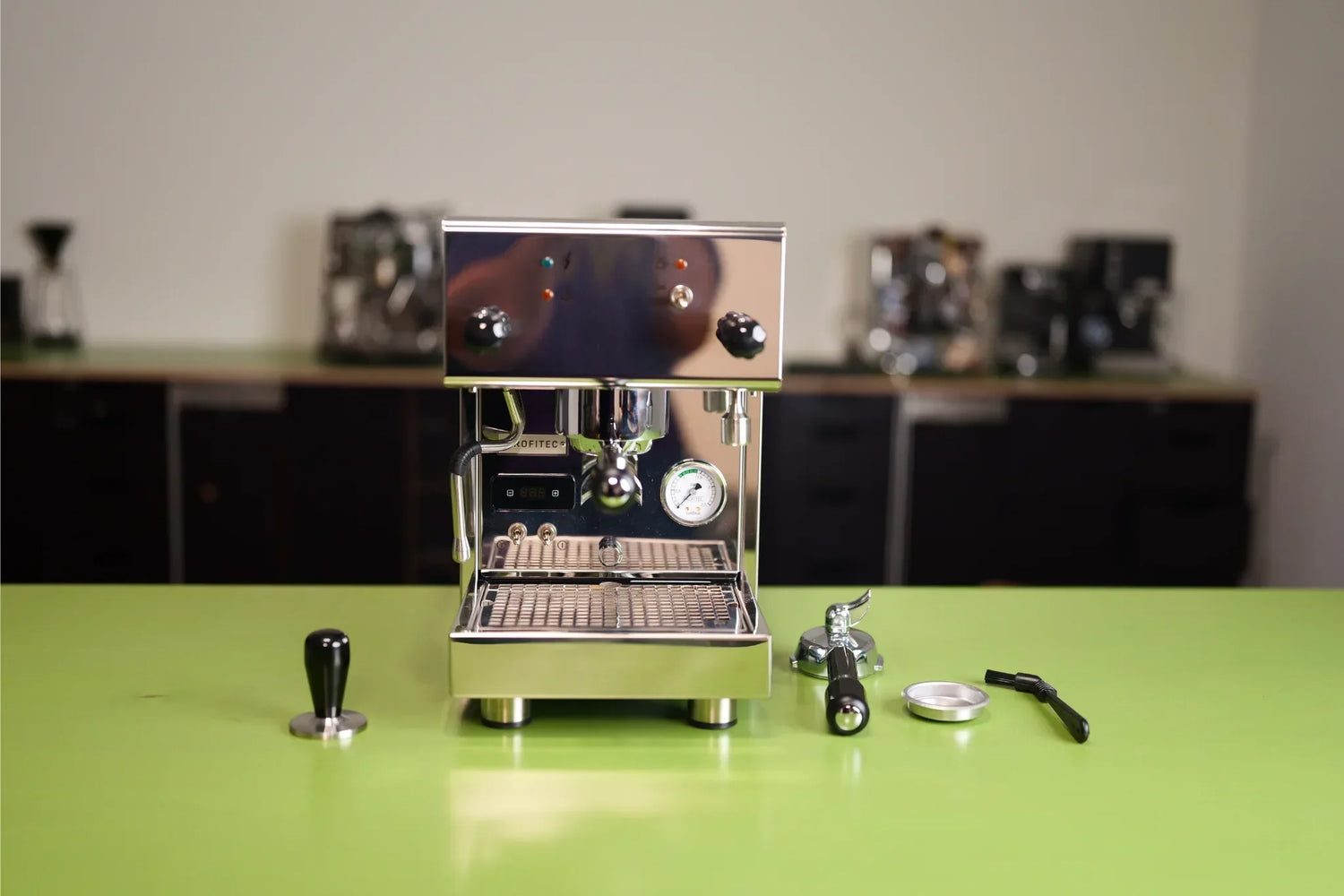

The Profitec Pro 300 joins a group of interesting dual boiler espresso machines for beginners. We have thoroughly tested the Profitec Pro 300 and present our results in a test video.*
Price and Classification
At around 1400 euros or CHF 1600, the Profitec Pro 300 is one of the most affordable dual boiler espresso machines on the market. Dual boiler espresso machines have two, usually independent boilers that can be individually adjusted for temperature. Unlike heat exchanger espresso machines, this allows independent milk steaming while espresso can be pulled in parallel. There are exceptions to these rules for both heat exchangers and dual boilers. The Profitec Pro 300 is not one of them.
When heating up the machines, we do notice a dependency. However, this does not affect the steaming performance of the machine. The 0.4 l brew boiler and the 0.75 l steam boiler are among the smallest boilers we have found in dual boilers. So it remains to be tested how the performance in steaming and espresso extraction and the important temperature stability look.
Buy Profitec Pro 300
The following specialty retailers distribute the Profitec Pro 300 and we can recommend purchasing from these businesses. All offer the option of adjusting the machine's offset.
Germany:
Switzerland:
We search for specialist partners for you, from whom we know they provide good work and good service, and we are in close contact with the mentioned retailers. The links are so-called affiliate links. If you order via one of these links, you won't pay a cent more – however, we receive a small commission that we invest directly in new test equipment.
We continue to search for competent partners in the DACH region for you.
Size, Weight and Accessories
The Profitec Pro 300 espresso machine has a height of 38.8 cm and a width of 25.5 cm. We measure a depth of 41.5 cm, which comes to 47.5 cm depth when we clamp in the portafilter. The total weight of the machine is 19.0 kg.
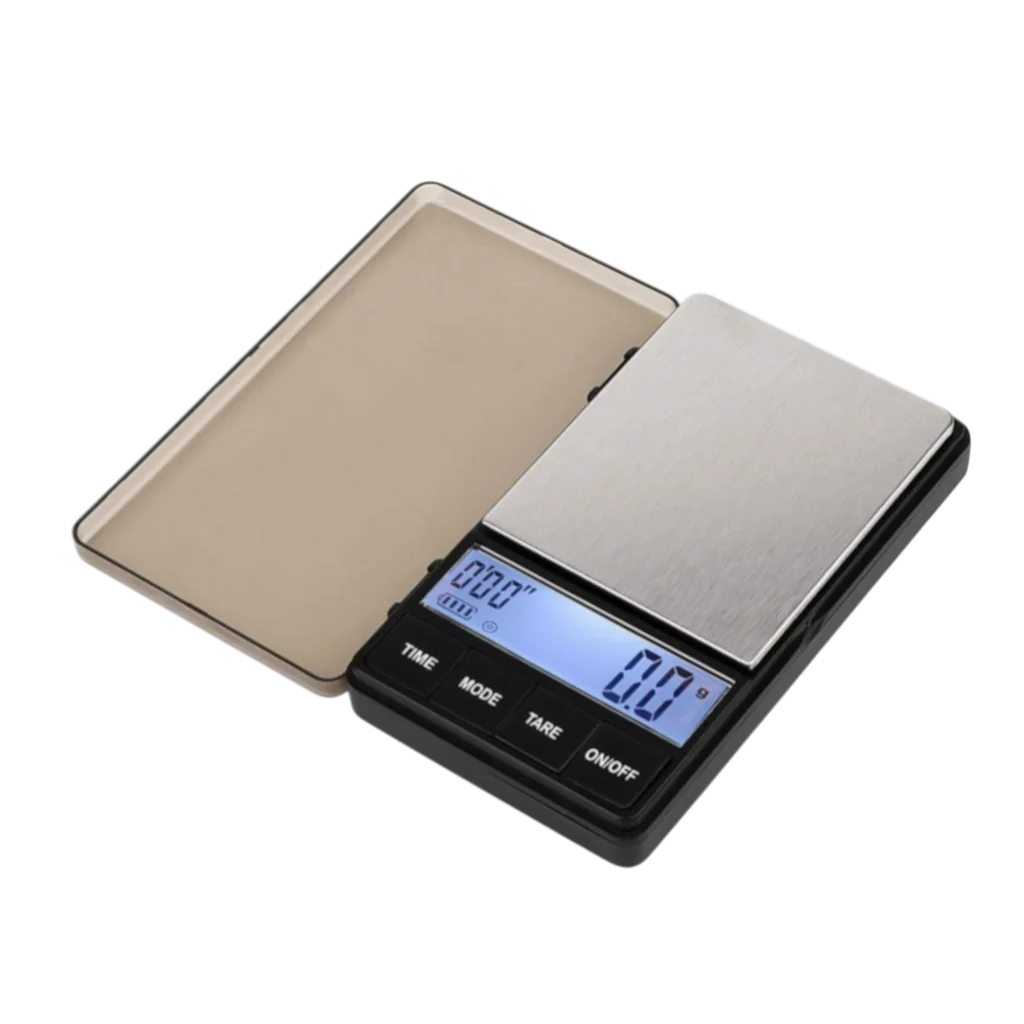
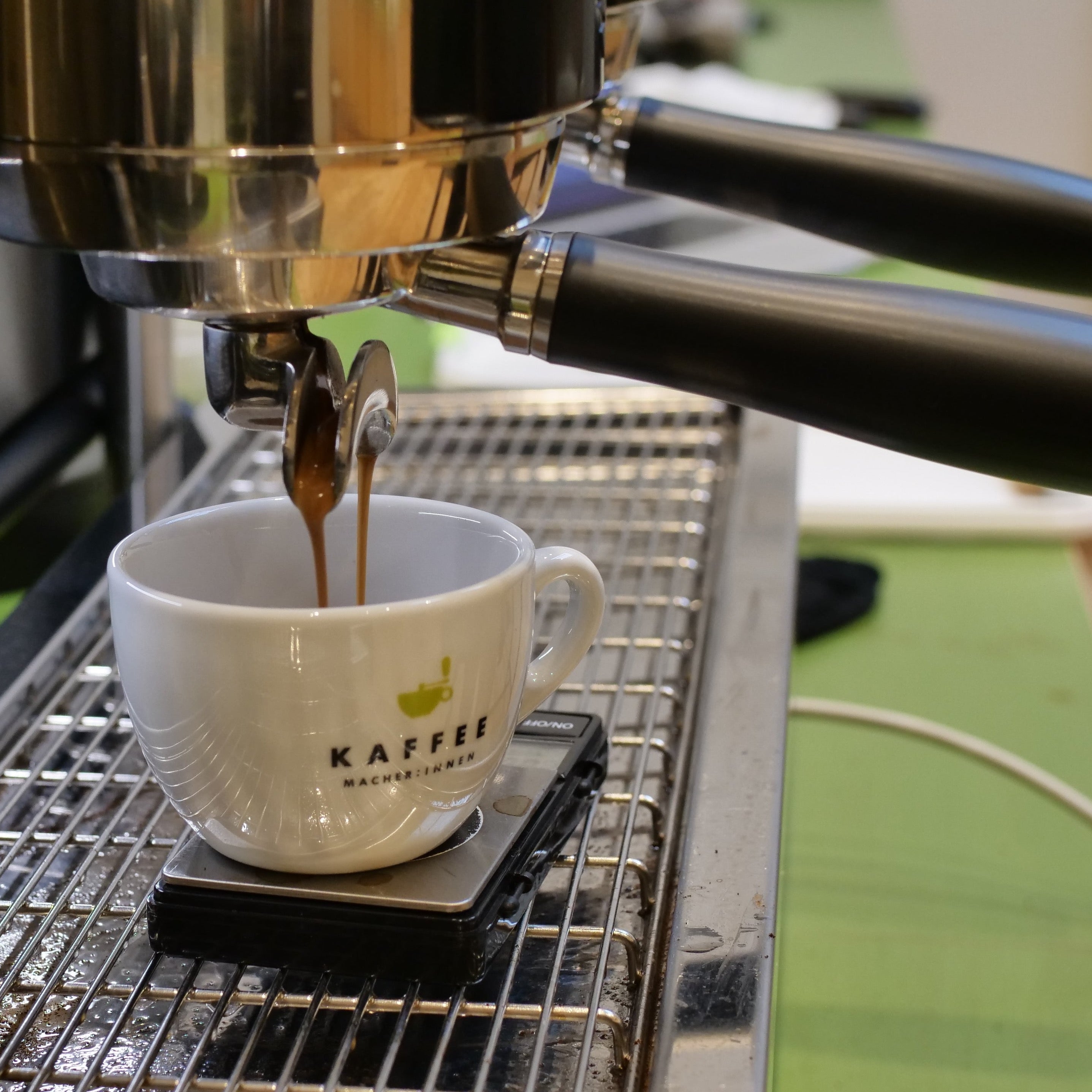
The brew group of the Profitec Pro 300 is relatively low. Between the drip tray and the outlet there is 7.8 cm of space. That is very little, especially when a scale also needs to fit under the cups. This is absolutely necessary with machines and flowmeters for setting up good espresso. Only really thin scales fit under the cappuccino cup, otherwise it has to be awkwardly threaded in. 3 to 5 millimeters of clearance would be worth its weight in gold here.

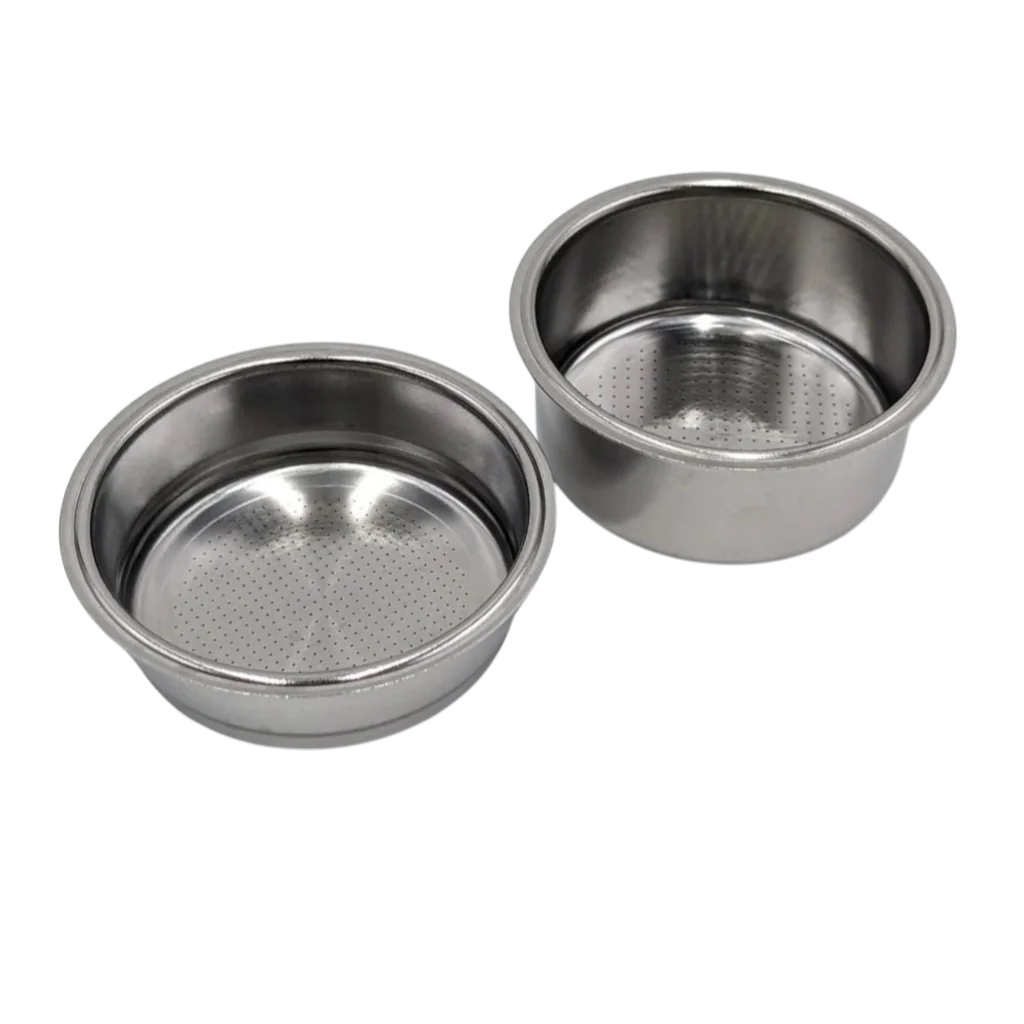
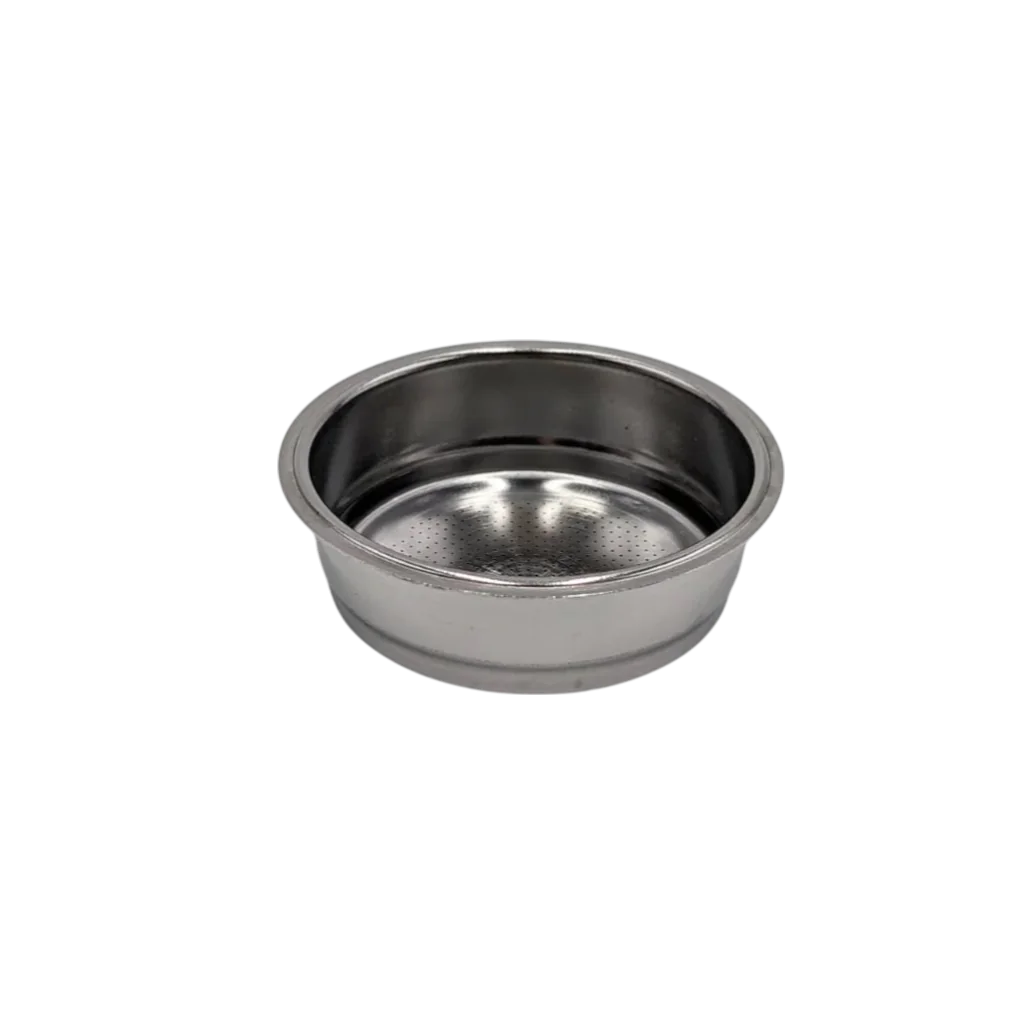
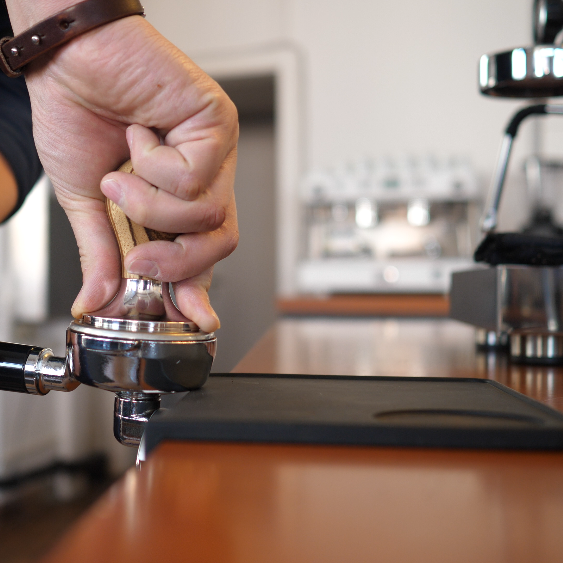
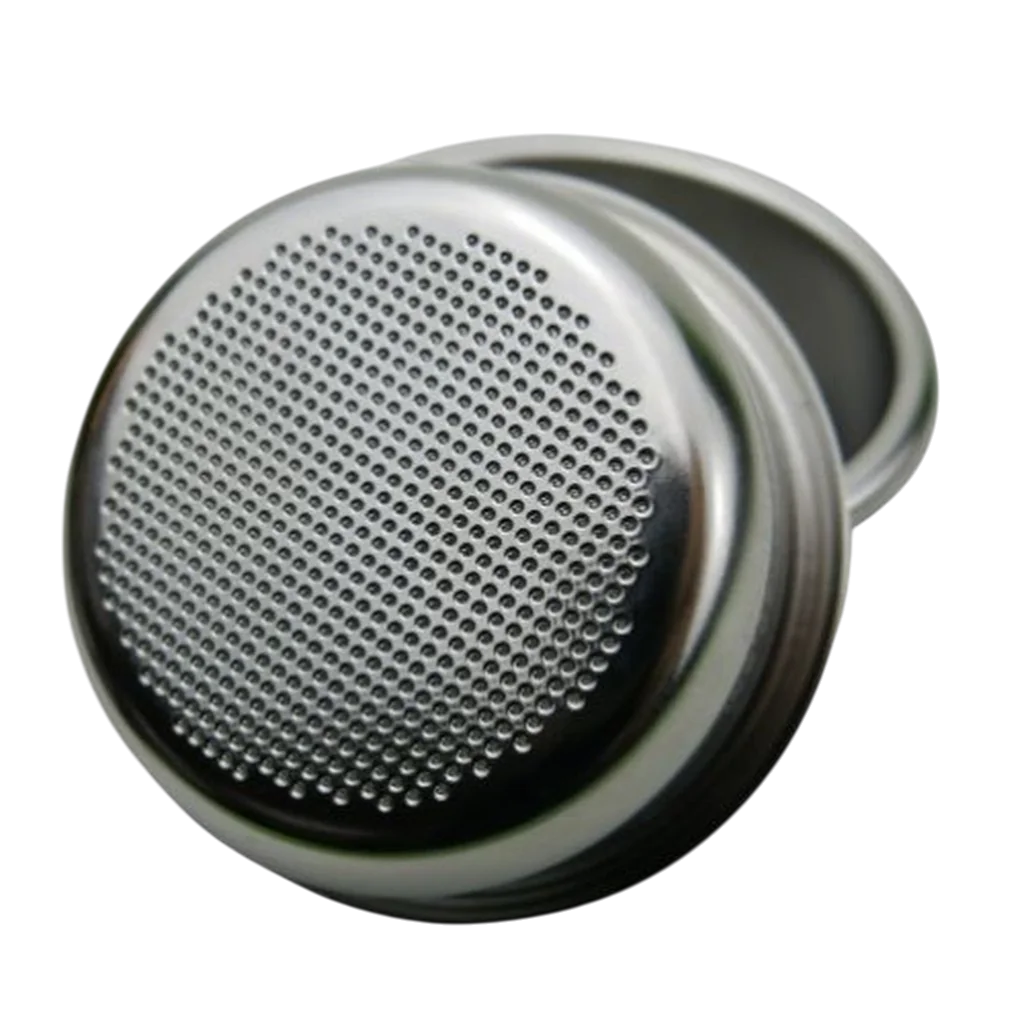
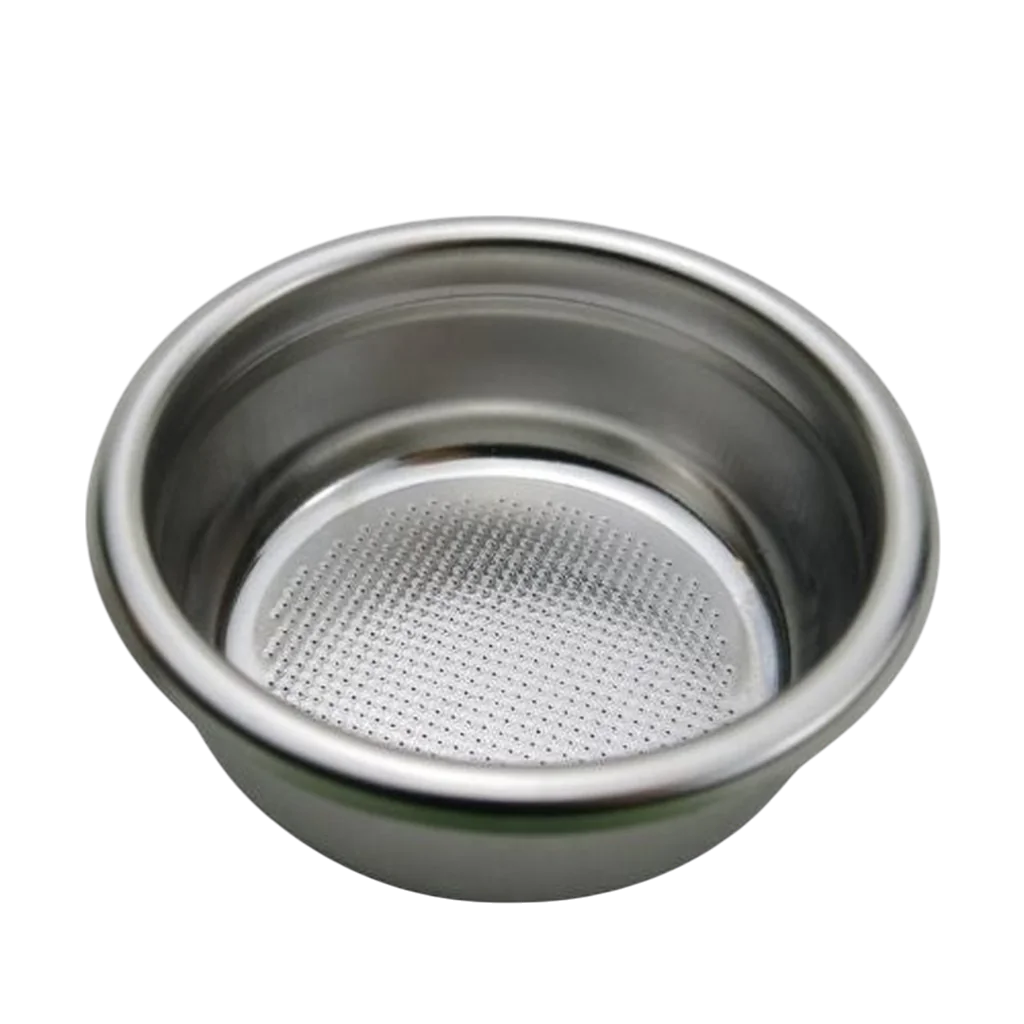
The included Profitec tamper has a rather thin base but fits very snugly into the included sieves. There is a gap of 0.4 mm, which is very small. A single and a double portafilter are included in the delivery. They appear high-quality, although the sieves are not precision sieves. The steam boiler gauge and steam wand also make a good impression.
We find some sharp edges, such as on the drip tray or the side ventilation shafts. Nevertheless, the material thickness of the machine and the overall impression are good compared to other machines in the same price range.
The positive external appearance is complemented by a 2.7-liter water tank that is easy to remove. It's positive that we don't have to awkwardly thread hoses into the tank here. A positive feature compared to a price-comparable Lelit Elizabeth.

Heat-Up Time and Temperature Stability
Anyone who likes to drink espresso quickly after turning on an espresso machine will appreciate a fast heat-up time. This is typically not the strong suit of dual boilers, as they usually leverage their strength through inertia and stability. However, the Profitec Pro 300 manages to heat up to operating temperature in about 15 minutes. We already measure a good 91 to 92 degrees on the first pull with a set brew temperature of 93. If several pulls are made one minute apart in succession, the machine does overshoot a bit. We measure 1.32 standard deviation on the KM protocol and 1.28 standard deviation on the WBC protocol. It could be better, but it's not a bad value either – it's in the range for this price class. What's nice is that we barely measure any offset when we base it on the average brew temperature of the WBC or KM protocol. With a set brew temperature of 93 degrees Celsius, the machine shows 93.26 degrees on the WBC protocol (second 4-25 of extraction).
Interestingly, we only achieve such heat-up performance if we switch on the steam boiler of the machine. If it is switched off, we only reach the target temperature after over 25 minutes. The slow warm-up phase is difficult to explain structurally. However, it is clearly important that the steam boiler in the machine's chassis contributes to the temperature.
The results of the temperature measurements surprised us structurally due to the heat-up time (with and without steam boiler). We therefore asked Profitec whether our measurement results were comprehensible. Profitec re-measured on additional Pro300 units and essentially confirmed our results.
Profitec Statement:
The waste heat from the steam boiler has an influence on the temperatures of surrounding components. As a result, when the steam boiler is switched off, the desired brew temperature is reached a few minutes later. A slight increase in the offset by qualified specialist personnel can compensate for the temperature difference when the steam boiler is switched off.
Without the steam boiler, we recommend a heat-up time of 25 minutes. In the graph above, we started pulling at 20 minutes. You can see that it takes some time before the brew temperature kicks in. In the following graph, we pulled the first shot after 25 minutes. It clearly illustrates that the temperature is then essentially there, even though a purge shot to warm up the portafilter still makes sense.

Measurements were taken using both WBC and KM protocols. The measurements are logged with the Scace 2 58mm portafilter, a K-type sensor, and a PCE-T 330. The initial measurement is taken at 25 minutes. We also verify the manufacturer's specifications. If a manufacturer states that an espresso machine should be hot after 8 minutes, we check this with the KM protocol. In a third measurement series, we work our way up to the heat-up time by taking a measurement each day and then letting the espresso machine cool down for 24 hours. We typically approach the heat-up time in 5-minute increments and pull KM protocol curves at, for example, 5, 10, 15, 20 minutes. The measurement procedure is as follows:
- Check the temperature of the water in the water tank. Target: 20 degrees +/- 2
- Heat for 25 minutes or the defined time with the measurement portafilter clamped, then
- unclamp
- purge for 5 seconds
- clamp
- extract for 25 seconds
- leave clamped for 15 seconds
- unclamp
- leave unclamped for 45 seconds
- purge for 2 seconds
- extract for 25 seconds
- This process is repeated a total of 5 times.
Energy Consumption of the Profitec Pro 300
The Profitec Pro 300 has very low energy consumption. Not only is the consumption without the boiler switched on spectacularly low. Even with the boiler, we achieve very good values of only 0.2 kWh including heat-up time and 5 double shots. Pulling a double espresso including heat-up time uses 0.16 kWh.
If we don't switch on the steam boiler, we do wait longer. However, since the larger 0.75-liter steam boiler doesn't need to be heated, the energy consumption for a double espresso is 0.08 kWh. If we add another 4 double shots, we come into the comparison window with our other performance measurements on other machines. We then measure 0.119 kWh and thus also note remarkably low consumption here. This puts the Profitec Pro 300 on the same level as some thermoblock espresso machines. Great!

Additional charts on energy consumption without steam are attached at the end of this page.
Making Espresso
Making espresso with the Profitec Pro 300 is easy to do. With a good grinder at your side, we have achieved excellent extractions with high consistency. The vibration pump guarantees a slow pressure build-up, which in our espresso pulls results in the first drops in the cup after 8 to 10 seconds. Extractions with such a slow pressure build-up tend to take a bit longer time-wise, depending of course on the coffee and preference.
The temperature of the shots is, as written above, sufficiently stable. With some knowledge of your own machine, you can develop a good feel for where the temperature is and whether longer purging is needed or not. If the machine sits idle for a while (30+ minutes with steam boiler), we recommend purging for 6-8 seconds.
The Profitec Pro 300 lacks features like pre-infusion or lower flow rate that we have found on other dual boilers in this price class. But it delivers what we expect from a good dual boiler. This also includes a PID-controlled adjustment of the brew boiler from the front of the machine.
In addition, it has a welcome "Last Shot" protection. Even when the water in the water tank is running out, the machine doesn't break off mid-pull but allows the home barista to finish the shot. Anyone who has ever cursed at their machine because the water ran out mid-pull knows how important such a function is for the barista's peace of mind.
Steaming with the Parking Brake On
With the Profitec Pro 300, we can steam milk in parallel to the espresso pull, as befits a dual boiler, and then also pour a cappuccino. Steaming in the default state works okay but takes time, and the Profitec Pro 300 is certainly not the fastest steaming machine. Unfortunately, the temperature of the steam boiler cannot simply be increased via PID control. The corresponding temperature control at the front only affects the brew boiler.
The steam boiler can also be supported in terms of performance. To do this, four screws must be removed and the top panel taken off. This is where the pressostat is hidden, which can be carefully adjusted. More on this in the video. Some home baristas also report having good experience switching the nozzle to a different hole count.
In the default setting, it takes us 58 seconds to heat 300 ml of water to 60 degrees. That is a slow value.

Conclusion on the Profitec Pro 300
The Profitec Pro 300 is an interesting dual boiler espresso machine from German manufacturer Profitec. Not only the broad network of specialty retailers that distribute the machine in many regions is a strong pro-argument for this dual boiler.
The Profitec Pro 300 impresses with overall good performance in many areas. Outstanding is the low power consumption for a dual boiler. The build quality of the machine is good and the temperature stability solid. The practical control switches for the steam and brew boiler as well as for turning on and off, and the no-frills design make the Profitec Pro 300 the right choice for home baristas who are looking for just that. While the steam performance doesn't blow us away in its delivery state, it can be improved via the pressostat inside the well-organized machine. The low mounting height of the portafilter is somewhat disappointing. Larger cups or higher scales don't fit well together under the outlets. We measure a height of only 7.8 cm, which is rather little.
We are sure: anyone who owns the Profitec Pro 300 will be able to enjoy good espressos and delicious cappuccinos in their home. For this, the dual boiler Profitec Pro 300 provides all the prerequisites.
* Note: We uploaded the video for the Profitec Pro 300 twice. In the first video version, we mistakenly said that the Profitec Pro 300 does not have insulated boilers. This is not a fact. We also didn't elaborate on the energy consumption. However, for a dual boiler, it is actually relatively low and an important argument for the espresso machine.


Active Power W and Active Energy kWh without Steam

Active Power W and Active Energy kWh with Steam