



























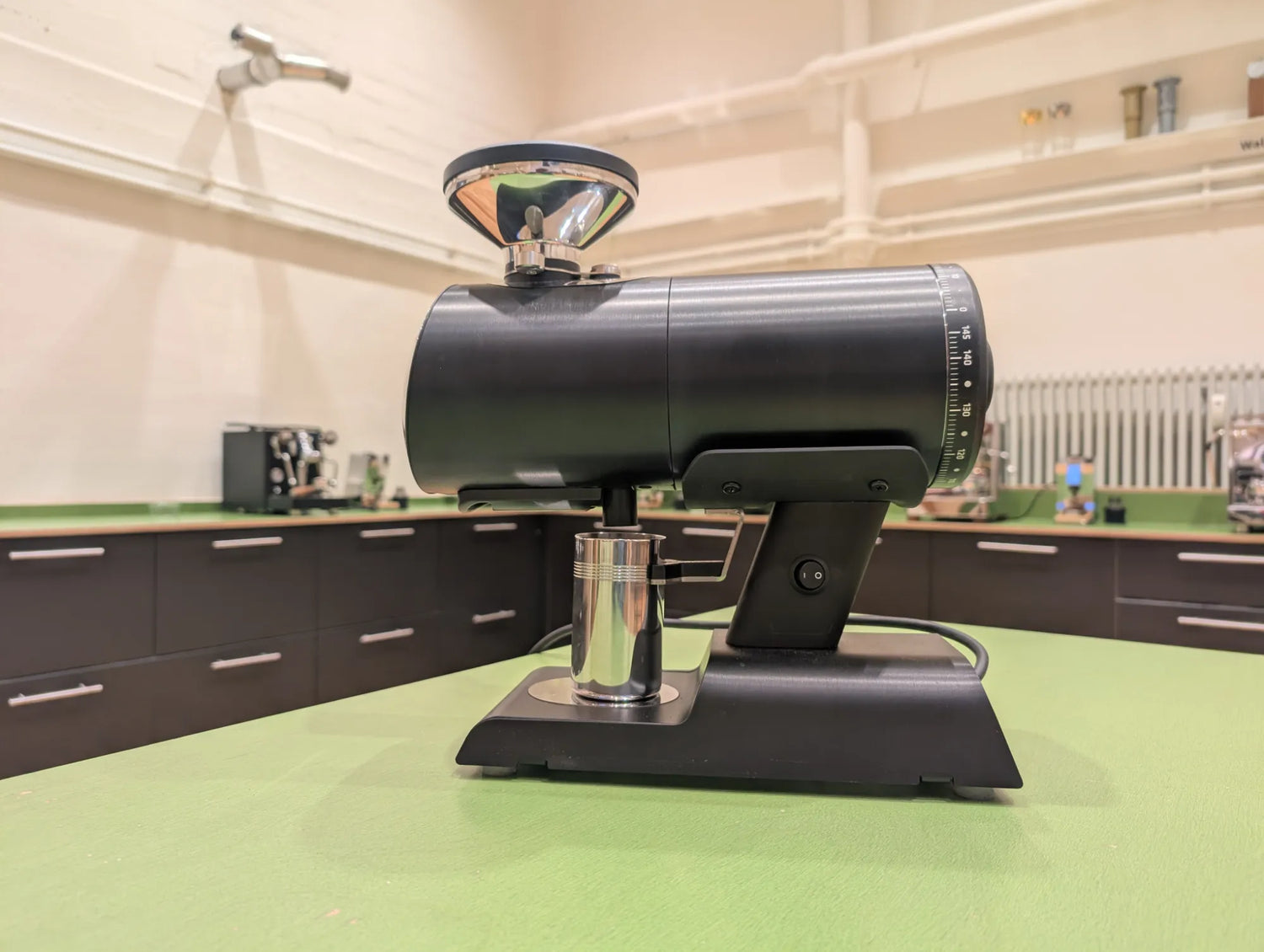

The Mazzer Philos impresses as a heavy, versatile single-dosing grinder for filter and espresso with exchangeable burrs, precise grinding performance and despite weaknesses in consistency.
We subjected the grinder to a six-month intensive test, tested it in the lab, measured particle distributions and also tested it under real conditions at the Swiss Coffee Festival. In this article and video, we summarize our findings. Of course, we also share our workarounds for the consistency issues that we also encountered with the Mazzer Philos.
Buy Mazzer Philos
The following specialty shops distribute the Mazzer Philos and we can recommend purchasing from these retailers. All offer the option to adjust the machine's offset.
Germany:[Partnerlinks]Stoll Espresso
Switzerland:[Partnerlinks]Adrianos, Simons Kaffee
We search for specialty partners on your behalf, partners we know do good work and provide good service, and we maintain close contact with these retailers. The links are so-called affiliate links. If you order through one of these links, you don't pay any extra – we receive a small commission, which we invest directly in new test equipment.
We continue to search for competent partners in the DACH region for you.
A Material Statement
On one hand, the Philos impresses with high-quality materials and manufacturing. The inner piston is completely machined from stainless steel, and the outer housing consists mainly of anodized aluminum. Combined with the 400-watt motor, the Philos weighs an impressive 12.5 kilograms. On the other hand, some plastic parts stand out negatively and detract from the overall premium appearance. These include the on/off button, the hopper lid, and the "click" mechanism for removing ground coffee at the coffee outlet chute. These parts appear less high-quality, and visible manufacturing edges and impressions are noticeable on the plastic parts.
While this diminishes the overall positive impression somewhat, it doesn't seriously compromise the overall quality of the grinder. The Philos is available in silver and black versions.
In our regions, the Philos runs at 50 watts and 1600 revolutions per minute. Mazzer itself offers two 64-mm burrs suitable for the Philos: The I189D are specifically recommended for espresso, while the I200D serves as an all-purpose solution for espresso and filter coffee according to the manufacturer. We can already confirm these specifications, and we go into more detail in the video and further down in the article.
The burrs are positioned vertically in the grinder and each is fixed with three screws. Changing the burrs is possible without tools. However, the two wing nuts are initially tightened so firmly that opening them poses an injury risk.
Our test grinder was delivered with good alignment. The entire inner and front-pull-out section is guided very precisely into the grinder and shows no play. This section carries the front burr. Particularly notable is a large pre-breaker, which according to Mazzer, functions less as a pre-breaker and more as a "guide" for coffee beans to the burrs.
As a specialty retailer for distributing the Mazzer Philos, we can recommend Stoll Espresso*.

Usability and Retention
Mazzer has placed the grind setting adjustment on the back of the Philos. This makes access difficult for people in wheelchairs and also for users when the grinder is positioned further back on a work surface or under a hanging kitchen element.
There are understandable reasons for this placement, but it does affect usability. However, an advantage of the design is that the grind setting remains fixed even if the grinder is opened and cleaned from the inside. By the way, the originally stepped grinder can be converted to a stepless version by removing a gear that is located under the cover of the grind setting adjustment. The steps of the Philos are relatively fine: per step, the burrs distance themselves by 0.6 micrometers, which results in a change in extraction time of just under two seconds for espresso.
The grinder impresses with minimal static issues and is thus a positive exception among single-dosing grinders. The bean hopper effectively reduces so-called popcorning. Additionally, the grinder features a sliding mechanism that can close the hopper. This makes the unsightly plastic lid unnecessary.
We measure a temporary retention of 0.1 grams and a permanent retention of 0.5 grams. In practice, the permanent retention can empty in favor of the temporary retention, which creates some play. At the front of the grinder is a hidden cleaning outlet used to empty the ground coffee chute. However, this was rarely used in our test because the rinsing of ground coffee after using the "click" dosing finisher was too cumbersome and didn't integrate smoothly into the workflow. With a temporary retention of 0.1 grams, we could live well, provided the effective output amount was correct.

The Mazzer Philos is easy to open and easy to clean.
Consistency Issues
Although we were able to measure very consistent shots and grinds with the Philos time and again, consistency issues occurred regularly nonetheless. We see the reason for this in the release of permanent retention. It frequently happened that the grinder dispensed 18.5 grams of coffee instead of the entered 18 grams. We only noticed this because we had gotten into the habit of always checking the dosage after grinding. This deviation occurred even though our workflow remained unchanged. In these cases, a larger portion of the permanent retention would release from the grinder and increase the coffee amount. At the next grinding, the retention would fill up again, so only 17.5 grams were dispensed – 0.5 grams were missing. The result was irregular espresso shots until we began to strictly monitor the output amount and either grind more coffee or reduce the weight.
From our perspective, however, this is only one factor that explains the occasional consistency issues with the Philos. The second lies in the geometry of the dosing cup. While the grinder itself has only minimal static issues, these appear much more pronounced in the dosing cup. Coffee sometimes sticks to the edges and corners at the bottom of the cup.
The main problem with the dosing cup lies elsewhere: Despite WDT (Weiss Distribution Technique) and careful puck preparation, the cup consistently led to massive channeling in our tests. The reason is that the cup sinks completely into the portafilter instead of, like many other dosing cups, resting lightly on the edge of the portafilter thanks to side wings. This creates craters down to the bottom of the portafilter, and even with the greatest care, we regularly observed channeling at the edges.
Although the dosing cup fits perfectly into the grinder through its magnetic mechanism and size, we stopped using it anyway. Instead, we first transferred the coffee into another dosing cup before putting it into the portafilter. You can find a dosing cup alternative in our shop as well.

Speed and Temperature
The Mazzer Philos grinds 18 grams of coffee in 15.2 seconds. Until all beans are completely ground and the last bit of coffee is knocked out, it takes correspondingly a bit longer. Nevertheless, with a maximum grinding speed of 22.4 grams in 10 seconds, the grinder shows a remarkably high speed for a single-dosing grinder. The ground coffee barely heats up – we measure an average temperature of 31.86 °C.
Our test model is noticeably loud when switched on but not yet grinding. Compared to the grinder of our esteemed YouTube colleague Lance Hedrick, this difference is particularly striking. Our Philos sounds more like the grinder used by our also highly esteemed YouTube colleague Aramse.
However, as soon as beans are added to the grinder, it is relatively quiet compared to other models. We measure a loudness of 78.1 decibels. A loudness below 80 decibels we rate as very quiet and thus pleasant for daily use.
Espresso and Filter Performance and Particle Distribution
We enjoyed numerous excellent espressos ground with the Mazzer Philos. Both burr variants delivered good results.
Burr Comparison
I189D: The espresso burrs I189D impressed us with dense, body-emphasized yet balanced espressos. The acidity was reduced, and the pleasant bitterness fit harmoniously into the flavor profile. Particularly with medium and darker roasts, the burrs brought the roasting aromas well into the cup. However, with more complex or lighter roasted coffees, there was somewhat lacking in clarity.
We really enjoyed our Apas espresso with the I189D burr. It is a medium roast, chocolatey and well balanced.
I200D: These burrs emphasized the individual character of the coffees more distinctly and delivered clearer results. However, this sometimes came at the expense of body. The extracted coffees were more elegant and complex with optimal preparation. However, the balance of flavors was harder to achieve than with the I189D burrs and often fit less well, especially with medium and darker roasts.
Filter Coffee
For preparing filter coffee, we always reach for the I200D burrs. Some of the best filter coffees of the past year were prepared by us with the Mazzer Philos and these burrs. The grinder impressively brought out the clarity and complexity of the aromas. Both complex specialty coffees and accessible classics like our "Amigo" were excellently extracted. The Mazzer Philos has proven to be an excellent filter coffee grinder and will certainly see frequent use in this capacity.

Particle Distribution
Our measurements of particle distribution confirm the quality of the burrs. While the I189D burrs delivered a good but not particularly narrow main peak of 206 micrometers, the I200D burrs achieved a significantly narrower and higher main peak of 188 micrometers. Interestingly, the fine peaks of the two burrs hardly differed. The main peak of the I189D shifts slightly to the left because the higher uniformity of the ground coffee allows for a finer grind setting.
The reproducibility of the grinding results also impressed us, even after recipe changes between different coffee drinks. This was evident both in our extraction tests and in the particle distribution measurements. The main peak width differed between the two burrs by only 3 or 4 micrometers after we switched from espresso to ristretto, then to lungo, and back to espresso.
Challenges
The biggest challenge lies in the grind setting adjustment, which is located on the back of the grinder and is difficult to view. Nevertheless, the grinder – particularly when using step regulation – remains very consistent in the repeatability of noted recipes.

Conclusion on the Mazzer Philos
A final conclusion on the Mazzer Philos requires a comparison with other grinders as well as an assessment of the price. The Mazzer Philos currently costs around 1,099 euros. This price is remarkable given the high-quality materials and only possible because Mazzer, as an established grinder manufacturer, has aimed for higher production volumes from the start. For these 1,100 euros, you get not only a powerful grinder but also presumably a grinder for life. Our three old Mazzer grinders have been in use for over 15 years and will likely continue to work for many more years.
Admittedly, there are some components on the Mazzer Philos that could be higher quality. These include the plastic grind outlet finisher, the lid, and the easily scratched surface for the dosing cup. However, if necessary, these parts can be replaced.
In its core area, however, the Mazzer Philos is excellent. It grinds excellent coffee with both burrs offered by Mazzer. The I189D burrs are likely the ideal choice for many, particularly for lovers of medium roasts. The I200D burrs, on the other hand, deliver excellent results, especially with filter coffee and more complex coffees. We were particularly impressed by the clarity that the grinder enables in filter coffee.
The consistency issues of the Philos are unfortunate, but can be well addressed with the workarounds we suggest. Replacing the dosing cup and weighing the coffee amount after grinding ensures a consistent workflow without outliers.
The Mazzer Philos is a powerful and high-quality single-dosing grinder that need not hide in terms of quality compared to more expensive models on the international market. Many of these models are significantly more expensive due to import and tax costs. Given its availability, repairability, and longevity, we would recommend the Philos at any time from a reputable retailer in the DACH region.
Recommended Specialty Retailers for Mazzer and the Philos
*We search for specialty partners on your behalf, partners we know do good work and provide good service. We maintain close contact with these retailers. These are affiliate links. If you order through this link, it costs you no more, but we receive a small commission that we invest in new test equipment.
Your Experience with the Mazzer Philos
What do you find good about the grinder in everyday use and what less so?
Have you had any difficulties with your model?
What should we double-check with our model?
Your feedback and experience reports make our test more thorough, meaningful, and better. Thank you in advance!


