




14 Manual Coffee Grinders Under €100 Tested – Which One Grinds Well for Filter Coffee AND Espresso?

Manual coffee grinders have some advantages over heavy electric coffee grinders. As a mobile, lightweight and handy option, they are the perfect coffee grinder for on the go, whether camping, hiking or traveling. But there is another important argument in favor of manual grinders: for under 100 euros, there are already some models that deliver relatively homogeneous grinds.
Suitable for filter coffee and espresso?
While many manual grinders do a good job with filter coffee, hardly any manual grinder grinds espresso-fine. Most electric grinders also fail in this discipline. The grind size for espresso is so fine that it demands a lot from the material. This pushes both the cheap burr sets and the driving force—in this case the motor or human at the manual grinder—to their limits.
The grinds should also not only be espresso-fine, but free of larger particles and lumps. These tear holes in the espresso under the pressure of the brewing water and allow faster flow-through and thus uneven extraction. That's not delicious!
To get straight to it: four coffee grinders under 100 euros passed the espresso test in our evaluation, some even quite well.
Why manual grinders make sense
We are often asked how to improve coffee quality at home. The first answer is simple: grind your coffee fresh. Freshly ground coffee is the first requirement for brewing good coffee. It doesn't matter whether you're preparing filter coffee or espresso.
After grinding coffee, the surface area is enlarged many times over. The result is that many of the most interesting aromas of a coffee fly away just minutes after grinding. Additionally, the surface of the coffee bean is greatly enlarged and oxygen and light easily reach the ground coffee. As a result, the oils present in the coffee oxidize more quickly.
This is why pre-ground coffee often tastes rancid and has little complexity. That's why buying a coffee grinder makes so much sense. A manual grinder not only does good work, it's also much cheaper than its electric counterpart. Whether a manual grinder or an electric grinder suits you depends mainly on how much coffee you grind per day.
Surprisingly enough: many inexpensive manual grinders do better work than some electric grinders costing over a hundred euros.
The basic data of manual grinders
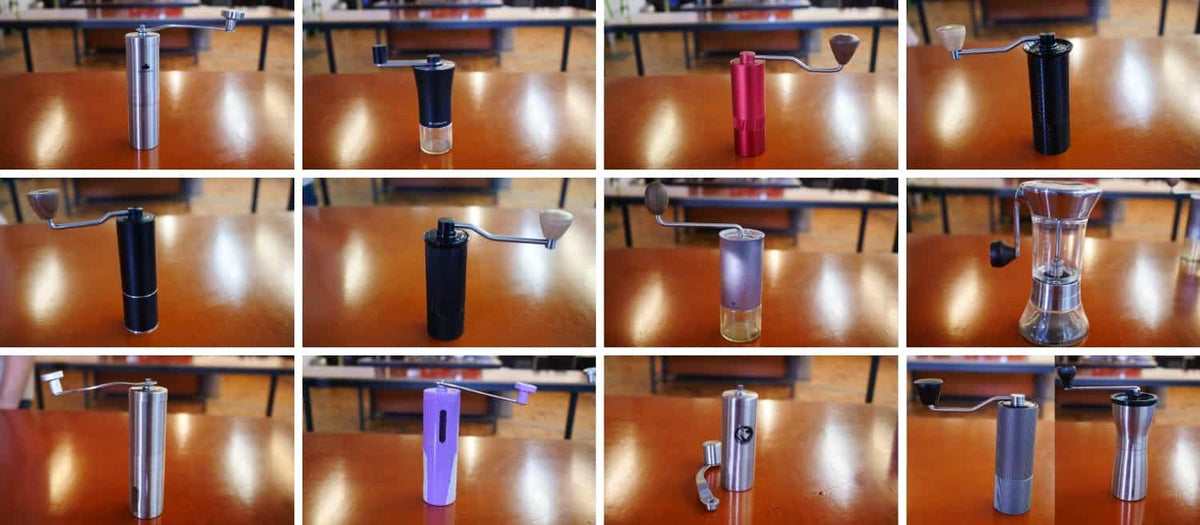
The technical testing was conducted by Felix Hohlmann. Did he know what he was getting into with this test? Actually, there's quite a bit you can compare when testing coffee hand grinders. This starts with the maximum bean capacity in the upper chamber, goes through the capacity in the collection chamber of the grinds, and ends with the material quality, the burr set, and the adjustability. And of course, the grinders also had to do their job as both filter and espresso grinders.
The following table summarizes the most important basic data.
| Test No. | Grinder name | approx. price (seen for) | Burr set | Settings | Material |
|---|---|---|---|---|---|
| 1 | VIENESSO Hand Coffee Grinder | 24.90 € | Steel (not fixable) | no | Stainless steel |
| 2 | Groenenberg Coffee Grinder | 25.00 € | Ceramic | yes | Stainless steel |
| 3 | Zassenhaus Buenos Aires | 30.99 € | Ceramic | yes | Lots of plastic – little metal |
| 4 | NITRIP Easy Clean Red | 72.49 € | Steel, good click system | yes | Stainless steel |
| 5 | Manual Coffee Grinder yobaih | 67.24 € | Steel, good click system | yes | Stainless steel |
| 6 | WishY Manual Coffee Grinder | 84.03 € | Steel, good click system | yes | Stainless steel |
| 7 | Nitrip Household Mini black | 50.09 € | Steel, good click system | yes | Stainless steel |
| 8 | Zassenhaus Quito | 79.90 € | Steel, good click system | yes | Stainless steel |
| 9 | Handground | 89.99 € | Ceramic | 8 settings | Plexiglass, stainless steel, glass |
| 10 | innislink Manual Coffee Grinder | 14.00 € | Ceramic | yes | Stainless steel |
| 11 | AXspeed Coffee Grinder | 14.99 € | Ceramic | no | Plastic |
| 12 | Rhinowares small for Aeropress | 46.42 € | Ceramic | no | Stainless steel, plastic |
| 13 | Hario Ceramic Coffee Mill Mini-Slim Pro | 49.99 € | Ceramic | yes | Stainless steel |
| 14 | Timemore C2 | 79.00 € | Steel, good click system | yes | Stainless steel |
The complete table with more information can be found here.
Here are some noteworthy points. The Handground grinder is by far the largest grinder in the field. With 85 grams capacity in the upper chamber and 60 grams in the collection compartment. At 790 grams and 21 cm, it's anything but a good travel companion, especially since the grinds container is made of glass.
The smallest grinder is the Nitrip Mini Black at 14 cm high and 5 cm in diameter. With only 19 grams capacity for both beans and grinds, you can grind just enough coffee for a double espresso or 300 grams of filter coffee.

The three test winners of the manual grinder test
Four grinders are suitable for grinding both filter coffee and espresso and thus initially set themselves apart from the other grinders. However, if you're only looking for a filter coffee grinder, you'll find other good models as well.
Of the four grinders, we can recommend three without reservation. The Nitrip Mini Black, the manual grinder Nitrip Easy Clean Red, and the Timemore C2 performed strongly in many respects.
The Grøneberg* costs only 25 euros and is the best of the very cheap grinders under 30 euros. In terms of workmanship and handling, it leaves some things to be desired. If you're looking for a value-for-money test winner, it's the Nitrip Mini Black* for us. It costs around 50 euros, but scores both in material quality and ease of use.
Nitrip Easy Clean Red – top espresso, high-quality build and eye-catcher
The red Nitrip Easy Clean Red stands out visually in the field of 14 test grinders. A closer look at the grinder reveals surprisingly high-quality craftsmanship. The entire grinder is made of metal and at 500 grams, the manual grinder is one of the heavier ones in the field. With 25 grams capacity in both the bean hopper and grinds container, the grinder has an ideal size for a manual grinder. This makes it easy to fill a double espresso (approximately 18 grams of coffee beans) as well as coffee for 400 ml of filter coffee (24 grams of coffee). The grinder's shaft has multiple bearings and the guide is also made of metal. The wooden handle is finely grained and feels nicer than the other handles of the coffee grinders in the field.

The steel burr set can be adjusted precisely by clicks. In our test, we ground 18 grams of coffee each and compared the grind consistency of the grinders. The Nitrip Easy Clean Red was the second fastest at a normal "hand-grinding speed", finishing the grinds in 35 seconds.
We achieved good filter coffee and the best tasting espresso in the field with the Nitrip Easy Clean Red. However, the espresso rating shouldn't be overweighted. We had the grinder set to 10 clicks, which allows for further adjustments both in the coarser and finer ranges. However, the extraction times jump by several seconds, which means a perfect grinder adjustment through the grind size alone is hardly possible. But this is a general disadvantage of manual grinders that hardly matters, especially when the extraction works out as well as it did in our case.
There's really only one criticism point regarding the Nitrip Easy Clean Red. The lid of the coffee grinder falls off a bit too easily. The principle of its smaller sister grinder, the Nitrip Mini Black, would have been better here.
When we bought the Nitrip Easy Clean, it cost 55 euros. Recently, we've seen it priced between 70 and 80 euros. We're keeping our eyes open and will link it again when it becomes available. And we're trying to track down the manufacturing factory and potentially bring the grinder to the European market ourselves.

Timemore C2
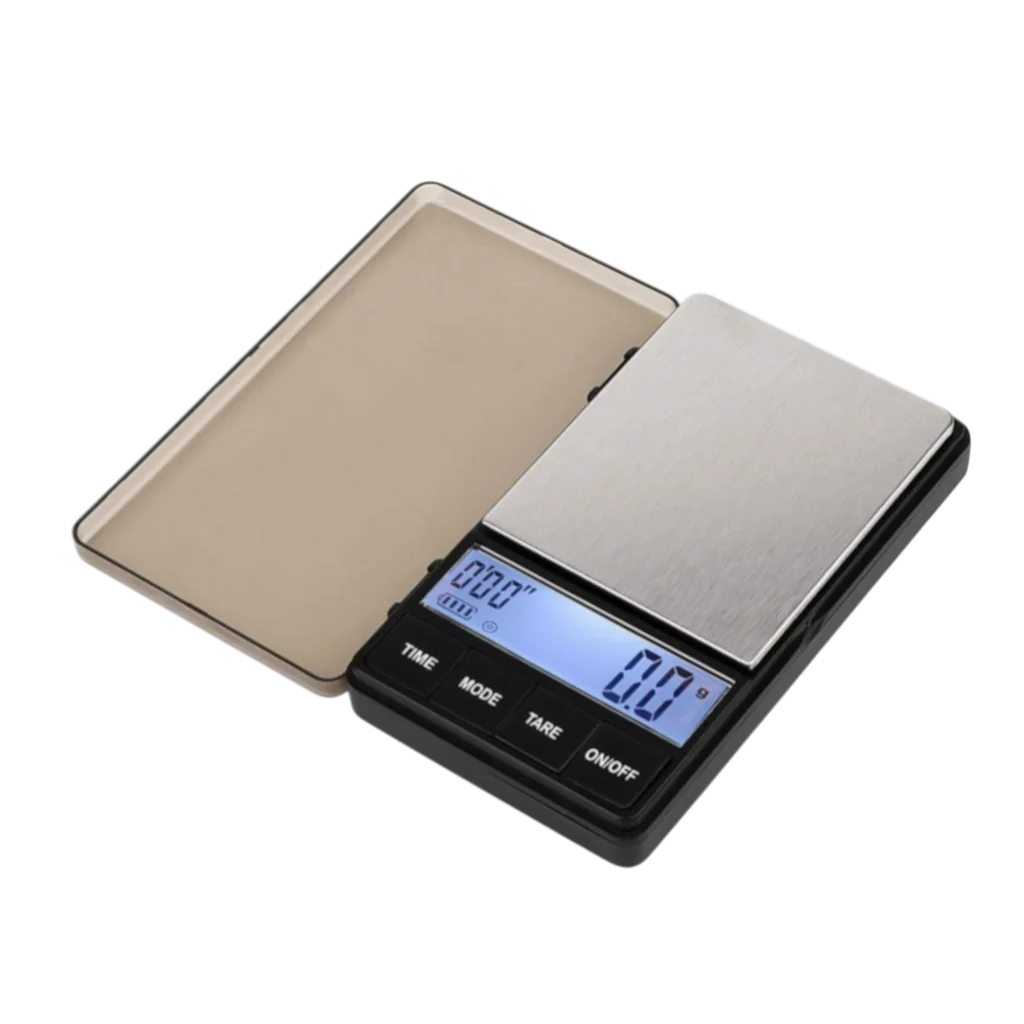
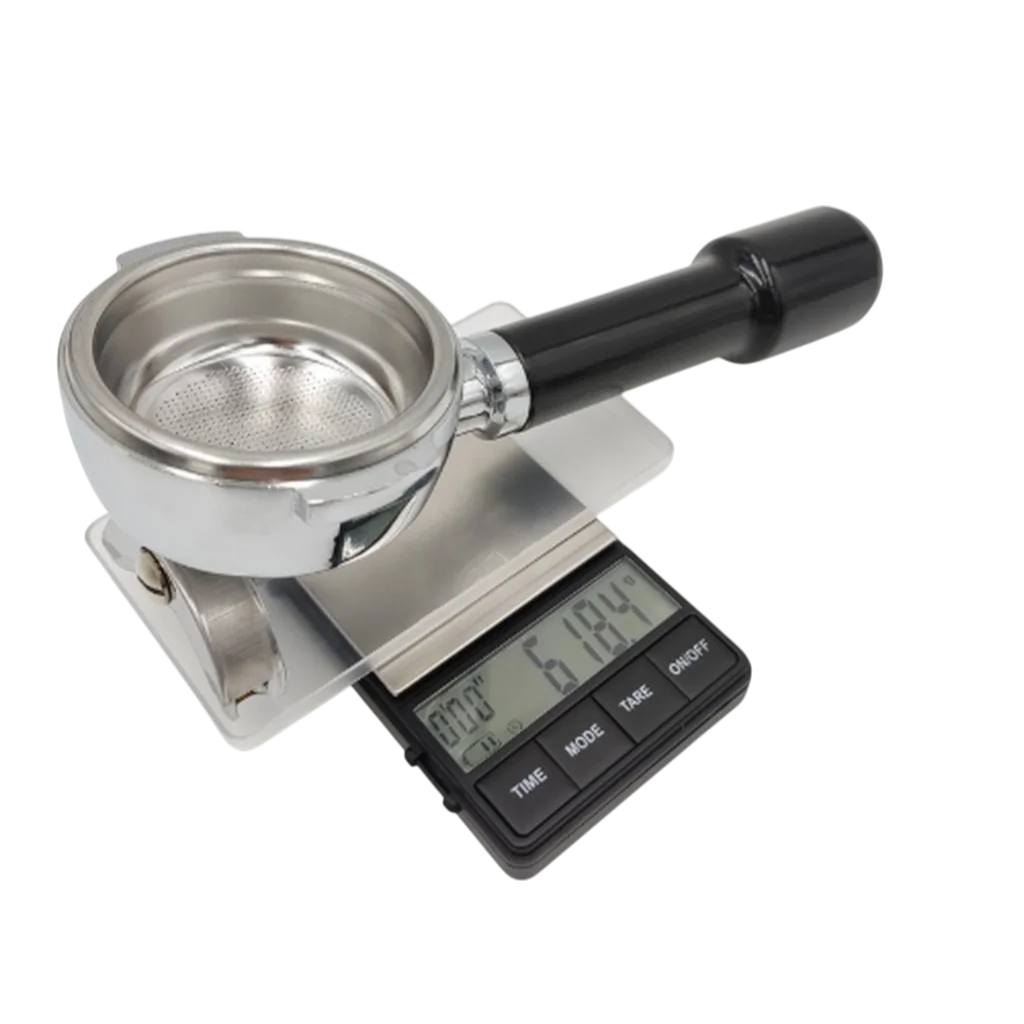
We're frankly pleased that the Timemore C2 manual grinder is among the top 3 grinders in the field. Because Timemore is a real coffee equipment manufacturer, while Nitrip also sells pillows and fire extinguishers. Timemore, for example, makes one of the cleverest scales on the market with dual weighing function.
The Timemore performs very solidly, was responsible for one of the best filter coffees in the field, and also grinds espresso-fine. The grinder is made of stainless steel and the shaft has multiple bearings. At 465 grams and a height of 15.7 cm, the grinder is among the more robust and heavier manual grinders in the field.
The bean capacity is 21 grams and the grinds container holds 27.5 grams of coffee. Like the Nitrip Easy Clean Red, the Timemore C2 also has a "lid falling off" problem. It lacks a magnet or other locking mechanism.
The steel burr set can be adjusted in steps and looks high-quality and sharp. For filter coffee we were at 25 clicks and for espresso at 13 clicks. The Timemore C2 was the fastest in the field of 14 grinders. 19 grams were ground in about 30 seconds. However, the burr set appears to be different now, as it takes much longer for espresso-fine grinds.
The Timemore C2 has an outer ridged structure, which facilitates a firm grip and prevents the grinder from slipping. The circumference of the grinder is still pleasant even for smaller hands.
Online we've seen the Timemore C2 priced between 79 and 85 euros.
Disclaimer and note: we now offer the Timemore Chestnut Slim 3 hand grinder in our shop. This grinder is even better suited for espresso.

Nitrip Mini Black
The manual grinder Nitrip Mini Black* can only be faulted on one point: it can hold no more than 18 grams of coffee in either the bean hopper or the grinds compartment. However, if you mainly use the grinder for yourself or as a companion for hiking or traveling, you'll be very well served with the Nitrip Mini Black.
This grinder also has multiple bearings in a metal housing. The grinder weighs 290 grams and is 14 cm tall with a diameter of 5 cm. This makes it the smallest and most handy grinder in the field. The fine ridges on the body make it easy to grip and it doesn't slip out of your hand.
Unlike the first two grinders, the Nitrip Mini Black doesn't constantly lose its lid. The lid locks securely and stays in place even when you turn the grinder upside down. The wooden knob holds firmly to the grinder handle with a magnet. This also looks high-quality and well made.
Like the other two grinders, the Nitrip Mini Black is also well suited for brewing filter coffee and espresso. Since the small grinder is more suitable than any other for mobile brewing, we prepared an espresso with the Flair. Very practical – the bean hopper fits perfectly into the brewing chamber. Pouring the ground coffee powder was therefore very easy.
For filter coffee we set the burr set to 23 clicks and for espresso to 11 clicks (for the Flair to 10 clicks). By the way, the grinder ground 19 grams in 35 seconds, making it one of the fast grinders.
The Nitrip Mini Black was at around 50 euros the cheapest of the three best grinders and is thus our value-for-money test winner.
How to adjust manual grinders using "clicks"
Once you've found the right grind size for filter coffee, you only need to readjust the grinder if you're using completely different roasts or coffees. For example, when switching from a lighter roasted coffee to a dark one, this may be necessary. In everyday use, filter coffee usually only requires minimal readjustments, since strength and extraction can also be controlled through swirling and dosing. For proper espresso adjustment, more precise setting is important.
If a grinder is adjustable in steps and has a click raster, it greatly simplifies adjustment. Above all, you can easily return to the original grind size. Adjusting the grinder by one step becomes audible with a clicking sound when adjusting. The zero point is the completely closed grinder (conical burr fully retracted). From there, you count up to the appropriate grind size. For example, we set the Timemore C2 to 25 clicks to grind coffee for filter coffee. For espresso adjustment, our grinder was set to 13 clicks.
Grinders with "clicks" allow you to write down recipes, switch coffees, and return to the old grind size.
Advantages and disadvantages of stepped and stepless adjustment in manual grinders
Very good professional grinders are either stepless or have a step raster with very small intervals. Stepless grinders can be adjusted most precisely because the adjustment is not tied to a raster. An example is the EK43 or Niche Zero, both grinders that can be used for both filter coffee and espresso. These grinders can quickly change from fine to coarse and do so in the smallest increments because a marked raster provides orientation.
With stepped grinders, adjustment is always tied to a raster. If the step jumps are very small, this grinder can also be adjusted very precisely. In the espresso range, a stepless burr set is usually preferred.
For manual grinders, grinders with steps have advantages. This is mainly because the adjustment screw is turned completely several times when setting the manual grinder. With stepless grinders, you simply don't know "where you are during adjustment" if the grinder can't be counted by clicks. In theory, a stepless grinder would also be more accurate with manual grinders. However, orientation is so difficult that we clearly recommend manual grinders with steps and "clicks".
Links with asterisks are affiliate links. If you buy a grinder through this link, you support us with our work. The grinder doesn't cost you any more and we fill our test machine fund. But: if possible and available, we always recommend buying a grinder locally from a small dealer or at the roastery. There you can get advice directly and in the future you'll have contacts. If a grinder is only available on Amazon and you buy it there, we're very happy if you shop through our link. Thank you!