




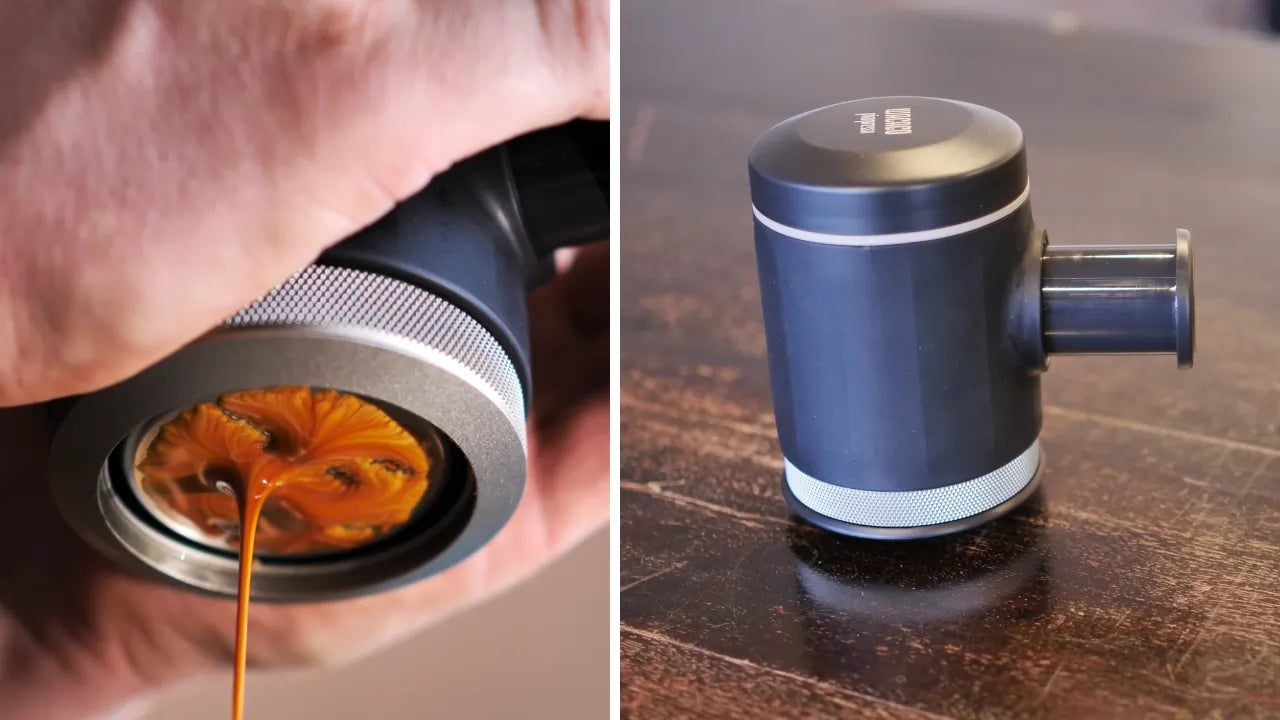

When traveling or on trekking tours, good freshly brewed coffee is always welcomed by all fellow travelers. As a rule, filter coffee is the right choice to make a group happy, because it's easier to brew in sufficient quantities quickly. In an article and video, I specifically address different coffees for on the go.
But when espresso cravings hit, filter coffee isn't the right answer. Flair, Aram and co. are only somewhat mobile and therefore not well suited for travel. The Wacaco Picopresso promises to do exactly that. And after I had already achieved decent results with its predecessor, the Wacaco Nanopresso*, I was particularly curious to see what the Wacaco Picopresso* promises in terms of coffee quality and build quality.
Coffee Quality with the Wacaco Picopresso
With all mobile espresso brewers, the first and most important question is whether they are actually capable of brewing espresso. Espresso is characterized by one key feature: the concentration of dissolved coffee particles in relation to water. The concentration range, also called strength, is not definitively defined, but ranges between 6 and 12% TDS (Total Dissolved Solids).
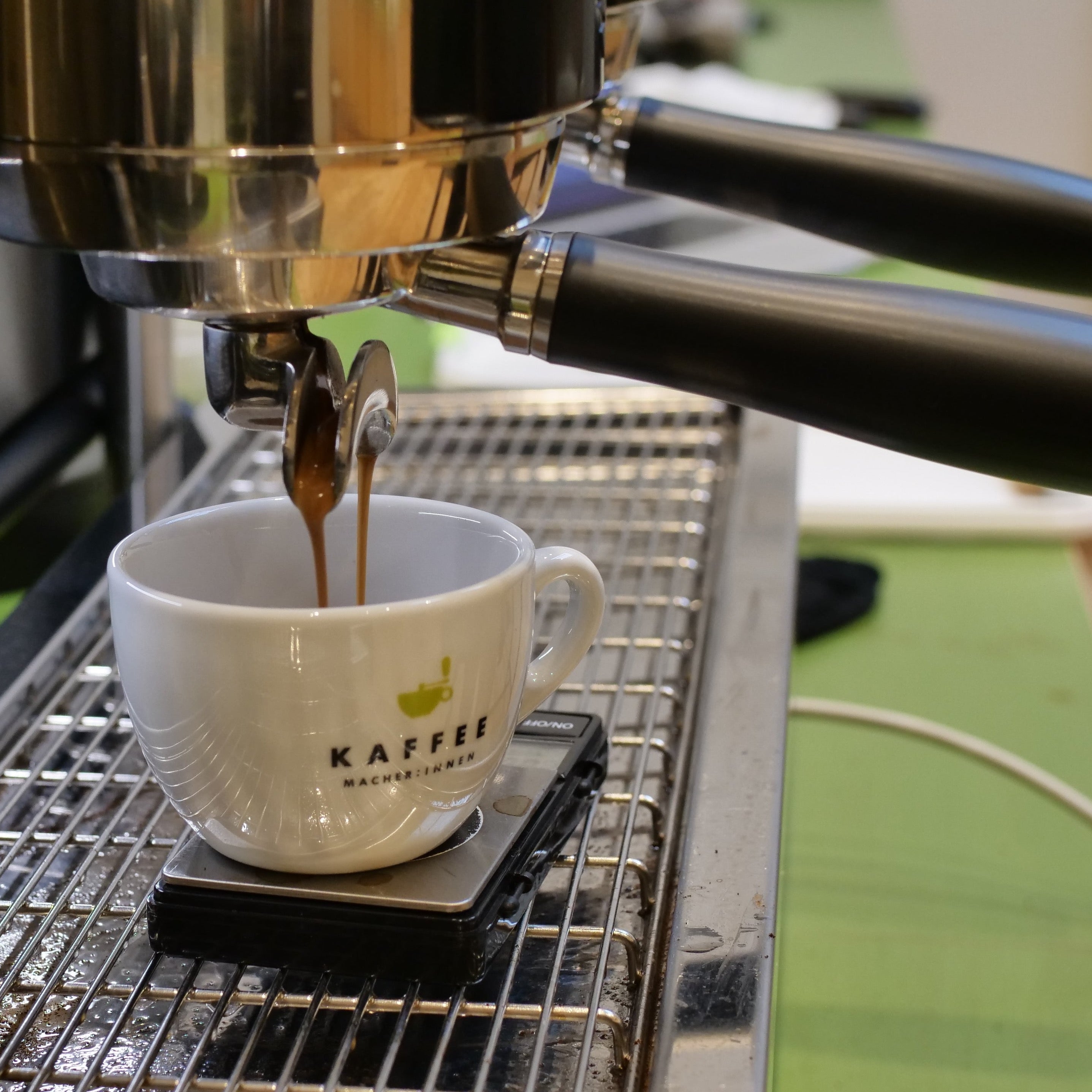
With the Wacaco Picopresso, we brewed an espresso with a strength of 9.7% TDS, using a drink ratio of 18 grams of coffee powder to 36 grams of espresso in the cup. A strong double espresso, in a 1:2 ratio.

The texture of the espresso was creamy and balanced, with a slight tendency toward acidity in taste. The acidity is emphasized by the rather low brewing temperature. The result is good for a mobile espresso brewer.
Anyone who wants to compare the Wacaco Picopresso with their top portafilter espresso machine will notice variations, especially in terms of consistency and reproducibility of results. But from our perspective, that's not really the goal of a mobile brewer either. It's designed to brew a good espresso while on the go, and we had that experience every time we took the Picopresso out on a kayak tour, hike, or even at the stadium.

Brewing with the Wacaco Picopresso - Tips
According to the manufacturer, the Wacaco Picopresso's basket holds 15-20 grams of coffee. We recommend working with 18 grams of coffee. With less fill, we noticed significantly more channeling.
- 18 grams is also recommended to follow our classic brewing recipes, which we provide for various coffees.
- First, the Picopresso should be thoroughly flushed with boiling water. To do this, pour boiling water into the brew chamber, unscrew the lid, and flush with pump strokes. Unlike Wacaco's instructions, we also recommend preheating the basket.
- Then quickly add the prepared 18 grams of espresso-fine ground coffee evenly to the basket, break up any lumps with the included needle tool if necessary, and tamp straight. The dosing ring can be used as a guide for this.
- Next, place the shower screen, screw on the basket, add boiling water again, close the brewer, and start pumping. After approximately 10 strokes, performed evenly and without pause, drops should appear at the bottom of the basket. These are only visible if the tapering plastic spout is not attached. The plastic spout can make sense. However, we recommend working without the spout when adjusting the grind size.
- If espresso drops don't appear at around 10 strokes, the grind is too fine. If first drops appear much earlier or the coffee is already flowing steadily from the brewer and splashing in all directions, the grind is too coarse.
- We used the Timemore C3 and set it to 8 to 9 clicks depending on the espresso.
- When the first drops appear, we recommend taking a pause of 5 to 10 seconds so the coffee can soak through completely with water. Then continue pumping regularly until the water is emptied or the desired amount of 36 to 45 ml is in the cup.
Without the plastic spout, you can admire the beauty of espresso extraction with a bottomless portafilter with good coffee preparation. However, it's not easy to brew espresso with the Wacaco Picopresso without channeling, since the pump strokes don't create consistent pressure. Channeling becomes visible when the espresso repeatedly forces itself out of the holes in small fountains and splashes in all directions instead of flowing evenly into the cup.
With the plastic spout, the espresso is channeled together and lands precisely in the cup.

Contents of the Wacaco Picopresso
The Wacaco Picopresso may be compact at 7.8 cm at its widest point and 10.6 cm at its highest point, but inside it contains a whole array of useful items.
Let's go through the Wacaco Picopresso's contents from left to right. The bottom locking cap is on the top left. The 15-20 gram basket is filled in the photo. A dosing ring makes it easier to add the coffee powder precisely and also serves as a guide for the tamper. Practical! The shower screen distributes the brewing water evenly over the coffee. The tamper closes flush with the basket. The lid on the top right closes the upper brew chamber. Below on the left you can see the included needle tool. It's a bit clunky, but it works nonetheless. The main body of the Picopresso can hold all the mentioned items except the lids for transport. The spout combines the brewing and reduces visual channeling (but not actual channeling). The brush and the dosing spoon are the two less useful items. The packed Picopresso with all its parts fits in the zip pouch.

Conclusion on the Wacaco Picopresso
For travelers who occasionally crave espresso, the Wacaco Picopresso, weighing just 450 grams, is a great mobile espresso maker. All accessories needed for brewing are included and the Picopresso is cleverly designed in other respects as well. The result is impressive and the espresso doesn't need to hide. We don't know of a more compact brewer that can keep up in terms of espresso quality.
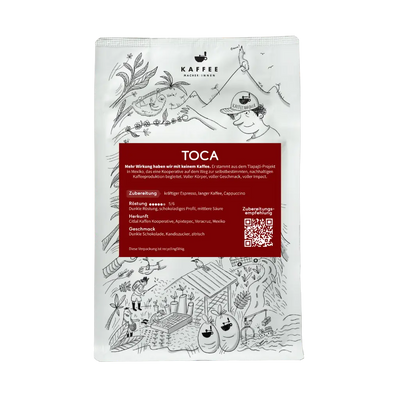
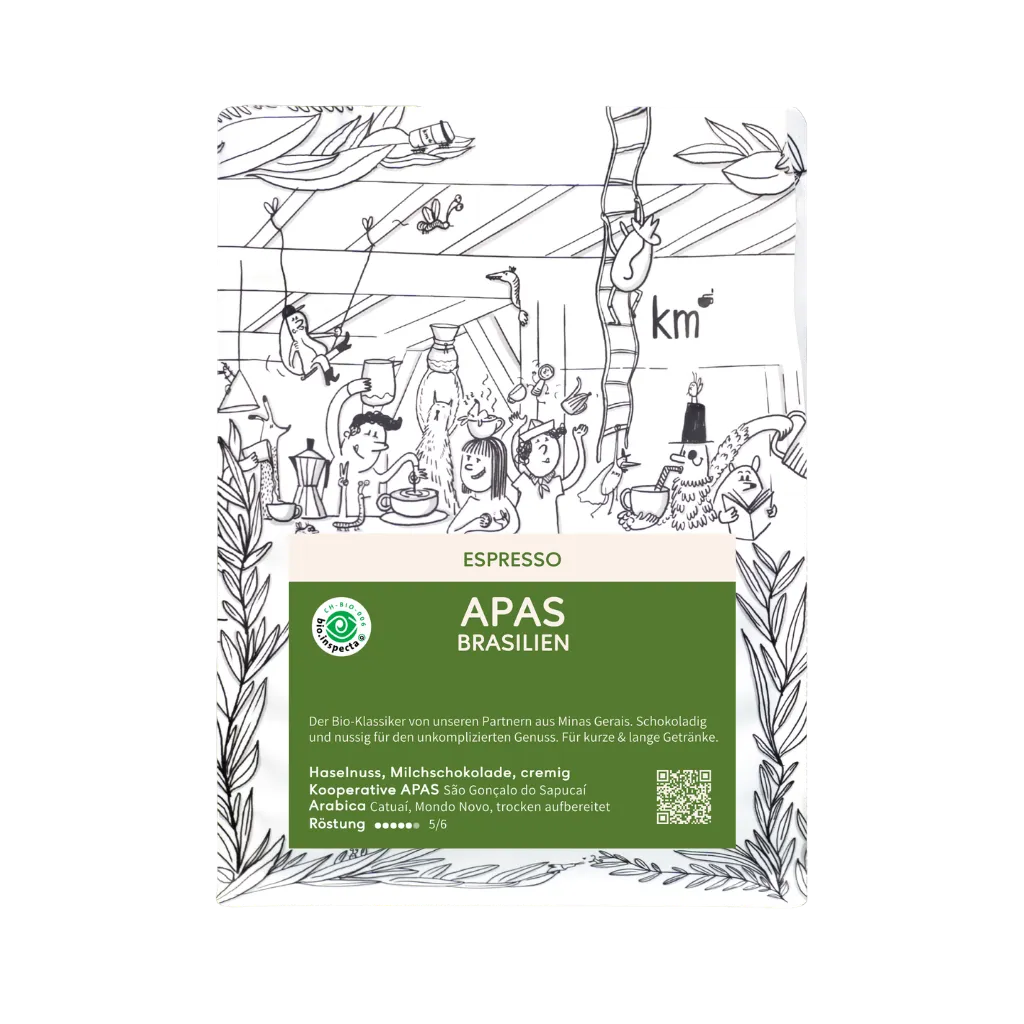
Important: a good hand grinder, quality coffee, and a kettle are necessary to brew the espresso. Since the Wacaco Picopresso, like all mobile brewers, struggles to maintain temperature, we recommend medium to dark roasts. Light roasts naturally bring lots of fruit acids, which can only be balanced by high brewing temperatures. From our range, we particularly like Mamy, Toca, Apas, and Boton.
Our Espressos in Switzerland.
- Mamy, Robusta from Guinea
- Toca, Mexico
- Apas, Brazil
- Boton, Blend
Our Espresso Roasts in Germany, Austria, and the EU
- Mamy, Robusta, Guinea
- Toca, Mexico
- Apas, Brazil
- Boton, Blend