








Timemore offers various high-quality hand grinders, including the Slim Plus from the Chestnut Slim series and the C2 from the Chestnut C/C2 series. While there are many similarities, there are also some key differences that we'll explore in this blog post.
Following our comprehensive comparison test of 14 hand grinders for coffee, we've added both grinders to our range. Simply because we think they're really good. You can find them in both our German and our Swiss shop.
Which Timemore hand grinder is right for me?
You're faced with the decision of purchasing a hand grinder and have come across Timemore's grinders. Why does the Slim Plus cost about €35 more than the C2? Is this price difference justified? And if so, why? Or does the Slim Plus simply look a bit more stylish?
We've repeatedly received questions about what exactly the differences are between these two grinders. We've decided to investigate this question in detail. In addition to the Slim Plus, we've also examined the white C2 and the anthracite/black C2.
The exterior of Timemore grinders

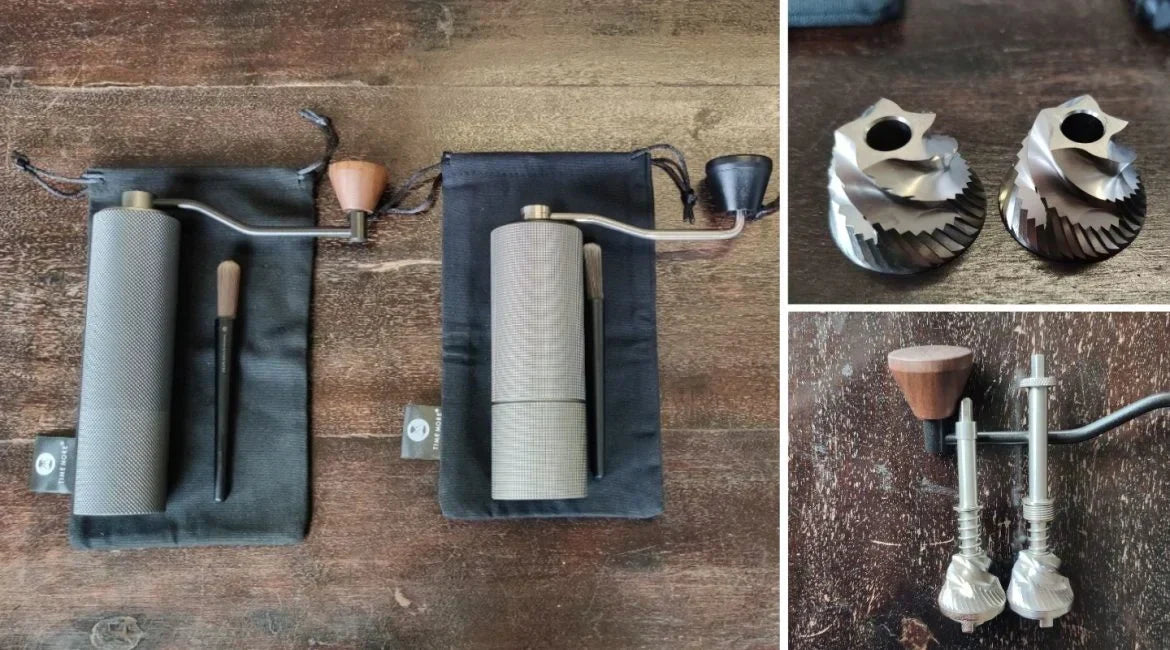
On the left the Timemore Slim Plus. In the middle and on the right the Timemore C2.
At 17.5cm in height, the Slim Plus is larger than the C2, which measures only 15cm. With a diameter of just 4.4cm, the body is noticeably slimmer than the C2 with its 5.1cm diameter. Another difference in the external appearance is the tactile feel. Interestingly, the two C2 models also differ from each other. The white C2 comes with a smooth, simple surface in a color that's more accurately described as off-white rather than pure white.

Anthracite/dark gray Timemore C2.
The C2 in anthracite/black, which is actually more of an anthracite/dark gray color, but is simply described as 'black' by Timemore, has a distinctly textured square pattern on the outside.

The Slim Plus comes with a noticeably finer pattern than the dark C2. This pattern is also easy to feel and fits comfortably in your hand. The most important aspect of the ribbed surface: the Timemore C2 doesn't rotate during grinding; instead, the pattern creates resistance.
Another difference in the exterior is evident when looking at the handle of the grinders. The handle on both C2 models is made of plastic. The Slim Plus handle is made of wood and can also be removed. It's held in place by a magnet. This allows the grinder to be disassembled more easily and, for example, packed more compactly for travel.
Accessories and packaging. Are there differences?
The C2 models come in a flip-open box. The Slim Plus packaging appears more premium and is comparable to a box you'd see in the smartphone industry.

Unboxing of the Timemore models.
In terms of accessories, there are no significant differences. All grinders come with an English-Chinese instruction manual. (Tip: if you think you only have a Chinese manual, just check the back). Also included is a nice black fabric bag, which is great for travel. Additionally, a brush for cleaning the grinder is included.
The interior of the Timemore C2 and Timemore Slim Plus
Now it gets interesting. Inside, there are clear differences between the C2 and the Slim Plus.
- Construction
- The grinding mechanism and grinding cone

Interior of the three Timemore models.
The construction
The Slim Plus body is made from a single piece of aluminum, whereas the C2 body has a plastic insert that holds the shaft.


On the left in each image is the C2 and on the right is the Timemore Slim Plus. When examining the shaft, several differences are immediately apparent. The shaft mount on the C2 is plastic, while the shaft mount on the Slim Plus is aluminum.
The Slim Plus shaft is longer, due to the different heights of the grinders (15cm versus 17.5cm). At the top, the Slim Plus features an additional locknut, which provides increased stability. Additionally, the spring used in the Slim Plus is noticeably stronger, which is especially beneficial for very fine espresso grind settings.
The grinding mechanism and grinding cone
Both grinding mechanisms are made of stainless steel and have 5 grinding teeth at the top. The difference only becomes apparent upon close inspection.
Timemore calls the grinding mechanism built into the Slim Plus E&B, which stands for Espresso and Brewing, but what's the real difference?
The Slim Plus grinding cone is somewhat larger and weighs 5 grams more (45g vs. 50g).
As this illustration shows, the E&B grinding mechanism also features additional blade grinding in the upper area and has two more grinding teeth in the lower area than the C2's grinding mechanism.

Summary: Timemore C2 and Timemore Slim Plus
The C2 is a very solid grinder with an excellent price-to-performance ratio, which is particularly suitable for filter coffee. Espresso can also be prepared, but the grinding takes considerably longer.
Due to the differences highlighted, the Slim Plus is technically a notch above the C2 and is, in our view, a very good and more affordable alternative to the best hand grinders on the market.
The differences between the C2 and Slim Plus in terms of internal construction and grinding mechanism also explain why the Slim Plus grinds noticeably faster and can achieve even finer grind settings than the C2.
In our opinion, the Slim Plus offers an excellent price-to-performance ratio and is a lot of fun to use in everyday life.