



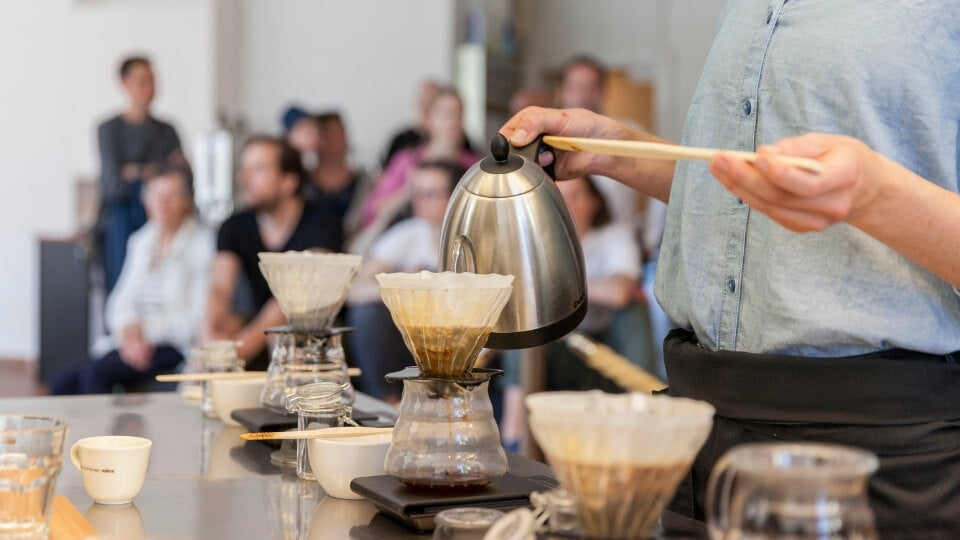

There are new Brewers Cup rules! These have far-reaching implications for the discipline. We have summarized and analyzed the consequences for you.
- Far-reaching changes in Compulsory Service
- New scoresheets, changed sensory focus and new calculation bases
- significant upgrade of the Head Judge with their own score sheet
- New definitions for water to be provided by the organizer
- Far-reaching consequences for the competition setting overall as well as coffee choice in Open Service
Compulsory Service
Quite a bit has changed! In particular, paragraph 9.1.C. now looks completely different. Let's first look at the facts and then try to interpret them.

In the future, not only must the provided coffee be used, but also the water made available and the grinder.
The old rule 9.3.C. is also eliminated, which stated: Coffee ground before the competition time will be allowed." Now coffee must be ground during the "Competition Time" (see also 11.3 second paragraph).
Consequences: With the option of choosing your own water, it was previously relatively easy to manipulate the character of the Compulsory Service coffee. By choosing softer or harder water, you could selectively emphasize acidity, body, or sweetness. This tool is now gone. The brewing recipe and brewing method become all the more important in the future.
Interesting additional difficulty: the coffee cannot be conveniently and repeatedly weighed and sieved before Competition Time. In fact, not even during Set-up Time, if we read the rules correctly! (See, among others, 13.2.3. fifth paragraph)
Depending on the brewing method, this puts some time pressure on the 7-minute Competition Time.
Score Sheet Cup Score | Open and Compulsory Service
Flavor and Overall are no longer weighted twice. Instead, Acidity and Body are the new major point providers. These rule changes apply to both Compulsory Service and Open Service, but have very different impacts.

In the Compulsory Service they are an interesting complement to the other changes noted above. Both Acidity and Body are components that can be beautifully manipulated through the choice of brewing devices and recipe.
Decisive for acidity is how clearly it contributes to the liveliness and fruity character of a coffee, without being sour, sharp, or dominant.
Body is a very interesting variable that describes the tactile performance of the coffee in the mouth. It's not primarily about intensity but rather about quality. A "light body" can be wonderfully soft and score many points. While a "heavy body" that is astringent and crude scores poorly.
It's certainly good that Overall is no longer in the double-point category. Compared to all other cup components defined in the Brewers Cup rulebook, Overall is the door most open to subjective impressions.
In Compulsory Service, the question of coffee choice doesn't arise – since it is provided. In Open Service, this question very much applies. Does this new evaluation approach have implications for coffee selection? I would say yes, definitely. But let's first cover the other changes in Open Service.
Open Service
At first glance, you could overlook the changes. Both in the summary of the overall competition and in the description of Open Service itself, nothing stands out initially. But quite a bit has changed. First with the water.
When selecting water in Open Service, participants are no longer bound to the range defined in 11.2., which applies to the water provided in Compulsory Service. This opens up completely new possibilities for playing with the water topic even more! What Compulsory Service loses, Open Service gains back all the more.
- The Head Judge must taste "their own water" hot and at room temperature. This is to ensure that the water is flavor-free.
All other rules are hidden in the Score Sheet! We've already reported above on the Cup Score topic. But quite a bit has also changed in the area of Presentation Score.
The three judges continue to award 40 points, but no longer doubled for the non-existent "Overall Impression" category; instead, they are doubled for Customer Service and Taste Description in the future.

The Cup Scores in the upper section of the sheet are filled out by the judges as in a blind tasting. It doesn't matter what the participant says, sings, or does. With Taste Description, there is now a comparison of whether what the participant described matches the blind tasting. And more than ever, this will be important in the future, because otherwise it hurts twice! And Customer Service also goes up, displacing Overall Impression.
The contents of Overall Impression don't disappear; instead, they move to the Head Judge's Score Sheet. Yes, and the Head Judge is not only allowed to cup in the future but is also the Technical Judge at the same time.

Overall Workflow includes Overall Impression. It will now evaluate workflow, use of tools, objects, and their organization. Cleanliness AND consistency are also evaluated!
Finally! Of course, what's in the cup is important. But for a long time I've thought it's important that uniform and consistent procedures are also decisive. There's now room for that in the Score Sheet.
Also new is the evaluation of sensory uniformity. And there's actually a rule change hidden here. Because previously, it wasn't necessary to brew three identical cups. I explicitly didn't do that at the World Brewers Cup in Rimini. That's no longer possible in the future. Instead, all cups must perform equally throughout the time.
Overall, the Head Judge can award 20 points. I'll come to the overall scoring and its impact further below.
Water
- In the future, water will be provided in Compulsory Service. (see 9.5.A and 9.1.C). So the option to play with water is eliminated, as described above.
- The range of water to be provided by the organizer has become significantly tighter and noticeably much "softer". Instead of a target range of TDS 150 mg/L and an allowed range of TDS 75 – 250 mg/L, the future requires TDS 85 mg/L or a range of 50 – 125 mg/L. "Calcium Hardness" is set at 51 mg/L instead of 68 mg/L.
What doesn't change!!!
9.4.D. This rule has been the downfall of many participants worldwide. It remains in force. It simply states that at least 120 ml must be served in a container. If the participant pours from a brewing vessel into a cup, the served cup must contain exactly 120 ml!Scoring
Now only the Compulsory round is counted towards the finals. Previously, all First Round results were "carried over". This eliminates points from a possibly poor or good Open Service round. The results of Compulsory Service become all the more significant! Because they are added in full to the Open Service results of the finals!This reads easily, but it's a really big deal! I interpret this as a significant upgrade of individual brewing skills in delivering with an unfamiliar coffee!
Open Service is calculated as follows. The results of Total Cup and Total Presentation are added per judge and divided by 1.40. The Final Scores of each judge are then added and the average calculated by dividing by three. This number is then multiplied by 1.4, the score from the Head Judge is added, and then divided by 1.6. Example: J1 gives 71, J2 73, J3 72 points = 72 average x 1.4 = 100.8 + 15 from Head Judge / 1.6 = 72.375
Seems complicated. It is. Let's take the same example and let the Head Judge give more or fewer points, in this case 10, 12, 14, etc., while the sensory judges stay at their average. Then it looks like this:
10 => 69.25, 12 => 70.5, 14 => 71.75, 16 => 73, 18 => 74.25, 20 => 75.5
Ten points of the Head Judge score amount to about 6.25 in the overall score. That's quite something! Those are points no one wants to miss. Probably in the finals when the championship is at a very tight level, then two more or fewer Head Judge points really hurt!
Summary and Conclusion!!!
I dare to claim: future champions and world champions will be crowned through Compulsory Service. And that's good, because that's the part of the competition where a brewer can show their skills the most! The importance of coffee in Open Service is diminished. There are still many points for it, but presentation and consistency in work are rated more heavily.Most recently, the Brewers Cup became increasingly a question of available budget for exquisite coffees and was dominated by certain varieties or green coffee companies. This development now receives a dampening.
In fact, the higher scores for Acidity and Body open up completely new possibilities for selecting green coffees. I'm curious what comes in the next few years.
Overall, I would say the new rules are very good for the Brewers Cup. I believe that the Brewers Cup with these rules in tow will remain on the passing lane! In that respect, my great praise goes to the team at WCE which developed the new rules!
PS: This is also important. 🙂