



























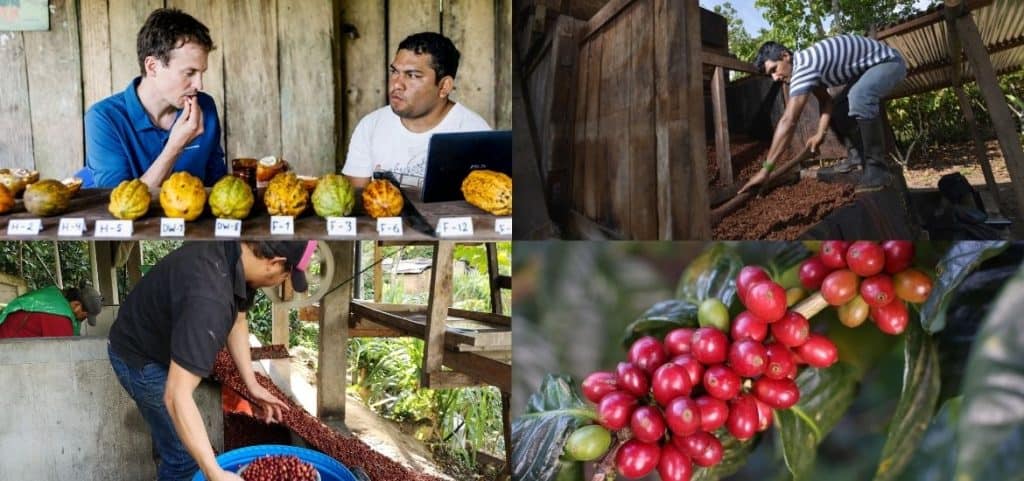
Chocolate and Coffee. Similarities and Differences. A Podcast with Christoph Inauen from Choba Choba
For many, chocolate and coffee simply belong together – as a luxury product. But the similarities and challenges of the two products begin already in cultivation. The transition to a better chocolate future for producers requires a different approach – Choba Choba presents a revolutionary alternative.
Often a "chocolate bar" is served with coffee because for many it simply goes so well together. Coffee itself is often described as chocolatey and both products also look good together visually. It seems as though chocolate and coffee were siblings.
There are also many similarities on the production side – cacao trees grow in the subtropics in the same way, like sun but not too much heat, like shade and differ in four original varieties.
"The distinction between Criollo and Trinitario is too simplistic," says Christoph Inauen and explains that they have established a variety garden in Peru to cultivate rare, old, forgotten and rediscovered varieties. They, that is Inauen's company Choba Choba, which is legally based in Switzerland, operates as a company in Peru and the producers in Peru themselves are shareholders.
The mentioned variety garden reminds me strongly of our project "1000 Variedades" in Nicaragua – an experimental plot slightly above our Finca Santa Rita, where we plant various varieties and want to observe their behavior.
 Christoph Inauen, co-founder of Choba Choba. Image: ZVG Choba Choba
The Choba Choba Model
Christoph Inauen knows the cacao and chocolate world very well. At 26, he built sustainable supply chains for one of Switzerland's largest chocolate conglomerates, which still exist today.
Shortly after, he joined management – an impressive fact that a company made sustainability a core concern as early as 2007. "Yes," says Inauen, "I don't know many other companies that started so early with this."
Inauen traveled frequently to cacao regions and established new partnerships. When after several years a producer who had meanwhile become his friend pointed out to him that despite the new situation, the seals and all the marketing, not much had changed for the producers, Inauen was shocked.
"Of course this was initially a shock, but later it became a motivation to choose a new approach." So Inauen founded Choba Choba with his business partner Eric Garnier and started the "Chocolate Revolution."
Choba Choba is a joint-stock company in which 30% of the shares belong to the producers themselves. They are thus directly involved in the company's profits. Choba Choba thus produces cacao itself, which is then further processed in Switzerland by Felchlin.
For Inauen, it is particularly impressive to see how the self-image of many producers has changed.
Previously, a producer would say: Hello, my name is Oswaldo, I am a cacao producer. Today he says: Hello, my name is Oswaldo, I work in international cacao trading.
Christoph Inauen, Choba Choba
Choba Choba pays producers 2.5 to 3 times more for cacao than if they sold their products on the world market. The chocolate is therefore also sold more expensively in Switzerland – from previously 8.50 CHF, prices dropped to just under 5 CHF thanks to efficiency improvements.
For us it was always clear that chocolate could not cost 1 or 2 francs. That simply doesn't make sense.
Christoph Inauen, Choba Choba
Chocolate Quality as a Door Opener
Choba Choba's message is actually easy to understand. But because it breaks with everything that characterizes the chocolate industry, it seems almost exotic. Getting the story to the shelf would be complex, because the product should primarily live through quality.
Excellent raw materials, no additives and precise processing make Choba Choba a premium chocolate. On the shelf, quality should be in the foreground – the message for a new approach in the cacao business should be communicated through other channels.
High Price as a Stumbling Block
Initially, a 90g chocolate bar was sold for 8.50 CHF. The price caused a stir. Can chocolate be that good? The story had to be discovered first. And criticism of Choba Choba became louder that while they want to reach poor producers, the end product is only accessible to the rich.
Through efficiency improvements, Choba Choba was able to lower the price and today sells the chocolate at Coop for just under 5 CHF – which is still a lot for a supermarket. So Choba Choba stands out precisely because of the higher price.
Do Small Companies Have to Grow Big?
In the podcast with Christoph Inauen, I also discuss whether small companies always have to scale – that is, whether they must be designed so that they continue to grow and grow.
Most investors see this as a basic requirement. However, and here Choba Choba and we coffee makers share the same vision: Ideas must be scalable. We need imitators, those who copy the model or improve it further.
Inauen says in the podcast that Choba Choba never wants to reach 100,000 producers, but rather wants to include the community.
We don't need to make sure that a few investors earn more. The investors should be the community. So producers and consumers.
Christoph Inauen, Choba Choba
Are Chocolate and Coffee Similar?
Yes, definitely. And not just as a luxury product but also behind it. The commodity chain is similar, the situation of the producers, the consolidated market and the challenges of the future – climate change, the aging of producers and soil quality.
Exchanges that look beyond one's own horizons are always worthwhile and help everyone. In this podcast, I almost always had the feeling that Christof was talking about coffee – some stories are so congruent. As coffee makers, we learn a lot from this – and want to learn even more. We'll see if one day we might also produce cacao.

