


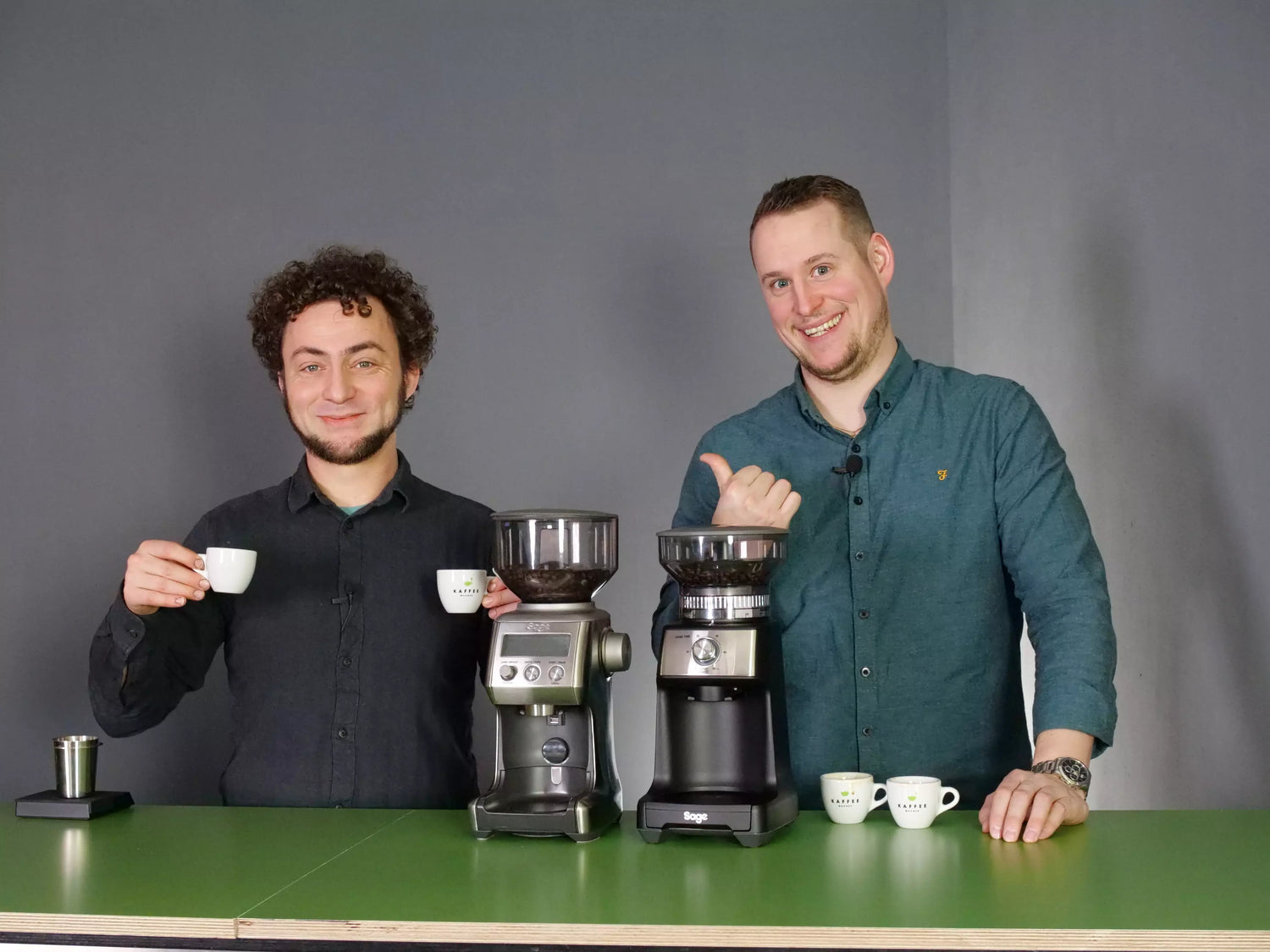

The Sage Dose Control espresso grinder is among the affordable espresso grinders in our test series. The grinder, also known by the abbreviation SCG600BTR, is the younger sibling of the Sage Smart Grinder Pro. We already looked at both grinders back in 2020 and basically found them to be good. However, even back then the Smart Grinder Pro clearly won the comparison. No wonder, as the Dose Control is the cheaper and less sophisticated grinder in the price range of 150 CHF/185 euros. Even in our comparison test of over 24 espresso grinders for home use, the Dose Control confirms the impression from back then. The Dose Control resembles the Smart Grinder Pro in many respects, especially when it comes to espresso and coffee quality. However, when it comes to ease of use, the Smart Grinder Pro is clearly ahead.
Good Espresso for Little Money
As far as espresso quality is concerned, the Sage "the Dose Control" is perhaps the best grinder on the market in terms of value for money. The grind setting adjustment is relatively good, and the results are sensorily similar to the Sage "the Smart Grinder Pro". In fact, both grinders also appear to be used in Sage's more expensive espresso machines such as the Express or Sage Barista Pro.
The espresso grinder was delivered with a good preset range. Once the range becomes too coarse or too fine, it can be easily readjusted as shown in our blog post. The grinder is too coarse or too fine if the espresso runs out of the portafilter too quickly at the finest grind setting, for example in less than 20 seconds. The basic adjustment is too fine if, despite the coarsest setting, the espresso still needs 30 seconds or more for extraction.
Unlike many cheaper coffee grinders advertised as espresso grinders, the Sage Dose Control allows the grind setting to be adjusted to the espresso range almost as desired. The basic adjustment, should the grind setting deviate, is also much easier to make than, for example, with the Graef CM800.
The grinder is available, for example, on Amazon, see here*. [Affiliate link]
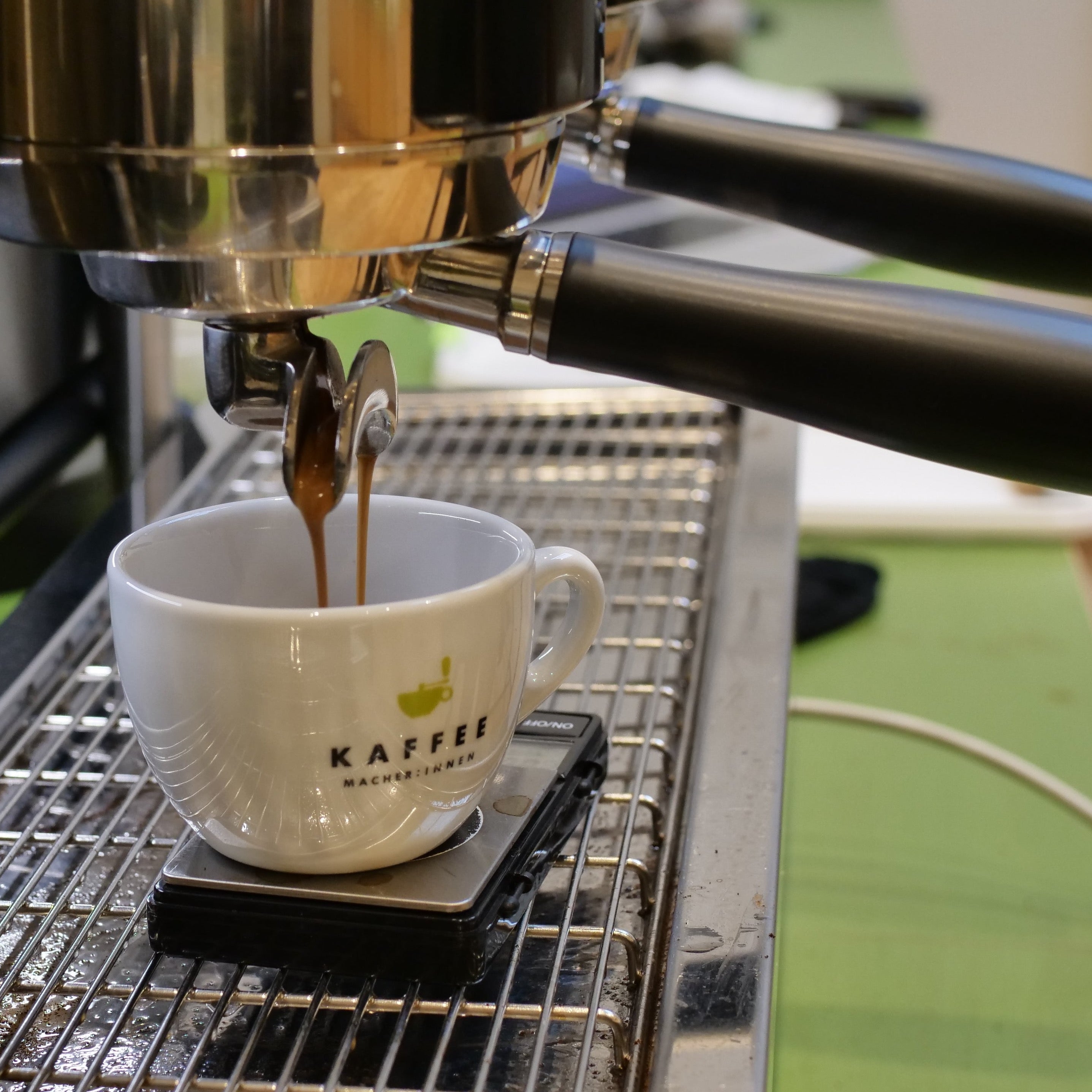
The espresso, when the grinder is properly adjusted and makes its way from the portafilter machine into the cup, was consistently in the good range in our tastings.
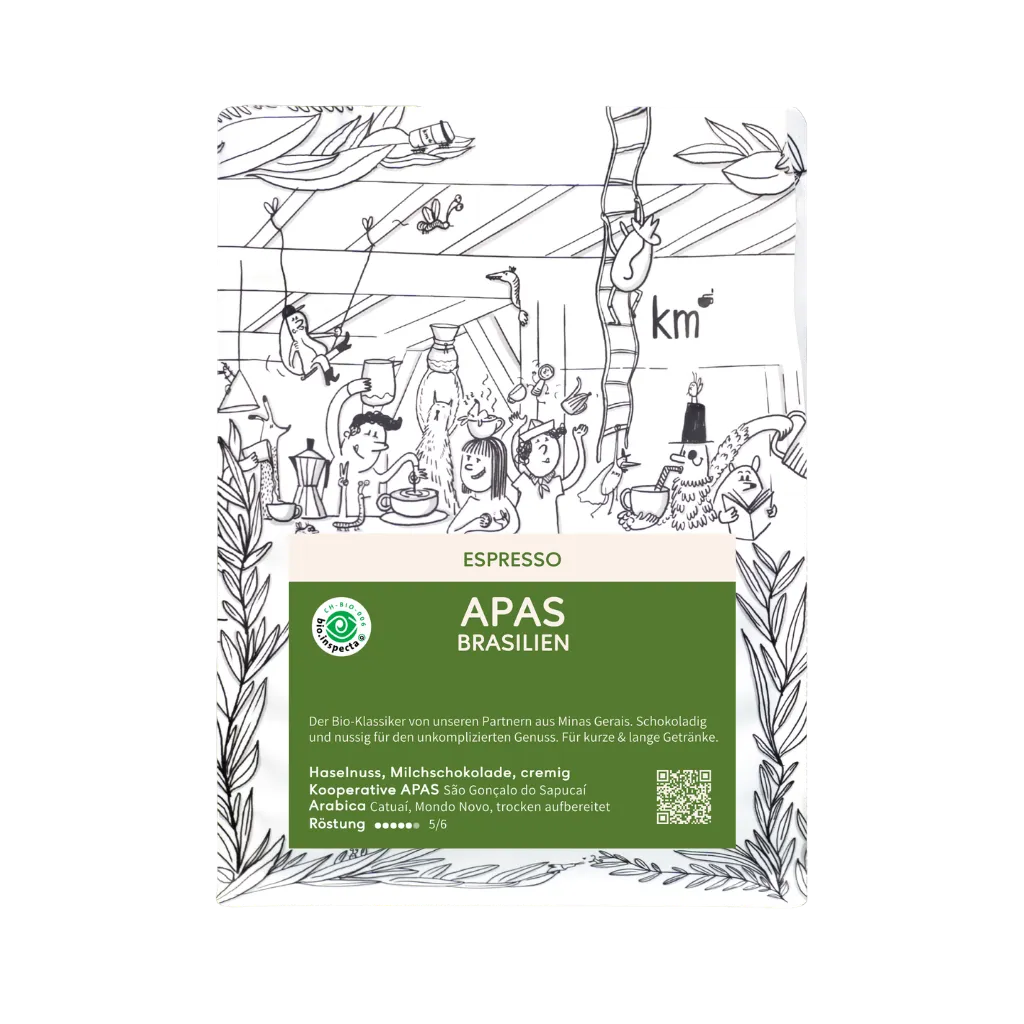
By the way, we brewed our Apas espresso, which we also use at Barista-Schulungen and serve in restaurants. The coffee can be ordered online in Switzerland and in Germany.
Weakness of the Sage Dose Control
The biggest weakness of the Sage Dose Control is indeed the operation. While the grinder does decent work internally, the exterior is frustrating when adjusting.
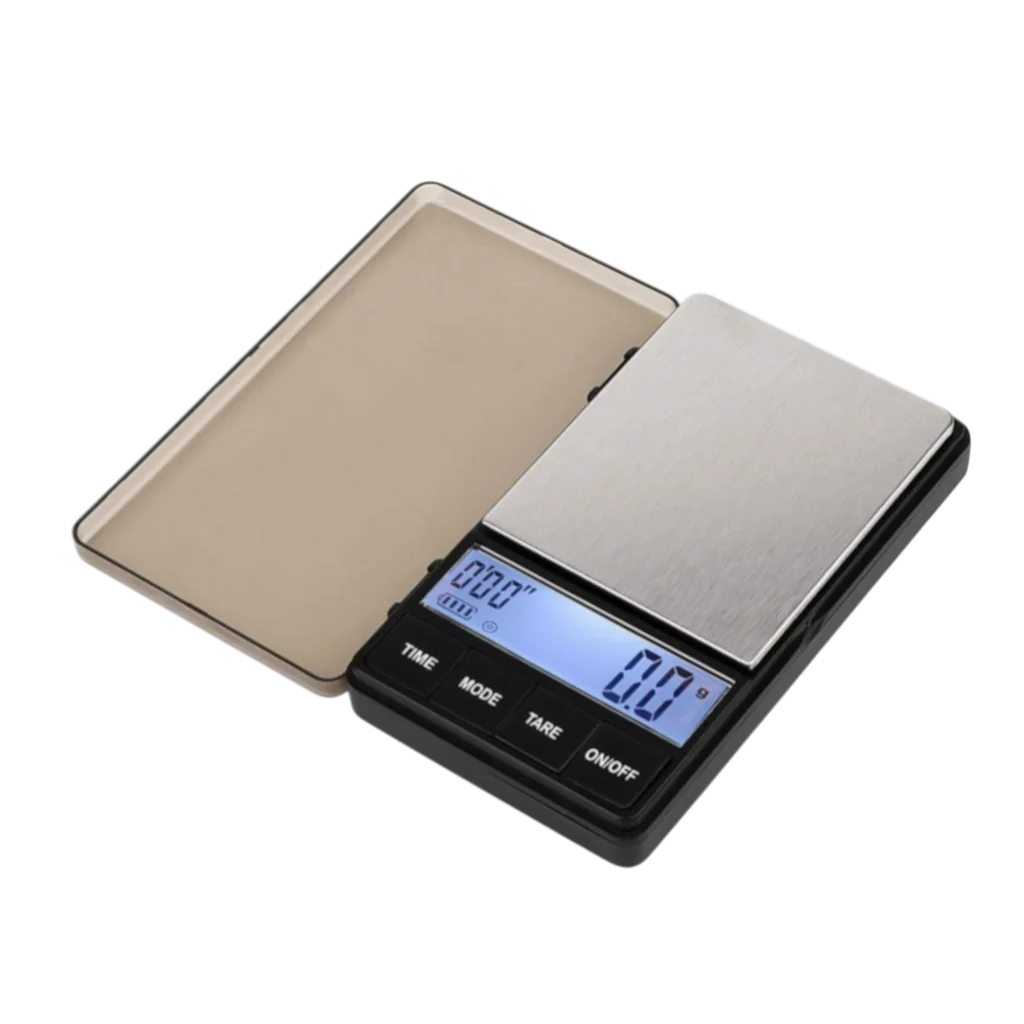
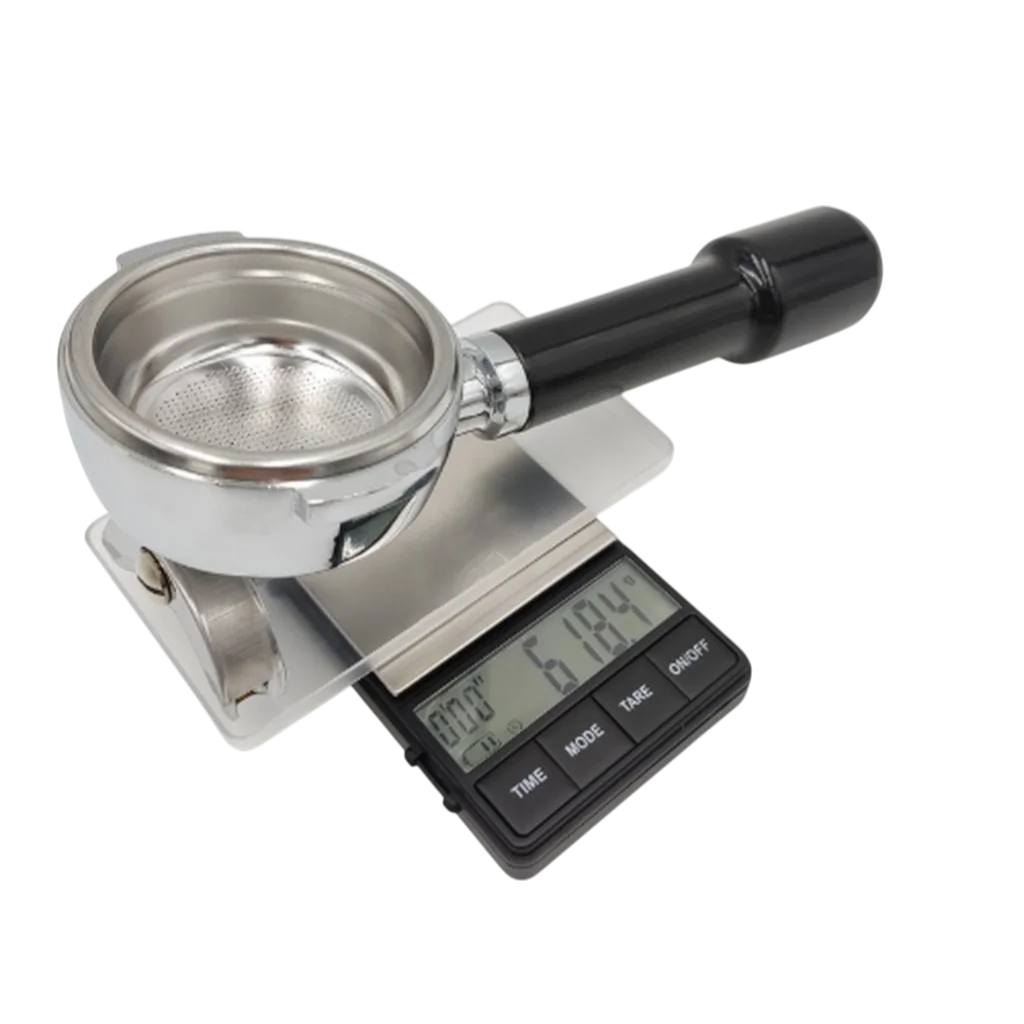
On the Dose Control, the dosage amount can only be adjusted in 1-second increments. One second more of grinding time means up to a good 2 grams of coffee more or less being ground. Precise adjustment of the grinder is hardly possible this way - unless you're lucky. Constant rechecking with a scale therefore makes sense.
The grind setting adjustment below the bean hopper is also not easy to handle. The grind setting can easily be changed when removing the bean hopper.
Particle Distribution and Grinder Precision
Particle distribution refers to the size arrangement of the ground coffee. Every grinder does not grind coffee powder in a single size, but covers smaller and larger particles. Good grinders, especially in the range of the selected grind size, grind a particularly large number of particles in a high and narrow peak. At the same time, they should not have too many fine particles.
For its price class, the Sage Dose Control has a surprisingly narrow main peak of only 202. This places the grinder in the range of better grinders. However, the fine peak at 25.5% is in the higher range. The smaller particles contribute to the texture of the espresso, but can also over-extract faster and thus leave a bitter impression. They also tend to result in a somewhat dusty feel.

The Dose Control placed itself in the middle field of espresso grinders in terms of precision. Overall, we extracted the same espresso four times with the same grind wheel setting and the same recipe. Each time the curve looked slightly different. In the following diagram you can see the initial espresso setting (T4). In T5 a ristretto was set. For T6 we chose a café crème grind size. For T7, the grinder was reset to the original grind size. It is easy to see here that the main peak fluctuates considerably higher than in T4.
This spike also describes well what we experienced taste-wise with the espresso. We drank many decent and good espressos, but we experienced noticeably larger flavor variations.

Filter Coffee Grinder?
But how does the Sage Dose Control perform when brewing filter coffee? We also looked at this in our comparison of four espresso grinders in the 6 price group. Even with very coarse grind settings, filter coffee was not easy to brew. The grinder tends to eject a lot of fine particles even with a coarse grind setting. When brewing filter coffee, these float to the top and, even with vigorous swirling, don't mix with the rest of the ground coffee. The fine particles settle on top of the rest and prevent both the vertical drainage of the brewing water and the lateral drainage. However, water should be able to drain vertically, as it should continue to extract soluble coffee components from the ground coffee here.
In terms of taste, filter coffee made with coffee from the Dose Control tastes like this: it is overall weak and watery because too little can be extracted from many particles due to insufficient water flow. At the same time, the high proportion of fines contributes to a noticeably unpleasant bitterness.
Is the Dose Control capable of brewing filter coffee? Yes, absolutely. It's just not particularly good. But the coffee will always be better than filter coffee made with pre-ground coffee.

Conclusion and Summary
With a volume of 82.1 decibels, Sage's little grinder is among the louder grinders. On the plus side, it makes a relatively good showing in terms of dead space and comes in at 3.4 grams. Of course, there are significantly better grinders in the test field - but that's relatively little.
The Sage Dose Control is among the slower grinders. It grinds 17.2 grams in 10 seconds. This makes it faster than its sister, the Sage Smart Grinder Pro - but still slow.
No noticeable heating occurred during six consecutive espresso extractions. The ground coffee remained relatively cool and at a temperature below 37 degrees was also in the positive range.
Over 10 extractions, the Sage Dose Control showed considerable variation. With a target grind size of 18 grams, the grinder produced the following amounts: 18.2 - 18.4 - 18.1 - 18 - 17.7 - 17.8 - 17.5 - 17.4 - 17.5 - 17.2
As a single-portion grinder, the Sage Dose Control can in principle be used. When used with an empty bean hopper, an average of 0.3 grams of coffee remain. To achieve precise extractions, working with a scale and measuring the ground portion is worthwhile here.
With a dead space of 3.4 grams of coffee, the grinder is among the espresso grinders with less dead space. On the other hand, 3.4 grams is still a lot of coffee that remains in the grinder from one grind to the next.
Overall, the Sage Dose Control is an entry-level grinder that meets all expectations for coffee quality for beginners. Only the ease of use leaves something to be desired. If you really want to grow into espresso preparation with pleasure, you're better equipped with the Sage Smart Grinder Pro. The additional investment of around 60 CHF/50 euros seems worthwhile to us.

*This is an affiliate link. If you order through it, it doesn't cost you more, but we receive a small commission that we use to acquire new test equipment.