













In our series on flavor profiles, we write about why coffee tastes the way it does. For the chapter on Ethiopia, we were able to win over Hannes Fendrich from Coffee Circle – an expert on Ethiopian coffee.
We've known Hannes and Coffee Circle for quite some time now and are repeatedly impressed by the work that Coffee Circle
Author: Hannes Fendrich
- Roaster and green coffee buyer at Coffee Circle Berlin
- German Brewers Cup Champion 2014 and 2016
- follow him on Instagram at @hannesmcmannes

ZVG: Coffee Circle
What does Ethiopian coffee taste like?
Ethiopia is not only the presumed birthplace of Arabica coffee. The country has a long coffee tradition and is one of the few coffee-producing countries where coffee consumption is firmly anchored in the culture. This means domestic demand for coffee is high and roughly half of the cultivated coffee remains in the country. Ethiopia is Africa's largest coffee-producing country and, according to ICO data, the world's fifth-largest coffee exporter.
As is often the case with coffee-specific topics, it is very difficult to make generalizing statements. The same applies to the taste of Ethiopian coffees.
In general terms, it can be said that Ethiopian coffees tend to be known for floral and fruity flavor notes and have a rather light body.
In specific individual cases, it then depends on numerous factors such as the region within the country, local varieties, altitude, processing, etc. Thus, coffee from the same region in Ethiopia (as in all other growing countries) can taste quite different from each other.
Before we go into the different regions in Ethiopia, to which certain profiles can generally be assigned, first a few Ethiopian specifics:
Processing: Washed vs. Unwashed
The two dominant processing methods are washed and unwashed (fully natural). Washed coffees from Limu, Sidamo, and Yirgacheffe taste noticeably more nuanced, finer, and have a lighter body than unwashed coffees. The unwashed coffees are often very fruity and berry-like, with a wine-like acidity.
Although washed coffees are often more relevant in the specialty coffee world, it is interesting to know that more than two-thirds (approximately 70 to 80%) of Ethiopian coffees are processed unwashed. The climatic conditions for pure sun-drying are optimal in Ethiopia, and in some coffee regions, water tends to be a scarce commodity.
Processes such as "honey processed" and experiments with certain fermentation methods are currently still very rare. The reason for this is that it has rarely been possible for exporters to process micro lots. Micro lots have no tradition in the Ethiopian coffee system, so exporters usually don't have the right machines to process smaller coffee lots. Here too, a turnaround is just beginning, so this trend will likely increase in the future.

ZVG: Coffee Circle
Variety diversity
The Ethiopian highlands in the western part of the country are the birthplace of Arabica coffee, and as a result, Ethiopia possesses the greatest genetic diversity of Arabica varieties of all coffee-cultivating countries.
To date, the JARC (Jimma Agriculture Research Center) in Ethiopia has isolated approximately 3,000 "coffee accessions" in their research facilities, but they have not yet genetically evaluated all of them. So there is an incredibly high genetic diversity in Ethiopia with up to 3,000 possible Arabica varieties.
Often, Ethiopian coffee varieties are grouped together as "heirloom varieties," which is not technically correct. A more accurate term is "local landraces," that is, the local landraces of Arabica.
Hannes Fendrich
These traditional, local varieties vary by region, which certainly contributes to the different flavor profile in each region. The most accurate classification is that provided by the JARC and the local landraces. Since most coffee is produced by smallholder farmers and they often cultivate different varieties, it is currently rare to have the opportunity to taste varietal pure coffees. With the increase in privately-run farms that we are currently seeing, this will hopefully become more common in the future.
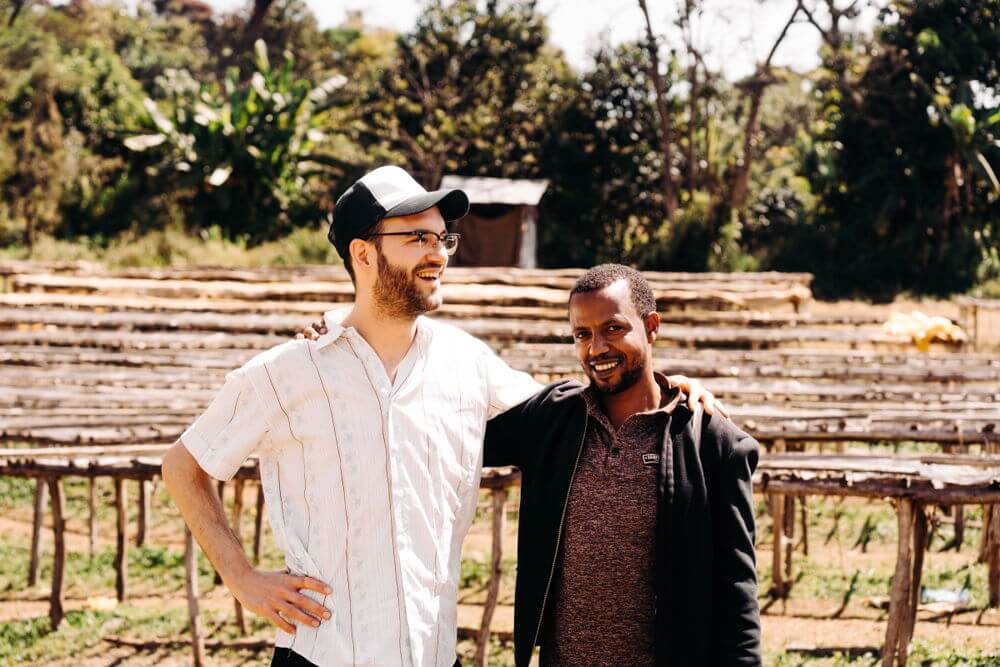
 Hannes Fendrich and Martin Elwert (both Coffee Circle) visit partner producers in Ethiopia (ZVG: Coffee Circle)
Growing conditions, soil, microclimate:
Of course, growing conditions play a major role. It has also been proven in Ethiopia that the very high-altitude growing regions in Sidamo, Yirgacheffe, and Limu produce the best qualities.
Fermentation and processing
Washed coffee:
The coffee cherries are predominantly washed and wet fermented in the traditional way in the south, that is, Sidamo and Yirgacheffe.
First, the pulp is mechanically removed and the bean with the mucilage is placed in water tanks for fermentation. Depending on the wetmill, this happens for a period of approximately 18 to 48 hours. After that, the beans are removed from the water tank and in the "washing channels" they are "guided" with wooden rakes into another water tank.
This occurs under pressure exerted by the wooden rakes, which removes a large portion of the mucilage. The last mucilage residues are then removed at the final station, the water tank, where the parchment coffee is soaked overnight in fresh water again.
It is known that this classic fermentation method has high water consumption, which is over 20 liters of water per 1 kg of red cherries. This high water consumption is controversial from ecological perspectives. Therefore, there is an increasingly growing movement toward eco-pulpers, a machine that, after pulping the bean, also mechanically removes the mucilage from the parchment coffee through friction.
This parchment coffee then goes into water basins overnight, where the remaining mucilage residues dissolve. The next day, the coffee is already transferred to the drying beds. Technically speaking, no fermentation actually takes place in this eco-pulped coffee.
A major advantage is that this type of processing uses only 1 to 2 liters of water per kg of red cherries and is therefore considered significantly more ecological than traditional processing.
What follows is an overview of the regions and their "typical" flavors, that is, a very generalized view, divided into east, south, and west. Coffee is also cultivated in a few areas in the north of Ethiopia, but these are rather negligible due to small quantities. (Photo: ZVG Hannes Fendrich. An older overview of the different coffee regions in Ethiopia)

The classic regions: Harar, Sidamo, Yirgacheffe
The East: Harar
Unwashed coffees traditionally come from the Harar region in the eastern part of the country, where a very dry climate prevails and the coffee cherries usually even dry on the coffee plant. As a result, the unwashed coffee from Harar develops very chocolatey and blueberry notes and is often associated with the classic Mocha taste and a full body. In the 1950s, 1960s, and 1970s, Ethiopia was internationally known mainly for its Harar coffees. This has changed somewhat over recent decades. Also because the local climate has become increasingly dry and coffee yields in Harar have dropped sharply. In addition, it is difficult to find clean unwashed coffees from Harar, which is why these coffees hardly appear in the specialty coffee scene. Moreover, the price for good Harar qualities is comparatively high. Nevertheless, Harar coffee enjoys a large following particularly in the Asian market.
The South: Sidamo, Yirgacheffe, and Guji
The area for Sidamo coffees extends over a large region and reaches south from Jawassa to the Bale Mountains. As vast as the area for Sidamo coffees is, so varied is the flavor profile.
Sidamo
The best qualities of washed coffees from Sidamo have a fruity and very distinctive flavor profile with citric acidity. The best growing areas in Sidamo include the districts of Bensa, Chire, and Arbegona, where cultivation altitudes reach up to 2,300 meters. These coffees have a sprightly acidity and taste reminiscent of ripe citrus fruits and black tea.
Yirgacheffe
Washed coffees from the southwestern neighboring region Yirgacheffe, on the other hand, are somewhat more floral and have less acidity. The outstanding qualities contain a complex aroma of Earl Grey tea or bergamot and ripe orange.
Guji
In the last two years, the Guji region has increasingly come into focus of specialty roasters because the coffees from Guji have grown very highly and deliver an exceptional flavor profile. For me, it reminds me of the cream of the crop of Yirgacheffe coffees: they are very floral and tea-like coffees with high sweetness from ripe stone fruits. There is also a theory that since Guji was recognized as an independent coffee region, the washing stations in Yirgacheffe have come under pressure and many farmers from high-altitude areas are no longer delivering their ripe cherries to Yirgacheffe but are now supplying washing stations in Guji. This could explain why it has become more difficult in recent years to find top qualities in Yirgacheffe.
Unwashed qualities from Sidamo, Yirgacheffe, and Guji can be very fruity and complex. Typically, the acidity is somewhat "winey." The aroma, in the best cases, reminds one of tropical fruits such as mango, papaya, and ripe orange. Yirgacheffe coffees are somewhat more floral, and in Sidamo and Guji coffees, the acidity is often somewhat more prominent. In terms of body, these coffees are fuller-bodied and creamier than their washed counterparts, and the acidity is distinctly wine-like. With both washed and unwashed qualities, the best coffees in character remind me more of tea than coffee.

The map from Technoserve and Nespresso
The Southwest: Limu, Kafa, Lekempti, Gambella, Tepi, Bench Maji, Bebeka
Limu or Jimma
Southwestern Ethiopia is the homeland of Arabica coffee; this is where Coffea Arabica originated, which emerged here around 700 AD. The west produces the largest amount of coffee, but in the international specialty coffee world, these coffees are somewhat less renowned. These regions are known for having wild-growing coffee plants in forest areas.
Jimma-Limu, Illubabor
In the region surrounding the city of Jimma, traditionally for a long time, mainly inferior unwashed qualities were traded as "Djimma Gr. 5." This was (and still is) an attractive coffee price-wise for the large industry.
Washed coffee from this region was long limited in volume and was little known internationally. Since about 10 years ago, when the NGO Technoserve supported numerous cooperatives in building washing stations with eco-pulpers, there has been increasingly washed coffee from this region that is classified on the export market as "Limu," which distinguishes itself by name from the poor image of Jimma coffee.
Limu coffees are therefore all coffees designated from the areas around Jimma and Illubabour. Compared to coffees from the south (i.e., Sidamo, Yirgacheffe, and Guji), Limu coffee tends to taste spicier, reminiscent of fresh cardamom, cloves, and the acidity tends more toward "winey" and can in part be rather grapefruit-like. The coffee tends to be more balanced, has a fuller body, but is usually somewhat less "distinctive" in flavor than coffees from Sidamo or Yirgacheffe. Nevertheless, particularly in the higher growing areas around the city of Agaro and in Illubabor, there are excellent qualities that are very complex and in taste remind one of ripe stone fruits and citrus fruits and have a tea-like character.
High-quality unwashed coffees from this region are currently still rare. The flavor profile is much spicier and less floral than the qualities from the south. Therefore, there is currently still no great demand for high-quality unwashed qualities from this region.
Kafa
Further to the southwest lies the region Kafa (or Kaffa or Kefa). In the deep forests of Kafa, most of Ethiopia's forest coffee is probably harvested, as there is still a relatively large population of wild coffee plants here. Most coffees are processed unwashed and have moderate quality. In recent years, there have also been increasingly washed qualities that, in terms of profile, remind one of Limu coffees. They are very spicy and can, in the best cases, also have aromas of ripe citrus fruits and even passion fruit.
Tepi
Located west of Kafa is the region Tepi, which has been little known on the export market so far. Tepi also offers excellent potential, as there are also altitudes of over 2,200 m. The flavor profile is similar to that of Limu and Kafa.
Bench Maji
South of Kafa lies the region Bench Maji, generally a rather lower-altitude region where standard qualities are mostly produced on large farms. This region therefore plays hardly any role in the specialty coffee world. The farm Bebeka is also located here, Ethiopia's largest coffee farm.
An impressive example of why one should not generalize about individual regions is the Gesha Village Farm. Gesha Village Farm was established less than 10 years ago in the highest-altitude part of Bench Maji. Here, three varieties (two Gesha varieties and the local variety 74110) are cultivated, picked, and processed meticulously and in a perfectionist manner, so that the privately-run farm managed to produce some of the best qualities from all of Ethiopia in this rather negatively connotated Bench Maji region in a very short time.
West and northwest of Jimma lie the two large regions of Gambella and Wollega (or Lekempti)
West of Jimma lies the region Gambella, and to its north the region Wollega. Wollega comprises Kelem Wollega, West Wollega, and East Wollega, three smaller regions, and overall a large area where coffee is cultivated, which is why the cup profiles vary greatly.
As yet, coffees from Wollega and Gambella are not very well known in the specialty coffee world, but there are already some outstanding qualities from these areas. The potential in some parts, such as Kelem Wollega, is impressive, which is why we will certainly hear and taste much more from Wollega in the future.
Literature references
Willem Boot: /bootcoffee.com/wp-content/uploads/2013/01/Ethiopian_Coffee_Buying_Guide.pdf (somewhat outdated, but a good introduction)
Aaron Davies: https://scanews.coffee/2017/05/26/aaron-davis-ethiopian-coffee-atlas/
Coffee Varieties: https://counterculturecoffee.com/shop/merchandise/a-reference-guide-to-ethiopian-varieties